
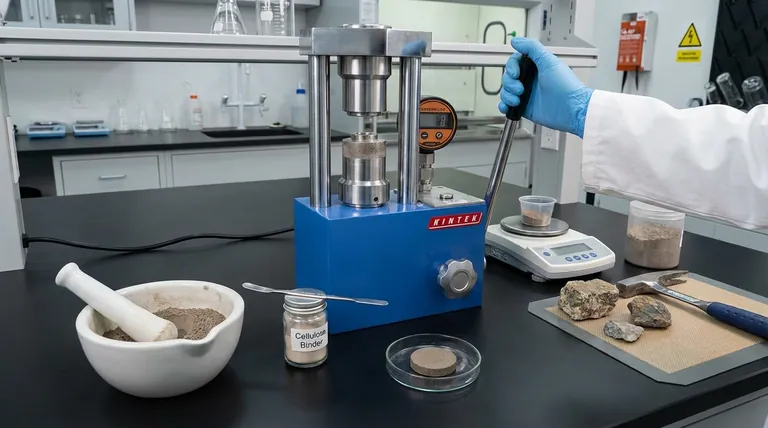
Geological samples must be ground to a fine powder and mixed with a binding agent to overcome their inherent hardness and lack of cohesion. For a standard 40 mm die, a pressing load of 10 to 20 tonnes is typically required to form a stable pellet, though harder mineral ores may demand loads starting at 25 tonnes.
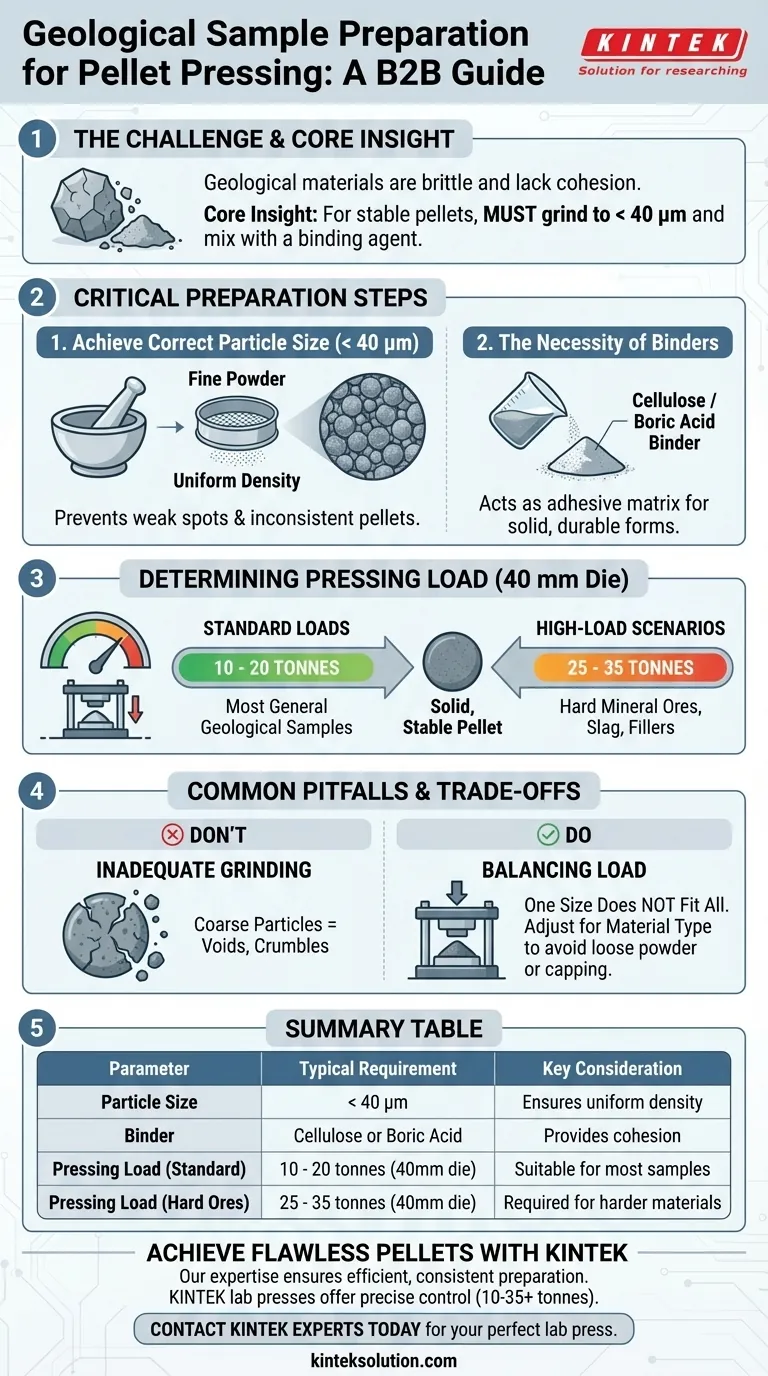
Core Insight: Geological materials are naturally brittle and have poor pellet-forming ability. To prevent the pellet from crumbling or exhibiting uneven density, you must prioritize achieving a particle size below 40 µm and integrating a cellulose or boric acid binder before applying pressure.
Critical Steps in Sample Preparation
Achieving the Correct Particle Size
The first and most vital step is grinding the geological sample to a uniform, fine powder. The target particle diameter should be 40 µm or less.
Achieving this fineness allows particles to pack together efficiently during the pressing process.
If the particles are too large, the pressure distribution will be uneven. This leads to weak spots and inconsistent pellets that may fail during handling or analysis.
The Necessity of Binders
Unlike some pharmaceutical or organic materials, geological samples are composed of hard, brittle minerals that do not stick together naturally.
You must mix the ground powder with a binding agent, such as cellulose or boric acid.
The binder acts as an adhesive matrix, ensuring the powder compresses into a solid, durable form rather than falling apart once the pressure is released.
Determining the Pressing Load
Standard Loads for Geological Analysis
The load required to compress powder into a solid pellet varies by material composition. For most general geological samples pressed in a 40 mm die, a load between 10 and 20 tonnes is standard.
This range is generally sufficient to achieve the necessary density for analysis without damaging the die or the sample.
High-Load Scenarios for Mineral Ores
While 10-20 tonnes is a common baseline, specific industrial materials dictate higher pressures.
Harder mineral ores, slag waste, and specific fillers often exhibit higher resistance to compaction. These materials may require loads starting from 25 tonnes and ranging up to 35 tonnes to bind effectively.
The applied pressure is the deciding factor in the final density and strength of the pellet.
Common Pitfalls and Trade-offs
The Risk of Inadequate Grinding
Skipping the fine grinding stage to save time is the most common cause of pellet failure.
Coarse particles create voids within the pellet. Even under high loads (20+ tonnes), these voids prevent the sample from structurally bonding, resulting in a pellet that crumbles upon ejection from the die.
Balancing Load and Material Type
Applying a "one size fits all" load can be problematic.
While a foodstuff might only need 2 tons, applying that same low load to a geological sample will result in loose powder. Conversely, applying extreme loads (35+ tonnes) to softer mineral mixtures without adjustment can sometimes lead to capping or lamination issues depending on the binder used.
Making the Right Choice for Your Goal
To ensure consistent analytical results, align your pressing parameters with the specific nature of your sample.
- If your primary focus is standard geological samples: Utilize a load of 10-20 tonnes in a 40 mm die, ensuring a binder is always present.
- If your primary focus is hard industrial ores or slag: Be prepared to increase the load to 25 tonnes or higher to achieve sufficient binding.
- If your primary focus is pellet durability and consistency: Prioritize grinding the sample to < 40 µm above all other variables to ensure uniform pressure distribution.
The quality of your data is directly dependent on the mechanical stability of your pressed pellet.
Summary Table:
| Parameter | Typical Requirement | Key Consideration |
|---|---|---|
| Particle Size | < 40 µm | Ensures uniform density and prevents weak spots. |
| Binder | Cellulose or Boric Acid | Provides cohesion for brittle mineral powders. |
| Pressing Load (40mm die) | 10 - 20 tonnes (Standard) | Suitable for most geological samples. |
| Pressing Load (40mm die) | 25 - 35 tonnes (Hard Ores) | Required for harder materials like slag and mineral ores. |
Achieve flawless pellets and reliable analytical results with KINTEK.
Our expertise in laboratory pressing ensures your geological sample preparation is efficient and consistent. KINTEK specializes in robust lab press machines, including automatic, isostatic, and heated lab presses, designed to meet the specific demands of handling hard mineral samples. We provide the reliable performance and precise pressure control (from 10 to 35+ tonnes) necessary for creating stable, high-quality pellets.
Let us help you optimize your preparation process. Contact our experts today to find the perfect press for your laboratory's needs.
Visual Guide
Related Products
- Automatic Laboratory Hydraulic Press for XRF and KBR Pellet Pressing
- Laboratory Hydraulic Pellet Press for XRF KBR FTIR Lab Press
- Lab Ring Press Mold for Sample Preparation
- Laboratory Hydraulic Press 2T Lab Pellet Press for KBR FTIR
- Lab XRF Boric Acid Powder Pellet Pressing Mold for Laboratory Use
People Also Ask
- Why is pressing powder into a pellet critical before sintering? Ensure Dense, Conductive Solid-State Electrolytes
- What is the role of a laboratory pressure machine and KBr in FTIR? Master Sample Preparation for Flame Retardants
- What are the advantages of using a laboratory automatic hydraulic press for HEA green compact forming?
- What are the advantages of using a lab automatic hydraulic press for HEA green body molding? Ensure Material Integrity
- How does an automatic laboratory hydraulic press improve KBr pellet preparation? Achieve Precision IR Spectroscopy



















