
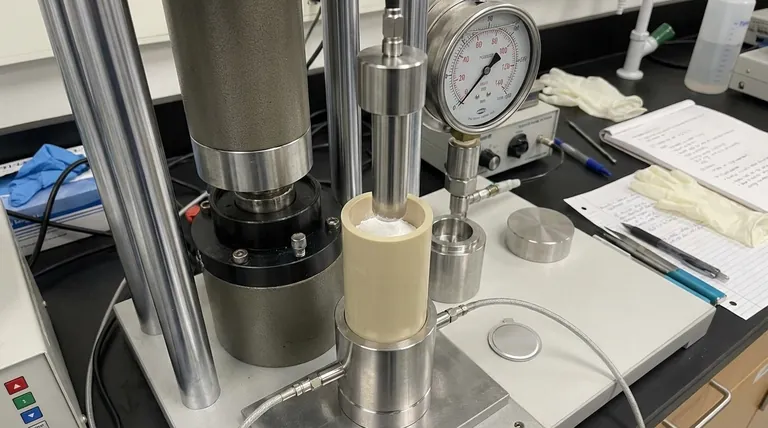
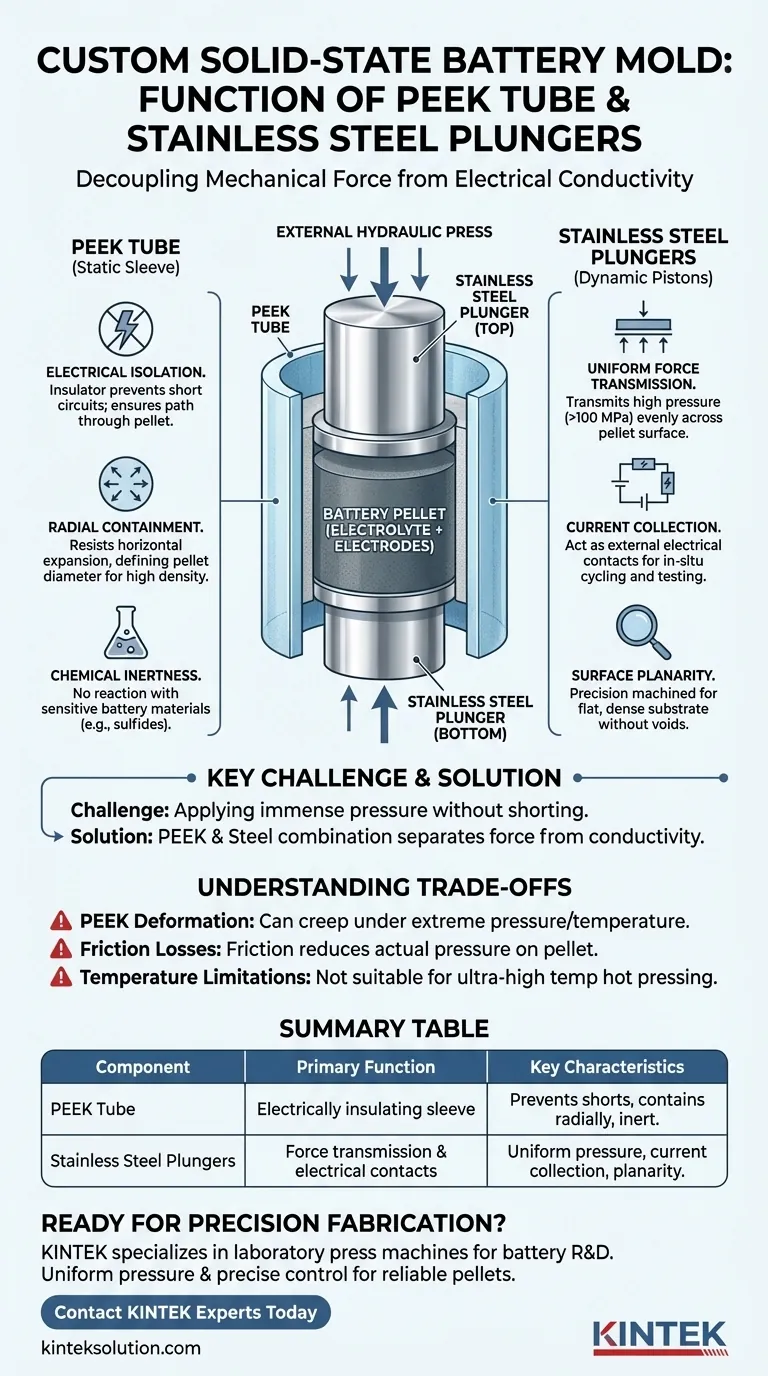
In a custom solid-state battery mold, the PEEK tube functions as the electrically insulating "sleeve" that defines the pellet's shape and contains the powder, while the stainless steel plungers act as the active pistons that transmit mechanical force and serve as electrical contacts.
The critical engineering challenge in solid-state battery fabrication is applying immense pressure (often >100 MPa) to densify the electrolyte without causing a short circuit. The PEEK and stainless steel combination solves this by decoupling mechanical force from electrical conductivity.
The Role of the PEEK Tube
The PEEK (Polyetheretherketone) tube is the static body of the mold. It provides the structural environment necessary to turn loose powder into a dense pellet.
Electrical Isolation
This is the primary reason PEEK is chosen over metal for the mold body. Because the top and bottom plungers act as current collectors, the sleeve connecting them must be an insulator to prevent a short circuit. PEEK ensures the only electrical path is through the battery pellet itself.
Radial Containment
When vertical pressure is applied to the powder, it expands outward horizontally. The PEEK tube resists this radial stress, keeping the powder contained within a defined diameter. This containment is essential for achieving the high density required for a functional solid electrolyte separator.
Chemical Inertness
Solid-state electrolytes (such as sulfides) are often highly reactive. PEEK is chemically inert, meaning it will not react with or degrade the sensitive battery materials during the pressing or testing process.
The Role of the Stainless Steel Plungers
The stainless steel plungers are the dynamic components of the assembly. They bridge the gap between the external hydraulic press and the internal battery materials.
Uniform Force Transmission
The plungers transmit the load from the hydraulic press directly onto the stacked powders. They must be rigid enough to transfer pressures often exceeding 100 MPa without deforming, ensuring the pressure is applied uniformly across the pellet's surface.
Current Collection
In many test setups, these plungers serve a dual purpose as external current collectors. They allow you to cycle the battery (charge/discharge) while it is still inside the mold, maintaining the necessary stack pressure during electrochemical testing.
Surface Planarity
The flat face of the plunger determines the surface quality of the resulting pellet. A precision-machined plunger eliminates voids and creates a flat, dense substrate, which is critical for the subsequent coating of electrode materials.
Understanding the Trade-offs
While the PEEK and stainless steel combination is standard, it is not without limitations. Understanding these constraints is vital for high-performance testing.
PEEK Deformation under Load
While PEEK is strong, it is a polymer. Under extremely high pressures (approaching the material's yield strength) or elevated temperatures, PEEK can deform or "creep" slightly more than a ceramic sleeve would. This can lead to minor inconsistencies in pellet diameter or difficulties in ejecting the pellet.
Friction Losses
Friction between the stainless steel plungers and the inner wall of the PEEK tube can absorb some of the applied force. This means the actual pressure "seen" by the battery powder may be slightly lower than what the hydraulic press displays.
Temperature Limitations
For processes requiring "hot pressing" at very high temperatures, PEEK may not be suitable. References indicate that ceramic (alumina) sleeves are preferred for hot-pressing or ultra-high pressure applications (e.g., 265 MPa) due to their superior hardness and thermal stability.
Making the Right Choice for Your Goal
The materials you choose for your die set define the limits of your experiment.
- If your primary focus is standard room-temperature assembly: Stick with the PEEK tube, as it offers the best balance of durability, chemical resistance, and ease of pellet ejection.
- If your primary focus is in-situ electrochemical testing: Ensure your stainless steel plungers are highly polished to maximize contact area and maintain consistent stack pressure during cycling.
- If your primary focus is hot-pressing or extreme pressures (>200 MPa): Consider replacing the PEEK tube with a ceramic or alumina sleeve to prevent deformation and ensure safety.
Ultimately, the quality of your solid-state interface depends on the mold's ability to maintain high pressure without compromising electrical isolation.
Summary Table:
| Component | Primary Function | Key Characteristics |
|---|---|---|
| PEEK Tube | Electrically insulating sleeve | Prevents short circuits, contains powder radially, chemically inert |
| Stainless Steel Plungers | Force transmission & electrical contacts | Transmit uniform pressure, act as current collectors, ensure surface planarity |
Ready to fabricate high-performance solid-state battery pellets with precision?
KINTEK specializes in laboratory press machines, including automatic lab presses, isostatic presses, and heated lab presses, designed to meet the exacting demands of battery research and development. Our equipment ensures the uniform pressure and precise control required for creating dense, reliable pellets with custom molds.
Let us help you optimize your solid-state battery fabrication process. Contact our experts today to discuss your specific application needs and discover the perfect press solution for your laboratory.
Visual Guide
Related Products
- Lab Cylindrical Press Mold for Laboratory Use
- XRF KBR Steel Ring Lab Powder Pellet Pressing Mold for FTIR
- Lab Ring Press Mold for Sample Preparation
- Lab XRF Boric Acid Powder Pellet Pressing Mold for Laboratory Use
- XRF KBR Plastic Ring Lab Powder Pellet Pressing Mold for FTIR
People Also Ask
- What is the purpose of incorporating cartridge heaters into a lab press mold for MLCC block compression? Optimize Results
- Why is precise cooling management of the lab press mold necessary? Protect Core Integrity in Thermoforming
- What is the function of a pressing tool in thermoplastic panels? Master Precision Shaping & Fusion Bonding
- Why is a high-performance laboratory molding press critical for in-situ electrolyte formation? Unlock Battery Success
- How does the geometry of laboratory molds influence mycelium-based composites? Optimize Density and Strength



















