
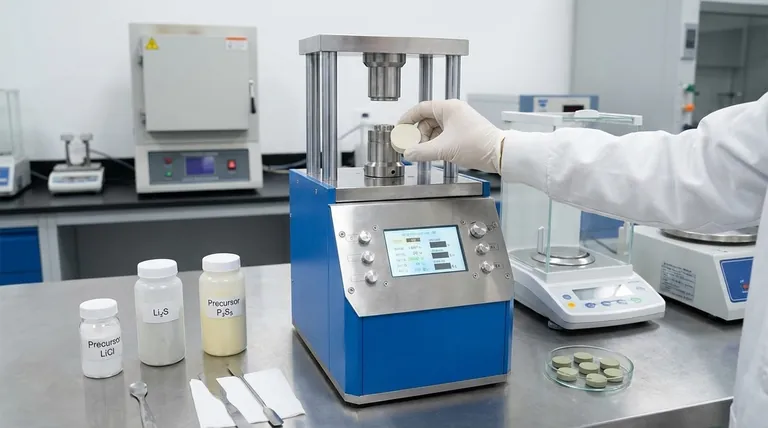
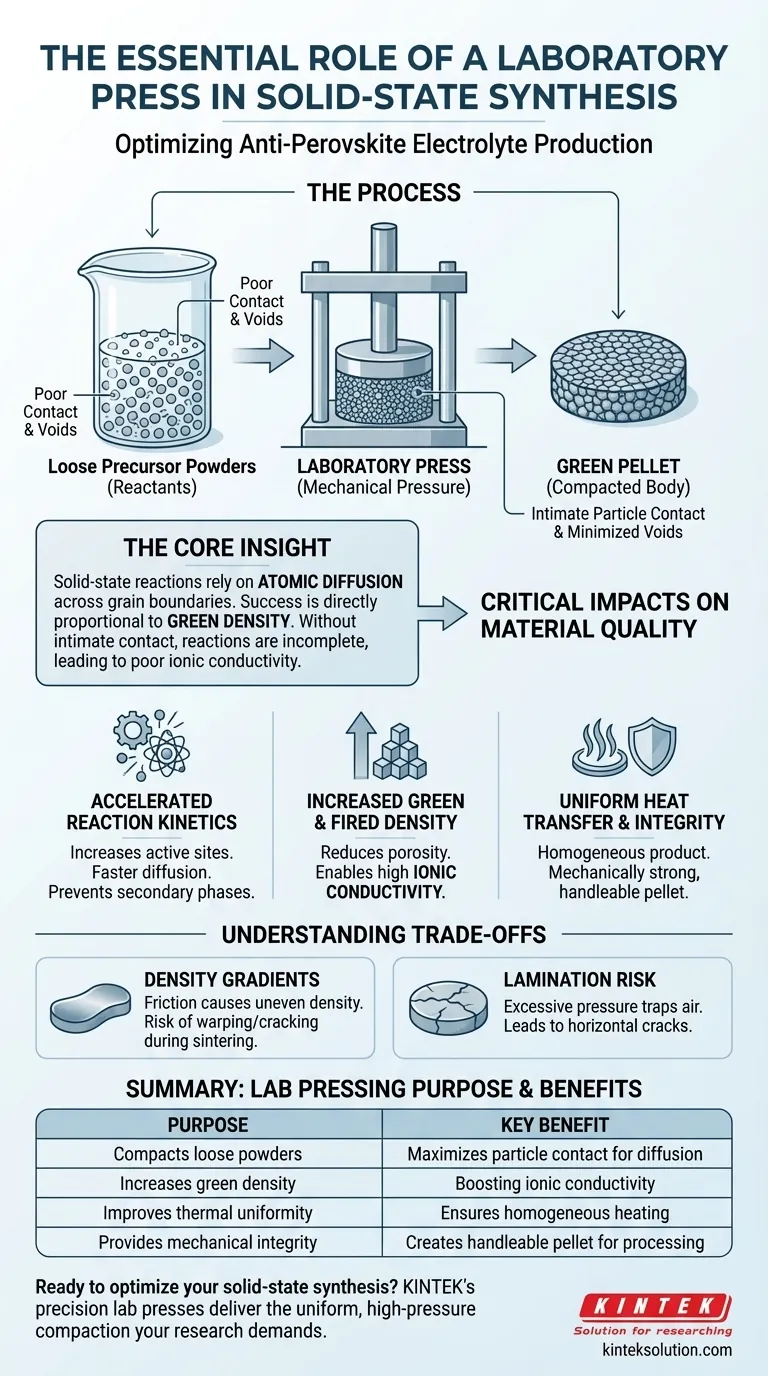
The primary purpose of using a laboratory press in solid-state synthesis is to compact loose precursor powders into a dense "green pellet" prior to heat treatment. By applying significant mechanical pressure, you minimize the voids between particles and maximize the surface area where reactants physically touch. This intimate contact is a prerequisite for solid-state diffusion, ensuring the chemical reaction proceeds efficiently to form a high-purity phase with optimal ionic conductivity.
The Core Insight In solid-state synthesis, reactants do not mix freely like liquids; they rely entirely on atomic diffusion across grain boundaries to react. Therefore, the success of the synthesis is directly proportional to the "green density" achieved by the press—without sufficient particle-to-particle contact, the reaction will be incomplete, resulting in poor ionic conductivity.
The Physics of Solid-State Reactions
Overcoming Diffusion Limitations
Unlike liquid-phase chemistry, where convection mixes reactants, solid-state synthesis relies on diffusion. Atoms must physically migrate from one solid particle to another to form the new crystal structure (such as an anti-perovskite).
If the powders are loose, the air gaps act as barriers that stop atoms from migrating. The laboratory press eliminates these gaps, reducing the diffusion distance and allowing the reaction to occur at reasonable timescales and temperatures.
Accelerating Reaction Kinetics
Pressing the powder increases the reaction kinetics. By forcing particles into intimate proximity, you increase the number of active sites where the reaction can initiate.
This is particularly critical for complex materials like electrolytes (e.g., Li6PS5Cl or LLZTO), where multiple precursors (like LiCl, Li2S, and P2S5) must react simultaneously. High compaction ensures that all reactant species are available at the reaction interface, preventing the formation of unwanted secondary phases.
Critical Impacts on Material Quality
Increasing Green Density
The immediate output of the press is a "green body"—a compacted pellet that has not yet been fired. A higher green density directly correlates to a higher fired density.
Achieving high density is essential for electrolytes because porosity blocks ion transport. By minimizing inter-particle voids at the pressing stage, you ensure the final ceramic product has low porosity and high ionic conductivity.
Ensuring Uniform Heat Transfer
Loose powders are poor thermal conductors because the air pockets between particles act as insulation. This causes uneven heating, where the outside of the sample reacts before the inside.
A dense pellet created by a lab press has significantly better thermal conductivity. This ensures that heat is distributed uniformly throughout the sample during sintering, leading to a homogeneous product with consistent properties across the entire pellet.
Mechanical Integrity for Handling
Beyond chemistry, the press serves a practical fabrication role. It converts free-flowing powder into a solid form with sufficient mechanical strength to be handled.
This allows the electrolyte to be moved into a furnace, coated with electrode materials, or stacked into a battery assembly without crumbling.
Understanding the Trade-offs
Density Gradients
While pressing is essential, using a uniaxial lab press can introduce density gradients. Friction between the powder and the die walls can cause the edges of the pellet to be denser than the center.
If this gradient is too steep, the pellet may warp or crack during sintering as different parts shrink at different rates.
The Risk of Lamination
Applying excessive pressure can sometimes be counterproductive. It may cause lamination, where the pellet develops horizontal cracks due to trapped air trying to escape or elastic rebound of the material.
Finding the optimal pressure—often around specific benchmarks like 120 MPa for certain sulfide electrolytes—is key to balancing density with structural integrity.
Making the Right Choice for Your Goal
To maximize the effectiveness of your solid-state synthesis, tailor your pressing strategy to your specific end-goal.
- If your primary focus is Ionic Conductivity: Prioritize maximizing green density. The tighter the particle packing, the easier the diffusion path, leading to a purer phase and lower final porosity.
- If your primary focus is Mechanical Stability: Focus on the uniformity of pressure. A pellet with uniform density will shrink evenly during sintering, preventing cracks and warping that compromise the separator's integrity.
Ultimately, the laboratory press is not just a shaping tool; it is a reactor that establishes the necessary physical conditions for solid-state chemistry to exist.
Summary Table:
| Purpose of Lab Pressing | Key Benefit for Synthesis |
|---|---|
| Compacts loose powders | Maximizes particle contact for efficient diffusion |
| Increases green density | Reduces final porosity, boosting ionic conductivity |
| Improves thermal uniformity | Ensures homogeneous heating during sintering |
| Provides mechanical integrity | Creates a handleable pellet for furnace processing |
Ready to optimize your solid-state synthesis of anti-perovskite electrolytes?
KINTEK's precision laboratory presses are engineered to deliver the uniform, high-pressure compaction your research demands. Our automatic lab presses, isostatic presses, and heated lab presses ensure you achieve the essential green density and mechanical integrity required for high-purity, high-conductivity materials.
Contact us today using the form below to discuss how our lab press solutions can accelerate your development of next-generation battery materials. #ContactForm
Visual Guide
Related Products
- Laboratory Hydraulic Press 2T Lab Pellet Press for KBR FTIR
- Laboratory Hydraulic Press Lab Pellet Press Button Battery Press
- Laboratory Hydraulic Press Lab Pellet Press Machine for Glove Box
- Laboratory Split Manual Heated Hydraulic Press Machine with Hot Plates
- Laboratory Hydraulic Pellet Press for XRF KBR FTIR Lab Press
People Also Ask
- What is the role of a laboratory pressure machine and KBr in FTIR? Master Sample Preparation for Flame Retardants
- What is the role of a laboratory hydraulic press in high-loading NCM811 cathode prep for solid-state batteries?
- What role does a laboratory hydraulic press play in reaction pellets? Optimizing Lunar Soil and Metal Fuel Density
- Why is a laboratory hydraulic press necessary for sample preparation? Precise Pelleting for Spiro Heterocyclic Analysis
- What are the general applications of a laboratory hydraulic press? Maximize Precision in Material Research



















