
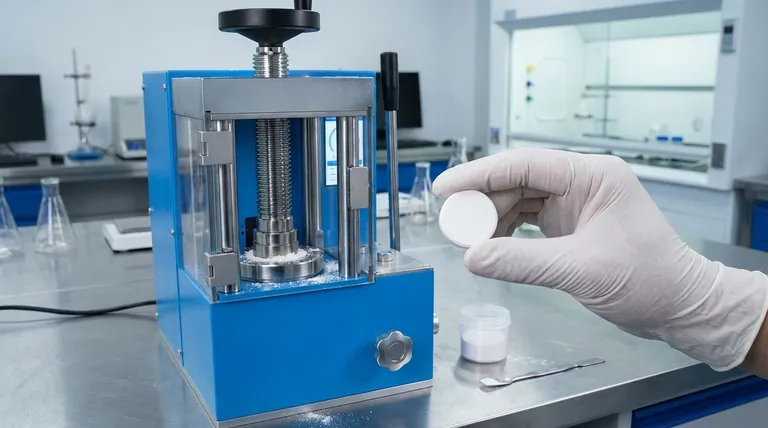
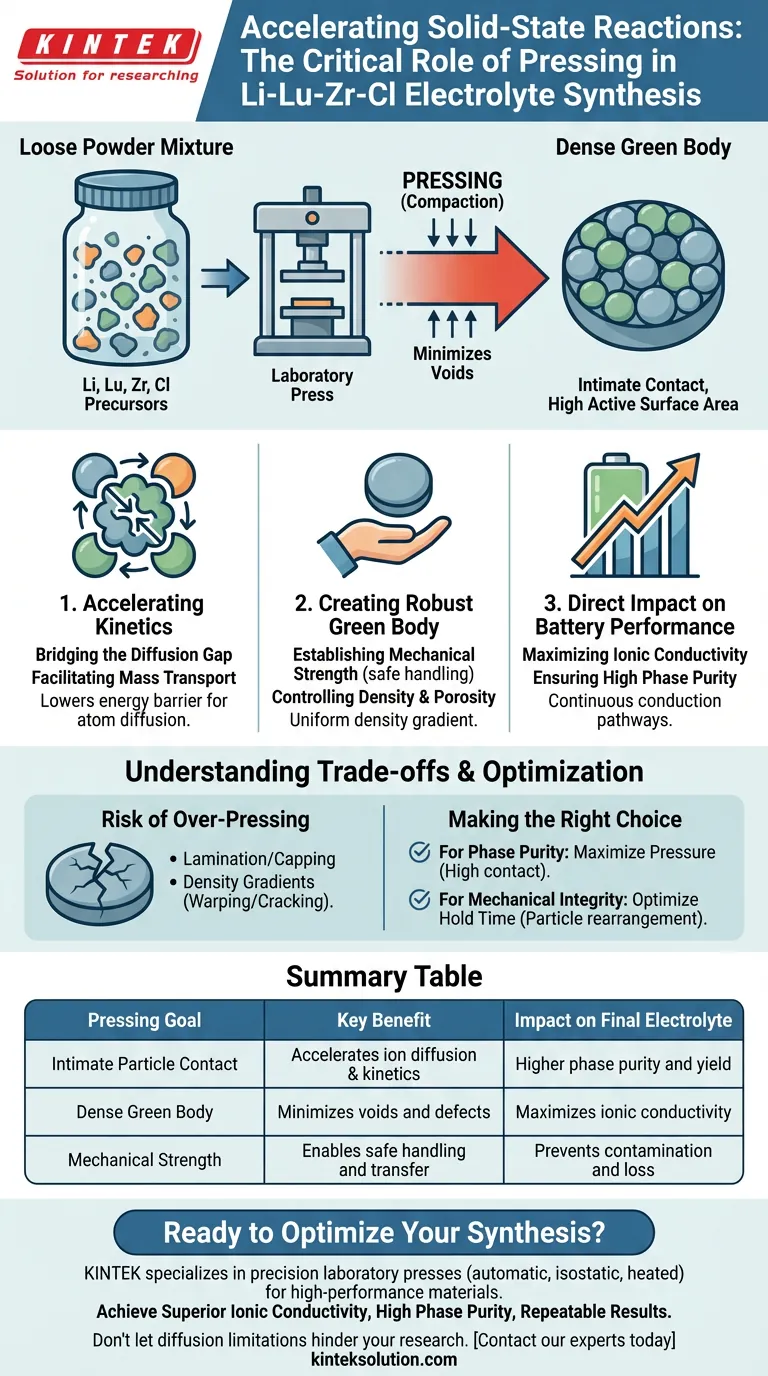
Pressing raw material powders into pellets is fundamentally about overcoming the diffusion limitations of solid-state reactions. By using a laboratory press to compact the Li-Lu-Zr-Cl precursors, you minimize the physical distance between reactant particles. This intimate contact is the primary driver for efficient ion diffusion, ensuring the reaction proceeds at a viable rate during heat treatment.
The mechanical force applied by the press transforms a loose mixture into a dense "green body." This step reduces inter-particle voids and maximizes the active surface area between reactants, which is a non-negotiable prerequisite for achieving high phase purity and optimal ionic conductivity in the final electrolyte.
Accelerating Solid-State Reaction Kinetics
Bridging the Diffusion Gap
In solid-state synthesis, reactants do not mix freely as they would in a liquid solution. The reaction occurs only where particles physically touch.
Pressing the powders creates intimate physical contact between the lithium, lutetium, zirconium, and chloride precursors. This contact bridges the microscopic gaps that would otherwise halt the movement of ions.
Facilitating Mass Transport
Heat alone is often insufficient to drive the reaction if the particles are loosely packed. The compaction process significantly promotes the kinetics of the solid-state reaction.
By increasing the contact area, you lower the energy barrier required for atoms to diffuse from one particle to another. This is essential for obtaining a uniform composition during heat treatment (e.g., at 650°C).
Creating a Robust "Green Body"
Establishing Mechanical Strength
Before sintering, the compressed powder is referred to as a "green body." A laboratory press ensures this body has sufficient mechanical strength to be handled without crumbling.
Without this structural integrity, transferring the material to a furnace or reaction vessel would result in material loss or contamination.
Controlling Density and Porosity
The magnitude of pressure and the duration of the hold time determine the initial packing density. A high-quality green pellet requires a uniform density gradient.
Minimizing inter-particle voids at this stage is critical. If the green body is too porous, the final sintered product will likely contain defects that impede performance.
The Direct Impact on Battery Performance
Maximizing Ionic Conductivity
The ultimate goal of a solid-state electrolyte is to conduct lithium ions efficiently. There is a direct correlation between the density of the green pellet and the ionic conductivity of the final product.
High-density compaction ensures that the conduction pathways are continuous. Any remaining voids act as insulators, blocking the flow of ions and degrading the electrolyte's performance.
Ensuring Phase Purity
Uniform compaction helps prevent localized "hot spots" or areas of unreacted material.
By ensuring the reactants are tightly packed, you facilitate a homogeneous reaction throughout the entire pellet. This leads to high phase purity, meaning the final material consists almost entirely of the desired Li-Lu-Zr-Cl crystal structure rather than impurity phases.
Understanding the Trade-offs
While pressing is essential, applying pressure incorrectly can introduce new problems.
The Risk of Over-Pressing
Applying excessive pressure can cause lamination or capping. This occurs when air is trapped inside the pellet and expands when pressure is released, causing the pellet to split horizontally.
Density Gradients
If the pressure is not applied uniformly (or if the die friction is too high), the pellet may develop a density gradient. This means the top may be denser than the bottom.
During sintering, these areas will shrink at different rates, leading to warping or cracking in the final ceramic.
Making the Right Choice for Your Goal
To achieve the best results with your Li-Lu-Zr-Cl synthesis, tailor your pressing parameters to your specific objectives.
- If your primary focus is Phase Purity: Maximize the pressure (within tool limits) to ensure the highest possible surface area contact between reactants, driving the reaction to completion.
- If your primary focus is Mechanical Integrity: optimize for a "hold time" under pressure rather than just peak force; this allows particles to rearrange and lock together, reducing internal stresses that cause cracking.
Success in solid-state synthesis relies on treating the pressing stage not just as a shaping step, but as a critical reaction accelerator.
Summary Table:
| Pressing Goal | Key Benefit | Impact on Final Electrolyte |
|---|---|---|
| Intimate Particle Contact | Accelerates ion diffusion & reaction kinetics | Higher phase purity and yield |
| Dense Green Body | Minimizes voids and defects | Maximizes ionic conductivity |
| Mechanical Strength | Enables safe handling and transfer | Prevents contamination and loss |
Ready to optimize your solid-state electrolyte synthesis?
The quality of your initial pellet directly dictates the performance of your final material. KINTEK specializes in precision laboratory presses—including automatic, isostatic, and heated models—designed to deliver the uniform compaction and controlled pressure essential for synthesizing high-performance materials like Li-Lu-Zr-Cl electrolytes.
Let our expertise in lab press machines help you achieve:
- Superior Ionic Conductivity through dense, defect-free green bodies.
- High Phase Purity by maximizing reactant contact area.
- Repeatable Results with precise control over pressure and hold time.
Don't let diffusion limitations hinder your research. Contact our experts today to find the perfect press for your laboratory's needs!
Visual Guide
Related Products
- Laboratory Hydraulic Press 2T Lab Pellet Press for KBR FTIR
- Laboratory Hydraulic Press Lab Pellet Press Button Battery Press
- Laboratory Hydraulic Press Lab Pellet Press Machine for Glove Box
- Laboratory Split Manual Heated Hydraulic Press Machine with Hot Plates
- Laboratory Hydraulic Pellet Press for XRF KBR FTIR Lab Press
People Also Ask
- What is the role of a laboratory pressure machine and KBr in FTIR? Master Sample Preparation for Flame Retardants
- What is the role of a laboratory hydraulic press in high-loading NCM811 cathode prep for solid-state batteries?
- Why is a laboratory hydraulic press necessary for sample preparation? Precise Pelleting for Spiro Heterocyclic Analysis
- What role does a laboratory hydraulic press play in reaction pellets? Optimizing Lunar Soil and Metal Fuel Density
- Why is a laboratory hydraulic press considered essential for DFC solid-state batteries? Unlocking Interface Efficiency



















