
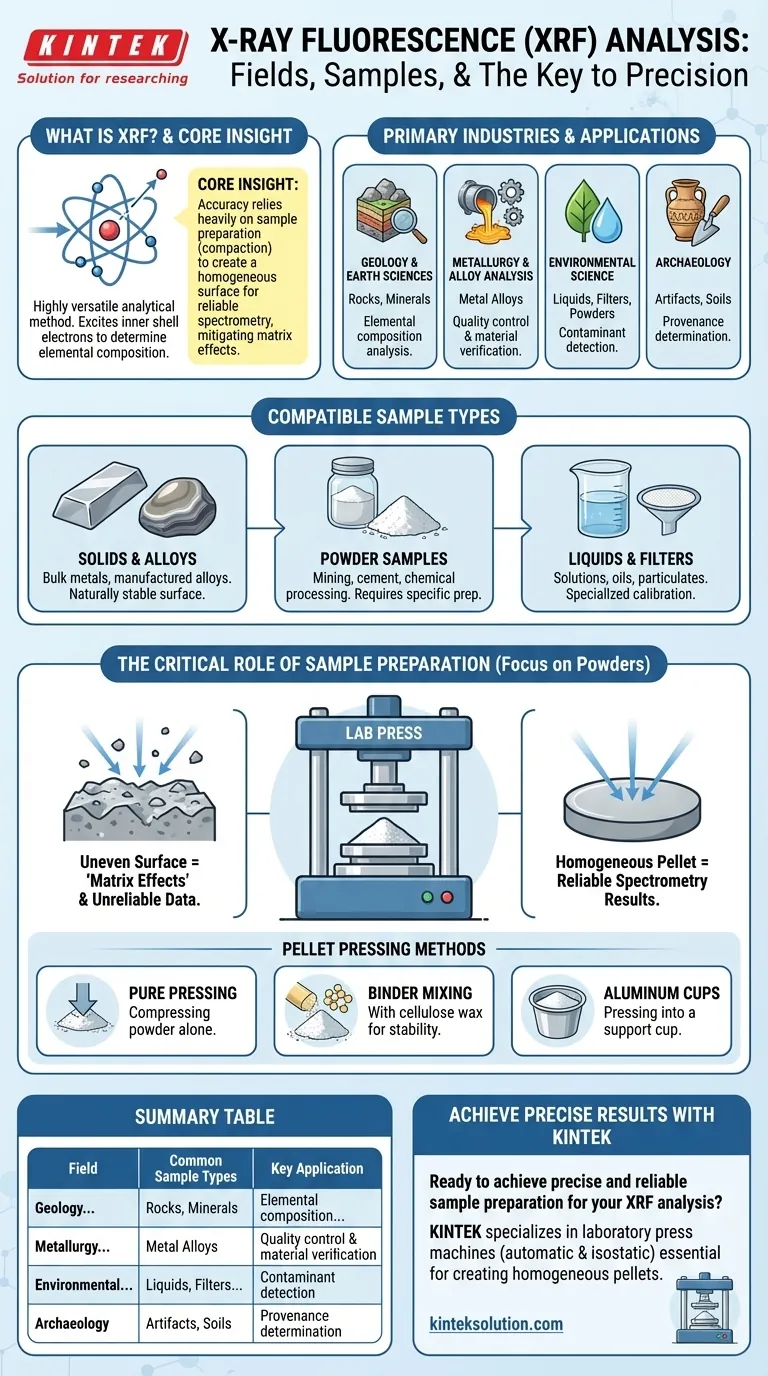
X-ray fluorescence (XRF) is a highly versatile analytical method primarily utilized in geology, metallurgy, environmental science, and archaeology. While its origins lie in analyzing solid geological formations, the technology has evolved to characterize a wide array of sample types, including alloys, loose powders, liquids, and specialized filter materials.
Core Insight: The versatility of XRF lies in its ability to excite inner shell electrons to analyze material composition, regardless of the sample's state. However, the accuracy of this data is heavily dependent on sample preparation—specifically compaction—to create the homogeneous surface necessary for reliable spectrometry.
Primary Industries and Applications
Geology and Earth Sciences
Historically, XRF was first adopted in the field of geology. It is the standard method for analyzing solid samples, such as rocks and minerals, to determine their elemental composition.
Metallurgy and Alloy Analysis
The technique is extensively used in metallurgy. It provides rapid analysis of metal alloys, ensuring quality control and material verification in industrial settings.
Environmental Science and Archaeology
XRF applications have expanded into environmental science and archaeology. In these fields, researchers analyze diverse materials to detect contaminants or determine the provenance of historical artifacts.
Compatible Sample Types
Solids and Alloys
Solid materials remain the most straightforward application for XRF. This category includes bulk metals, rocks, and manufactured alloys that provide a naturally stable surface for analysis.
Powder Samples
Analysis of powder samples is common but requires specific preparation. Powders are frequently encountered in mining, cement production, and chemical processing.
Liquids and Filters
Modern XRF capabilities extend to liquid samples and filter materials. This allows for the analysis of solutions, oils, and particulates trapped on air or water filters.
The Critical Role of Sample Preparation
Mitigating Matrix Effects
Direct analysis is not always possible; sample compaction is often necessary. Surface variations and localized heterogeneities in a sample can cause "matrix effects," which alter emission spectra and impair accuracy.
Achieving Homogeneity
To ensure the spectrometry results represent the bulk material, the sample surface must be ideal. Compacting the material creates a homogeneous representation, minimizing errors caused by irregular surfaces.
Pellet Pressing Methods
For powder samples, several pressing techniques exist to suit different analytical needs.
- Pure Pressing: Compressing the powder by itself.
- Binder Mixing: Mixing the powder with a cellulose wax binder before pressing to increase stability.
- Aluminum Cups: Pressing the sample into a cup for additional structural support.
Understanding the Technical Nuances
Atomic Excitation Mechanism
XRF operates on a different principle than optical spectroscopy. It involves the interaction of X-rays with the inner shell electrons of an atom, rather than the valence electrons.
Surface Sensitivity
Because XRF relies on these specific atomic interactions, the physical state of the sample surface is critical. If a sample is not properly compacted or smoothed, the excitation of atoms may be inconsistent, leading to unreliable data.
Making the Right Choice for Your Goal
To maximize the effectiveness of XRF analysis, align your sample preparation with your specific material type.
- If your primary focus is analyzing solid alloys or rocks: You can often rely on the inherent stability of the material, provided the surface is clean and flat.
- If your primary focus is analyzing powders: You must prioritize pellet pressing (with or without binders) to eliminate surface variations and ensure a homogeneous analysis.
- If your primary focus is environmental liquids or filters: Ensure your XRF instrumentation is specifically calibrated for non-solid matrices to account for the unique density differences.
XRF offers robust analytical power across diverse fields, provided the physical sample is prepared to match the precision of the physics involved.
Summary Table:
| Field | Common Sample Types | Key Application |
|---|---|---|
| Geology & Earth Sciences | Rocks, Minerals | Elemental composition analysis |
| Metallurgy & Alloy Analysis | Metal Alloys | Quality control and material verification |
| Environmental Science | Liquids, Filters, Powders | Contaminant detection |
| Archaeology | Artifacts, Soils | Provenance determination |
Ready to achieve precise and reliable sample preparation for your XRF analysis? KINTEK specializes in laboratory press machines, including automatic lab presses and isostatic presses, which are essential for creating homogeneous pellets from powder samples. Ensure your analysis is accurate and efficient—contact our experts today to find the perfect press for your laboratory's needs!
Visual Guide
Related Products
- XRF KBR Plastic Ring Lab Powder Pellet Pressing Mold for FTIR
- Lab XRF Boric Acid Powder Pellet Pressing Mold for Laboratory Use
- Laboratory Hydraulic Pellet Press for XRF KBR FTIR Lab Press
- Automatic Laboratory Hydraulic Press for XRF and KBR Pellet Pressing
- XRF KBR Steel Ring Lab Powder Pellet Pressing Mold for FTIR
People Also Ask
- What is the purpose of making KBr pellets for FTIR? Achieve Precise Molecular Analysis with Solid Samples
- What factors should be considered when choosing a lab press for XRF pellet preparation? Ensure Accurate and Consistent Results
- Why are pellets used in XRF analysis, and what is their limitation? Boost Accuracy and Speed in Your Lab
- How are pellets prepared for XRF analysis and what is a potential drawback? Master XRF Sample Prep and Accuracy
- What are the different types of XRF pellet preparation methods available? Manual, Hydraulic, and Automated Presses Explained







