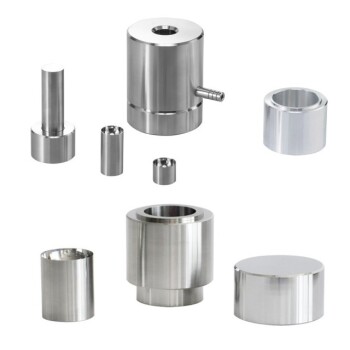
Determining the optimal die size for an XRF pellet press is fundamentally an exercise in geometric and mechanical compatibility. You must select a diameter that aligns with your XRF spectrometer’s sample cup aperture while ensuring your specific press can generate sufficient force to compact that surface area into a stable, analyzable disc.
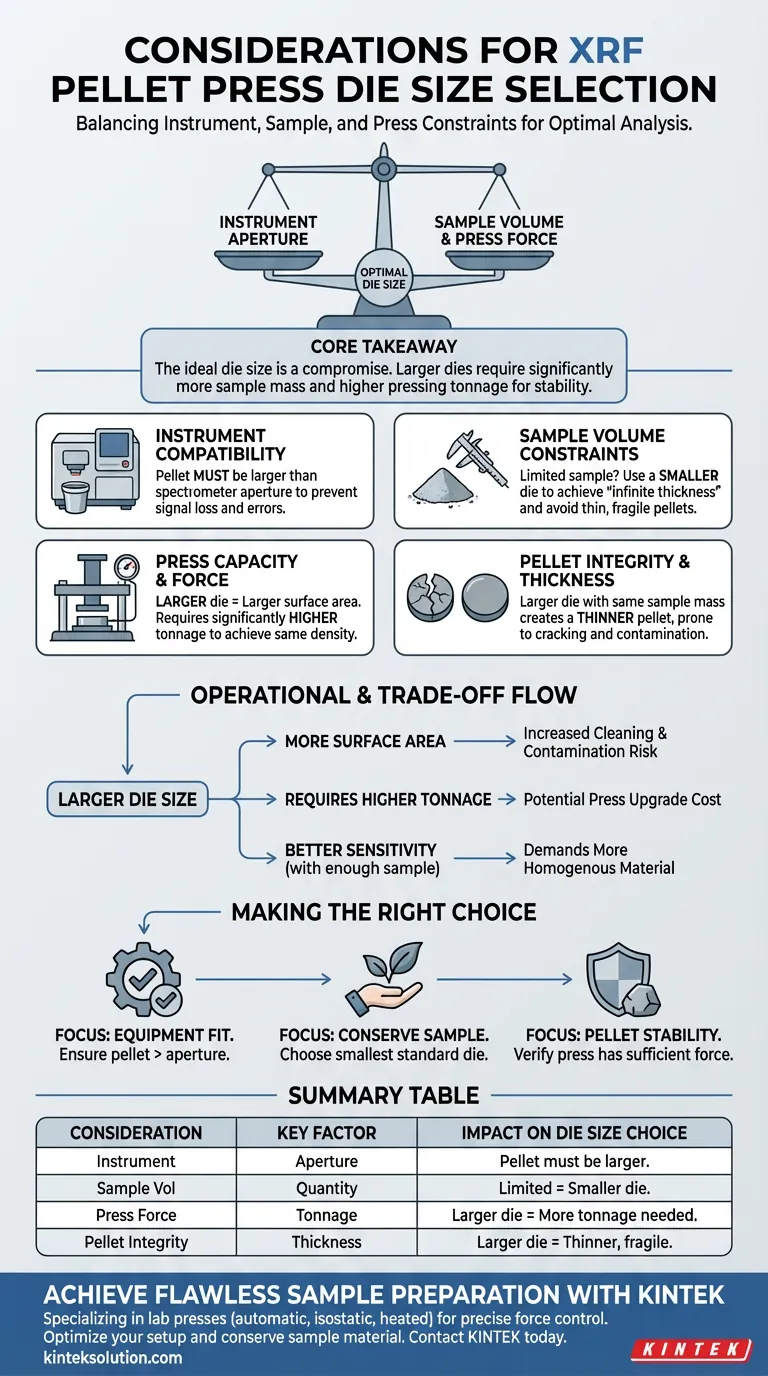
The Core Takeaway The ideal die size is a compromise between the aperture requirements of your XRF instrument and the volume of sample material available. A larger die requires significantly more sample mass and higher pressing tonnage to achieve the critical thickness and density required for accurate analysis.
Instrument and Sample Compatibility
Matching the Spectrometer
The primary constraint is the physical interface of your XRF instrument. The final pellet diameter must fit securely within the instrument's sample cup.
If the pellet is smaller than the spectrometer’s aperture, the X-rays will strike the sample cup holder rather than the sample, rendering the analysis useless.
Sample Volume Constraints
Your available sample quantity dictates the upper limit of your die size. A larger diameter die spreads the material over a wider area.
If you have limited sample material, using a large die will result in a wafer-thin pellet. This may fail to satisfy the "infinite thickness" requirement for XRF analysis, leading to erroneous results where the instrument detects what is behind the pellet rather than the sample itself.
Physical Implications of Die Diameter
Pressure Distribution
The diameter of the die directly influences the pressure (PSI) applied to the sample for a given force (tons).
A larger die distributes the pressing force over a larger surface area. Therefore, to achieve the same density and binding quality as a smaller pellet, a larger die requires a press with a significantly higher tonnage capacity.
Structural Integrity and Thickness
Reference data indicates that controlling the final thickness of the pellet is vital for preventing analytical errors.
Widening the die diameter without increasing the sample mass reduces pellet thickness. Thin pellets are mechanically fragile and prone to cracking during extraction or handling, potentially contaminating the spectrometer.
Operational Considerations
Cleaning and Contamination
The surface area of the die correlates to the effort required for cleaning. Larger dies have more surface area in contact with the sample, increasing the risk of cross-contamination if not cleaned thoroughly.
You must ensure the die material is compatible with your sample to prevent abrasion or chemical reactions that could introduce impurities into the pellet.
Press Capacity Compatibility
When selecting a die, you must cross-reference the maximum tonnage of your hydraulic press.
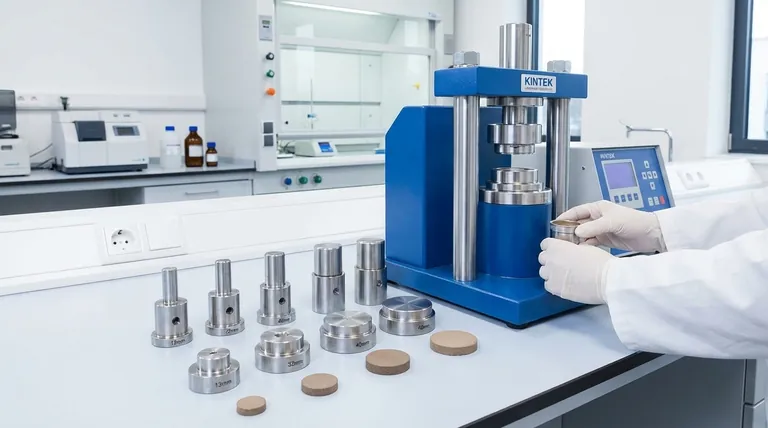
A press with a modest force gauge may effectively compact a 13mm pellet but fail to bond a 40mm pellet adequately. Ensure your press is rated for the force required to bond the specific surface area of your chosen die size.
Understanding the Trade-offs
The Cost of Scaling Up
Moving to a larger die size often necessitates upgrading the entire pressing infrastructure. Larger pellets require robust automatic or high-tonnage manual presses to maintain density, increasing both capital cost and the physical footprint of the equipment.
Sample Scarcity vs. Sensitivity
A larger analysis area (larger die) generally improves XRF sensitivity by capturing more signal. However, this demands a large quantity of homogenous sample material. If your samples are precious or scarce, a smaller die that just barely covers the aperture is the technically superior choice.
Making the Right Choice for Your Goal
To select the correct die size, evaluate your laboratory's specific constraints:
- If your primary focus is Equipment Compatibility: Ensure the die diameter produces a pellet slightly larger than your XRF spectrometer's primary aperture to prevent signal loss.
- If your primary focus is Sample Conservation: Choose the smallest standard die size allowed by your instrument to maximize pellet thickness while using minimal material.
- If your primary focus is Pellet Stability: Verify that your hydraulic press can deliver sufficient pressure (force per unit area) for the chosen diameter to bind the material solidly.
Ultimately, the correct die size allows you to consistently produce a dense, infinite-thickness pellet that fits your instrument without exhausting your sample supply.
Summary Table:
| Consideration | Key Factor | Impact on Die Size Choice |
|---|---|---|
| Instrument Compatibility | Spectrometer Aperture | Die diameter must produce a pellet larger than the aperture. |
| Sample Volume | Available Material Quantity | Limited sample favors a smaller die to achieve sufficient pellet thickness. |
| Press Capacity | Press Tonnage (Force) | Larger dies require significantly higher tonnage to achieve the same density. |
| Pellet Integrity | Pellet Thickness & Density | A larger die with the same sample mass produces a thinner, more fragile pellet. |
Achieve Flawless Sample Preparation with KINTEK
Selecting the correct die size is critical for producing high-quality pellets for accurate XRF analysis. The right lab press ensures you can achieve the necessary density and stability for any die diameter you require.
KINTEK specializes in lab press machines – including automatic, isostatic, and heated lab presses – designed to meet the precise force and control needs of modern laboratories. Our equipment helps you consistently produce perfect pellets, maximizing your spectrometer's performance while conserving valuable sample material.
Let our experts help you optimize your pellet press setup. We can guide you to the perfect press and die combination for your specific application and sample type.
Contact KINTEK today to discuss your lab's requirements and ensure your sample preparation is a success!
Visual Guide
Related Products
- Lab XRF Boric Acid Powder Pellet Pressing Mold for Laboratory Use
- XRF KBR Steel Ring Lab Powder Pellet Pressing Mold for FTIR
- XRF KBR Plastic Ring Lab Powder Pellet Pressing Mold for FTIR
- Laboratory Hydraulic Pellet Press for XRF KBR FTIR Lab Press
- Automatic Laboratory Hydraulic Press for XRF and KBR Pellet Pressing
People Also Ask
- Why are pellets used in XRF analysis, and what is their limitation? Boost Accuracy and Speed in Your Lab
- What are the primary factors to consider when deciding between a manual and an automatic XRF pellet press? Optimize Your Lab's Efficiency
- What are the differences between manual and automatic XRF pellet presses? Choose the Right Press for Your Lab's Needs
- What are the different pellet pressing options for XRF sample preparation? Choose the Best Method for Accurate Analysis
- What are specialized XRF pellet preparation presses designed for? Boost Lab Efficiency with High-Throughput Automation