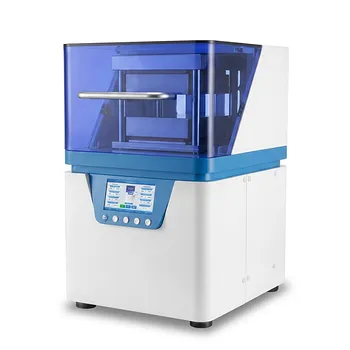
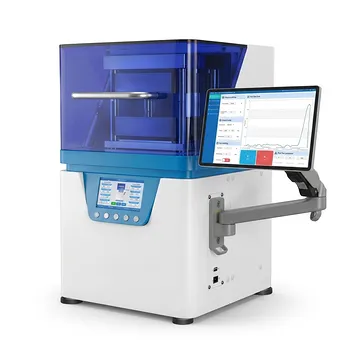
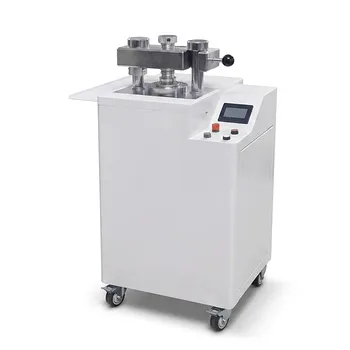
Benchtop presses are primarily utilized in environments focused on small-scale material testing, precise sample preparation, and educational instruction. Unlike heavy industrial machinery, these compact units are engineered to sit directly on standard laboratory workbenches, making them the standard choice for facilities where floor space is limited but material analysis is required.
While they differ from high-volume industrial models in scale, benchtop presses provide the ideal balance of accessibility and functionality for research laboratories and academic institutions requiring versatile, small-batch sample processing.
Key Environments for Application
Research and Development Laboratories
The most common setting for a benchtop press is the laboratory. These units are specifically optimized for small-scale material testing.
Researchers utilize them for sample preparation, allowing for the creation of consistent test specimens without the need for massive infrastructure.
Academic and Educational Institutions
Educational settings frequently deploy benchtop presses to bridge the gap between theory and practice.
Instructors use these machines to teach students about material properties and compression techniques. Their scale makes them approachable and safe for student use while still demonstrating core engineering principles.
Why These Settings Choose Benchtop Models
Maximizing Limited Workspace
The "benchtop" designation is the defining feature for these environments.
Labs often struggle with limited room. The compact design of these presses allows facilities to maintain testing capabilities without sacrificing valuable floor space to large, free-standing machinery.
Versatility and Durability
Despite their smaller size, these presses are typically constructed from high-quality materials designed for a long service life.
They offer the versatility to handle a variety of sample materials, making them a cost-effective solution for labs that test different substances daily.
Accessibility for Operators
In both labs and classrooms, ease of use is critical.
Benchtop presses generally feature a user-friendly design with simple controls. This accessibility ensures that students or researchers can focus on the results rather than struggling with complex machine operation.
Understanding the Trade-offs
Scale Limitations
It is important to recognize that benchtop presses are purpose-built for "small-scale" work.
They do not possess the sheer force capacity or physical clearance of floor-standing industrial presses. Consequently, they are generally unsuitable for heavy manufacturing or processing large, bulky components.
Throughput Constraints
While excellent for preparation and testing, these units are not designed for high-speed mass production.
If your facility requires high-volume throughput, the manual nature and smaller capacity of a benchtop press may become a bottleneck.
Determining if a Benchtop Press Fits Your Needs
To ensure you select the correct equipment for your facility, consider your primary operational goals:
- If your primary focus is R&D and sample prep: Choose a benchtop press to gain versatility and save space while handling small-scale testing requirements.
- If your primary focus is education: Prioritize these models for their user-friendly controls and compact safety, which are ideal for teaching students material science fundamentals.
By matching the equipment's scale to your specific testing volume and spatial limits, you ensure efficient operations and a lasting investment.
Summary Table:
| Setting | Primary Application | Key Benefit |
|---|---|---|
| R&D Laboratories | Small-scale material testing & sample prep | Precise control and consistency |
| Academic Institutions | Teaching material science & engineering | Safe, approachable, and educational |
| Small Facilities | Limited floor space operations | Compact footprint on standard benches |
| Testing Centers | Small-batch sample processing | Versatility across different materials |
Elevate Your Laboratory Precision with KINTEK
Are you looking to maximize your research capabilities within a limited workspace? KINTEK specializes in comprehensive laboratory pressing solutions tailored for precision and durability. From manual and automatic models to heated, multifunctional, and glovebox-compatible designs, we provide the tools necessary for advanced battery research and material analysis.
Whether you need a compact benchtop unit for sample preparation or advanced cold and warm isostatic presses, our experts are ready to help you find the perfect fit for your lab.
Contact KINTEK today to discuss your pressing needs!
Related Products
- Automatic Hydraulic Heat Press Machine with Multi Stage Programmable Control and Integrated Water Cooling Plate Size 180x180mm
- Automatic Hydraulic Hot Press with Large Plate and Precision Temperature Control for Advanced Material Sample Preparation and Industrial Research
- Automatic High Temperature Heated Hydraulic Press Machine with Heated Plates for Lab
- Laboratory Hydraulic Pellet Press for XRF KBR FTIR Lab Press
- Automatic Heated Hydraulic Press Machine with Heated Plates for Laboratory
People Also Ask
- How does a laboratory hydraulic heat press facilitate the molding of cellulose composite specimens? Precision Molding
- How is a hydraulic heat press used for sample preparation? Achieve Uniform, Void-Free Samples for Lab Analysis
- What is the role of a hydraulic heat press in material testing? Unlock Superior Data for Research & QC
- What is a hydraulic heat press? Discover Precision Material Bonding and Sample Preparation
- What are the industrial applications of a hydraulic heat press? Powering Lamination, Bonding, and R&D Efficiency