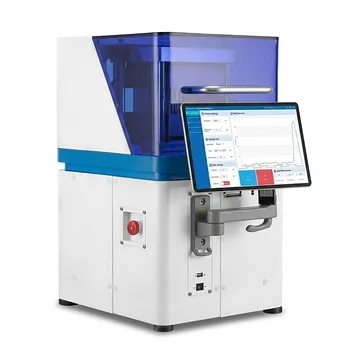
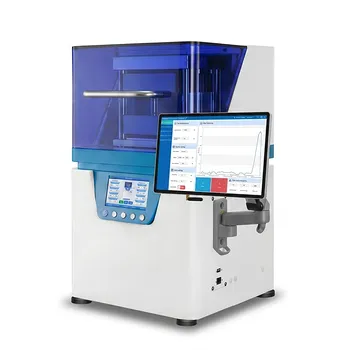
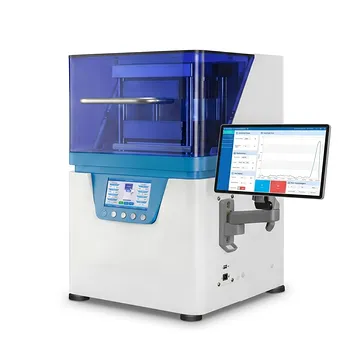
Modern laboratory presses offer a suite of sophisticated control and monitoring capabilities designed for precision and reproducibility. These systems typically include granular control over operational parameters such as speed, pressure, and temperature, alongside advanced features like controlled cooling. Furthermore, integration with industrial PCs allows for comprehensive data logging, enabling the recording and analysis of every step in the pressing process.
By integrating industrial computing with granular control over thermal and mechanical variables, advanced laboratory presses ensure total process transparency and repeatability for critical R&D applications.
Precise Control of Process Variables
Managing Mechanical Force
To ensure experimental consistency, advanced presses allow operators to strictly regulate speed and pressure. This level of control is essential for preventing defects in sensitive materials that may react poorly to sudden force application.
Advanced Thermal Regulation
Beyond simple heating elements, high-end laboratory presses often feature controlled cooling capabilities. This allows researchers to manage the material's temperature profile during the cool-down phase, which is often as critical as the heating phase for material properties.
Digital Integration and Data Intelligence
Industrial PC Interfaces
Modern units have moved beyond analog gauges, integrating directly with industrial PCs. This integration centralizes control, allowing users to input complex operational parameters through a digital interface rather than manual valves.
Full Process Recording
A key advantage of PC integration is the ability to record entire process data. The system captures continuous streams of information regarding pressure, temperature, and time throughout the operation.
Subsequent Analysis
The value of data logging lies in post-process analysis. By reviewing the recorded data, laboratory professionals can validate the quality of the press cycle, troubleshoot inconsistencies, and maintain a rigorous audit trail for quality assurance.
Understanding the Trade-offs
Complexity and Training
The shift from manual to PC-controlled systems introduces a learning curve. Operators require specific training to navigate the software interface and program the equipment correctly, unlike intuitive manual pumps.
Maintenance Dependencies
Adding industrial computing and controlled cooling systems increases the complexity of the machine. This may require more frequent calibration and software maintenance compared to purely mechanical presses, which are often more robust and easier to service in-house.
Making the Right Choice for Your Goal
Selecting the right feature set depends on whether your priority is material exploration or strict process validation.
- If your primary focus is material research and development: Prioritize systems with controlled cooling and variable speed to accurately simulate different processing environments and test material limits.
- If your primary focus is quality assurance and compliance: Ensure the unit features industrial PC integration to automatically capture and store data logs for every cycle, ensuring traceability.
The transition from manual operation to fully automated, data-rich pressing is the key to elevating laboratory results from simple forming to scientific precision.
Summary Table:
| Feature Category | Advanced Capabilities | Research & QA Benefit |
|---|---|---|
| Mechanical Control | Variable speed & pressure regulation | Prevents material defects & ensures consistency |
| Thermal Management | Integrated controlled cooling systems | Manages temperature profiles for material integrity |
| Data Integration | Industrial PC & digital interfaces | Centralized control and complex cycle programming |
| Process Intelligence | Real-time logging & audit trails | Validates cycle quality and ensures full traceability |
| Operational Mode | Automated & programmable cycles | Reduces human error compared to manual operation |
Elevate Your Laboratory Precision with KINTEK
Take the guesswork out of material research with KINTEK’s comprehensive laboratory pressing solutions. Whether you require manual simplicity or the sophisticated power of automatic, heated, and multifunctional models, our equipment is engineered for total process transparency.
Our systems cater to the most demanding applications—from battery research to advanced metallurgy—offering glovebox-compatible designs and specialized cold and warm isostatic presses. Gain full control over your data and mechanical variables to ensure repeatable, scientific results every time.
Ready to upgrade your lab's capabilities? Contact KINTEK today to find the perfect press for your research!
Related Products
- Laboratory Hydraulic Press Lab Pellet Press Button Battery Press
- Laboratory Hydraulic Press Lab Pellet Press Machine for Glove Box
- Laboratory Split Manual Heated Hydraulic Press Machine with Hot Plates
- Laboratory Hydraulic Pellet Press for XRF KBR FTIR Lab Press
- Laboratory Hydraulic Split Electric Lab Pellet Press
People Also Ask
- How is a laboratory hydraulic press used for HAP composite gels? Master Mineral Substrate Standardization
- What role does a laboratory hydraulic press play in reaction pellets? Optimizing Lunar Soil and Metal Fuel Density
- What role does a laboratory hydraulic press play in the preparation of piezoelectric ceramic discs for DC-PG? | KINTEK
- Why is a laboratory hydraulic press required for PBAT and PLA sample preparation? Achieve Flawless Characterization
- What role does a laboratory hydraulic press play in the assembly of all-solid-state battery test cells? Expert Guide