
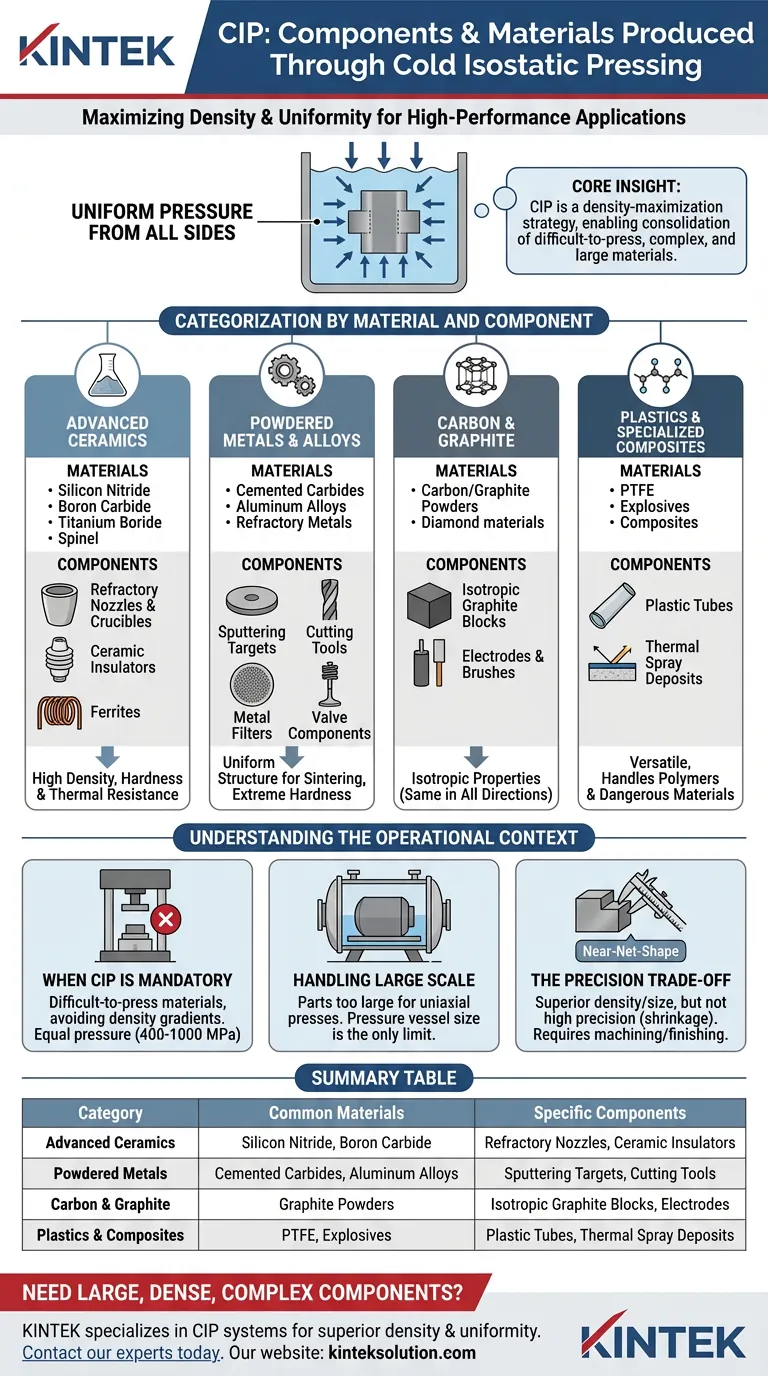
Cold Isostatic Pressing (CIP) produces a diverse range of high-performance components by consolidating powders into dense, robust shapes. Specific outputs include advanced ceramic parts like silicon nitride and boron carbide, large refractory crucibles, metallic sputtering targets for thin films, and industrial components such as cutting tools, valve coatings, and isotropic graphite blocks.
Core Insight: CIP is not merely a shaping process; it is a density-maximization strategy. By applying uniform pressure from all sides via a liquid medium, it allows for the consolidation of large, complex, or "difficult-to-press" materials—such as cemented carbides and sputtering targets—that would fail or lack uniformity under standard uniaxial pressing.
Categorization by Material and Component
Advanced Ceramics
The ceramics industry relies heavily on CIP to produce high-density parts that require exceptional hardness and thermal resistance.
Common Materials:
- Silicon nitride and silicon carbide.
- Boron nitride and boron carbide.
- Titanium boride and spinel.
Specific Components:
- Refractory nozzles and crucibles: Used in high-temperature metal processing.
- Ceramic insulators: Critical for high-voltage electrical applications.
- Ferrites: Magnetic components used in electronics.
Powdered Metals and Alloys
CIP is instrumental in powdered metallurgy for creating preforms and parts that require uniform internal structure before sintering.
Common Materials:
- Hard metals and cemented carbides.
- Aluminum, magnesium, and copper alloys.
- Refractory materials (metals with very high melting points).
Specific Components:
- Sputtering Targets: Highly compacted disks or plates used to deposit thin films in semiconductor manufacturing.
- Cutting Tools: Carbide inserts and tools that require extreme hardness.
- Metal Filters: Porous metal components used for filtration.
- Valve Components: Coated components in engines to reduce cylinder wear and improve durability.
Carbon and Graphite
Graphite production utilizes CIP to ensure isotropic properties, meaning the material has the same physical properties in all directions.
Common Materials:
- Carbon and graphite powders.
- Diamond and diamond-like materials.
Specific Components:
- Isotropic Graphite: Used for muffle furnace components and electrodes.
- Electrodes and Brushes: Electrical materials requiring consistent conductivity.
Plastics and Specialized Composites
Beyond metals and ceramics, CIP is versatile enough to handle polymers and dangerous materials.
Common Materials:
- Plastics (PTFE and others).
- Explosives and pyrotechnics.
- Composites.
Specific Components:
- Plastic Tubes: High-density polymer tubing.
- Thermal Spray Deposits: Coatings consolidated for better adhesion and density.
Understanding the Operational Context
When CIP is Mandatory
CIP is specifically chosen when materials are difficult to press with conventional methods. Standard rigid die pressing often results in density gradients (uneven hardness) in complex shapes. CIP eliminates this by using an elastomer mold submerged in liquid, applying equal pressure (400 MPa to 1000 MPa) from every angle.
Handling Large Scale
One of the distinct advantages of CIP is the ability to process parts that are too large for uniaxial presses. Because the pressure vessel size is the only limit, manufacturers can produce massive green parts (pre-sintered) like large ceramic billets or heavy metal preforms that would be impossible to compact in a mechanical die.
The Precision Trade-off
While CIP achieves superior density and size capabilities, it is generally used for parts that do not require high precision in the sintered state. The flexible mold allows for significant shrinkage and shape change. Therefore, CIP is typically a near-net-shape process, requiring machining or finishing after the part has been pressed and sintered.
Making the Right Choice for Your Goal
- If your primary focus is High-Performance Ceramics: Use CIP to consolidate materials like silicon nitride or boron carbide to achieve maximum packing density before firing.
- If your primary focus is Thin Film Deposition: Rely on CIP to create sputtering targets, ensuring the material is dense and uniform for consistent coating quality.
- If your primary focus is Large-Scale Manufacturing: Choose CIP for creating massive billets or preforms that physically exceed the capacity of standard rigid die presses.
- If your primary focus is Material Uniformity: Select CIP for isotropic graphite or cemented carbides to ensure the material properties are identical in every direction.
CIP is the definitive solution for transforming loose powder into large, dense, and structurally sound components that demand uniform internal integrity.
Summary Table:
| Category | Common Materials | Specific Components |
|---|---|---|
| Advanced Ceramics | Silicon Nitride, Boron Carbide | Refractory Nozzles, Ceramic Insulators |
| Powdered Metals | Cemented Carbides, Aluminum Alloys | Sputtering Targets, Cutting Tools |
| Carbon & Graphite | Graphite Powders | Isotropic Graphite Blocks, Electrodes |
| Plastics & Composites | PTFE, Explosives | Plastic Tubes, Thermal Spray Deposits |
Need to produce large, dense, or complex-shaped components with uniform properties?
KINTEK specializes in lab press machines, including advanced Cold Isostatic Presses (CIP), to help you achieve superior material density and uniformity for your most demanding applications. Whether you're working with advanced ceramics, powdered metals, or specialized composites, our expertise ensures your materials perform reliably.
Contact our experts today to discuss how a KINTEK CIP system can enhance your laboratory's capabilities and streamline your production process.
Visual Guide
Related Products
- Manual Cold Isostatic Pressing CIP Machine Pellet Press
- Electric Lab Cold Isostatic Press CIP Machine
- Automatic Lab Cold Isostatic Pressing CIP Machine
- Electric Split Lab Cold Isostatic Pressing CIP Machine
- Lab Isostatic Pressing Molds for Isostatic Molding
People Also Ask
- Why is Cold Isostatic Pressing (CIP) necessary for SBN ceramics? Achieve High-Density and Crack-Free Sintering
- Why is Cold Isostatic Pressing (CIP) applied after uniaxial pressing? Optimize Superconductor Precursor Density
- What are the process advantages of using Cold Isostatic Pressing (CIP) for LSMO? Achieve Defect-Free Density
- What types of equipment are available for cold isostatic pressing? Explore CIP Solutions for Labs and Production
- What are the technical advantages of cold isostatic pressing equipment compared to uniaxial compression equipment? Learn More!
















