
Choosing a standard Cold Isostatic Pressing (CIP) system is a strategic decision that prioritizes efficiency and proven performance. These off-the-shelf units provide significant advantages in cost, delivery time, and reliability by leveraging pre-engineered designs optimized for common industrial applications. They are an ideal solution for processes where the need for extensive, one-off customization is not the primary driver.
The decision between a standard and custom CIP system is not about good versus bad, but about alignment. Standard systems offer unmatched value and speed for established processes, while custom solutions are necessary for pushing the boundaries of material science or unique component geometries.

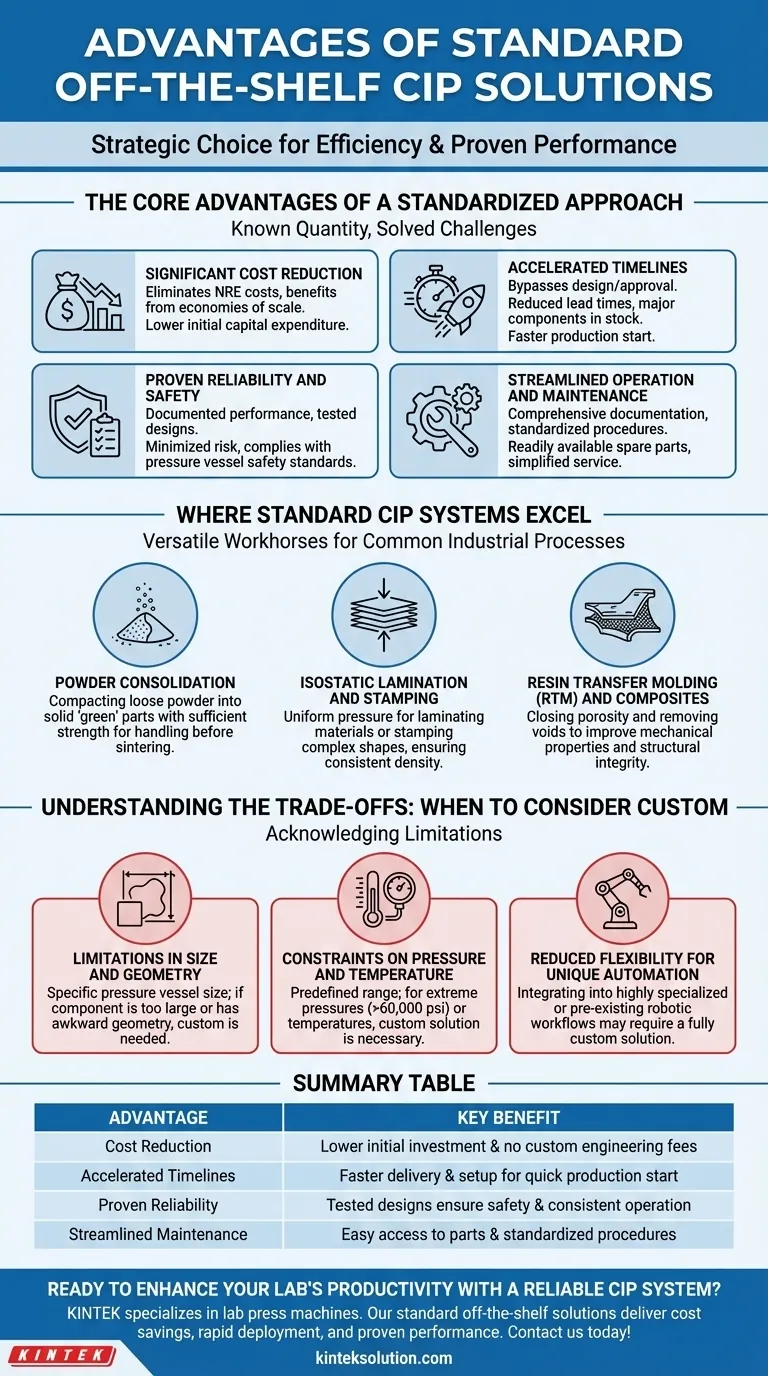
The Core Advantages of a Standardized Approach
Opting for a standard CIP unit is an investment in a known quantity. The benefits stem directly from the fact that the engineering, sourcing, and assembly challenges have already been solved.
Significant Cost Reduction
Because standard systems are pre-engineered, you eliminate the substantial non-recurring engineering (NRE) costs associated with custom design, analysis, and validation.
Manufacturers also benefit from economies of scale, purchasing components in volume and passing those savings on. This makes the initial capital expenditure significantly lower than a bespoke build.
Accelerated Timelines
A standard CIP system bypasses the lengthy custom design and approval phase. Lead times are drastically reduced because major components are often in stock and the assembly process is a well-rehearsed procedure.
This allows your team to move from procurement to production in a fraction of the time required for a custom-built machine.
Proven Reliability and Safety
Standard models have a documented history of performance and safety in the field. They are built upon designs that have been tested, refined, and validated across numerous installations.
This history minimizes the risk of unforeseen operational issues and ensures the system complies with established pressure vessel safety standards from day one.
Streamlined Operation and Maintenance
These systems come with comprehensive documentation, standardized operating procedures, and established maintenance schedules.
Spare parts are more readily available and often interchangeable, simplifying long-term service and reducing potential downtime.
Where Standard CIP Systems Excel
Standard CIP units are engineered to be versatile workhorses for a range of common industrial processes that benefit from the application of uniform, isostatic pressure.
Powder Consolidation
This is a primary application where a loose powder is compacted into a solid "green" part with sufficient strength for handling before its final sintering or firing process. Standard presses are perfectly configured for this task.
Isostatic Lamination and Stamping
Standard systems provide the uniform pressure needed to laminate layers of materials or to stamp complex shapes into powdered metals or ceramics, ensuring consistent density and eliminating defects.
Resin Transfer Molding (RTM) and Composites
For composite manufacturing, a standard CIP can be used to close porosity and remove voids within a part, significantly improving its mechanical properties and structural integrity.
Understanding the Trade-offs: When to Consider Custom
While standard systems offer compelling advantages, they are not the right fit for every situation. Acknowledging their limitations is key to making an informed decision.
Limitations in Size and Geometry
Standard CIP systems are built with a specific pressure vessel size (working diameter and height). If your component is too large or has a particularly awkward geometry that won't fit, a custom vessel is your only option.
Constraints on Pressure and Temperature
These units operate within a predefined range of pressure and, if applicable, temperature. For cutting-edge materials research or unique applications requiring pressures beyond typical industry norms (e.g., >60,000 psi), a custom-engineered solution is necessary.
Reduced Flexibility for Unique Automation
While standard presses are designed for automation, integrating them into a highly specialized or pre-existing robotic workflow may require compromises. A fully custom solution can be designed from the ground up to match complex automation requirements perfectly.
Making the Right Choice for Your Application
Your final decision should be guided by a clear understanding of your project's primary objective.
- If your primary focus is budget and speed for a common application: A standard, off-the-shelf CIP system will almost always provide the best value and fastest path to production.
- If your primary focus is developing a novel material or a highly unique part geometry: You should begin the conversation with vendors about a custom-engineered solution to meet your specific parameters.
- If your primary focus is integrating a press into a complex, existing automated line: Carefully evaluate the control systems and I/O capabilities of standard units before defaulting to a more expensive custom build.
By understanding this core distinction, you can confidently select a solution that aligns perfectly with your technical goals and business constraints.
Summary Table:
| Advantage | Key Benefit |
|---|---|
| Cost Reduction | Lower initial investment and no custom engineering fees |
| Accelerated Timelines | Faster delivery and setup for quick production start |
| Proven Reliability | Tested designs ensure safety and consistent operation |
| Streamlined Maintenance | Easy access to parts and standardized procedures |
Ready to enhance your lab's productivity with a reliable CIP system? KINTEK specializes in lab press machines, including automatic lab presses, isostatic presses, and heated lab presses, tailored for laboratory needs. Our standard off-the-shelf solutions deliver cost savings, rapid deployment, and proven performance for applications like powder consolidation and composite manufacturing. Contact us today to discuss how we can support your specific requirements and drive your projects forward!
Visual Guide
Related Products
- Electric Lab Cold Isostatic Press CIP Machine
- Automatic Lab Cold Isostatic Pressing CIP Machine
- Electric Split Lab Cold Isostatic Pressing CIP Machine
- Manual Cold Isostatic Pressing CIP Machine Pellet Press
- Warm Isostatic Press for Solid State Battery Research Warm Isostatic Press
People Also Ask
- What are the applications of electric lab cold isostatic presses in research settings? Advance Material R&D with High-Pressure CIPs
- What role do electric lab cold isostatic presses play in industrial contexts? Bridge R&D and Manufacturing with Precision
- How does electrical Cold Isostatic Pressing (CIP) contribute to cost savings? Unlock Efficiency and Reduce Expenses
- What are some research applications of electric lab CIPs? Unlock Uniform Powder Densification for Advanced Materials
- What are the characteristics of standard off-the-shelf electric lab CIP solutions? Achieve Immediate, Cost-Effective Processing















