
The primary advantage of Cold Isostatic Pressing (CIP) over relying solely on uniaxial pressing lies in the application of uniform, isotropic pressure. While a uniaxial press is necessary to form the initial shape, following it with a CIP step significantly increases the "green density" of the Li₇La₃Zr₂O₁₂ (LLZO) pellet, eliminating the internal defects and density gradients that compromise the final electrolyte's performance.
Core Insight: Uniaxial pressing creates a pre-form with uneven internal stress; CIP corrects this structure. By applying hydrostatic pressure from all directions, CIP ensures the uniform shrinkage necessary during sintering to achieve high ionic conductivity and mechanical strength in the final ceramic.
The Mechanics of Pressure Application
Limitations of Uniaxial Pressing
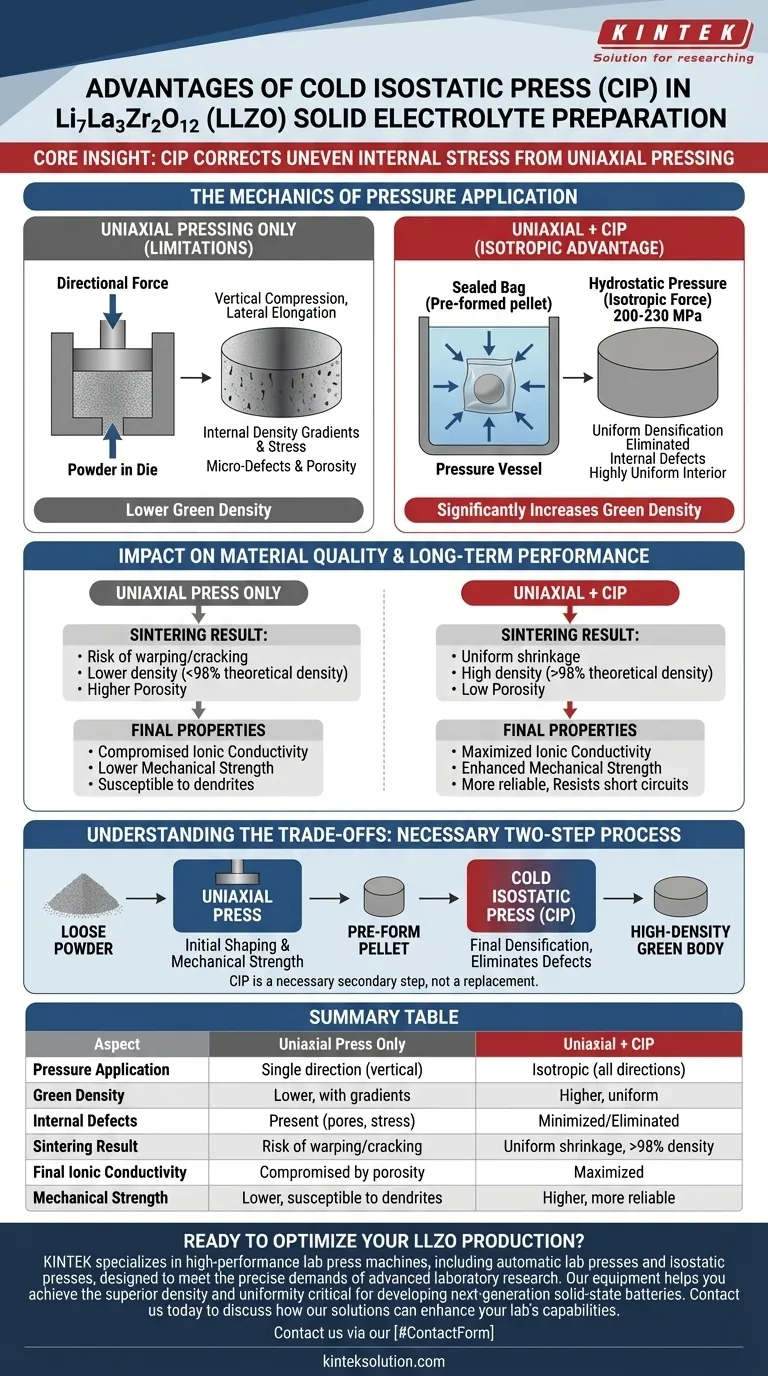
Uniaxial pressing applies force in a single vertical direction. While effective for compacting loose powder into a specific shape (such as a 10 mm circular pre-form), this directional force has limitations.
It often leads to vertical compression coupled with lateral elongation. Consequently, using only this method can introduce internal density gradients and stress concentrations within the pellet.
The Isotropic Advantage of CIP
In contrast, Cold Isostatic Pressing utilizes a liquid medium to apply hydrostatic pressure. This force is "isotropic," meaning it is applied uniformly from all directions rather than just one.
Operating at pressures around 200–230 MPa, CIP densifies the material without causing the macroscopic deformation often seen with excessive uniaxial pressure. This results in a structure with a smoother surface and a highly uniform interior.
Impact on Material Quality
Maximizing Green Density
The immediate goal in preparing LLZO solid electrolytes is achieving a high "green density" (the density of the object before it is fired). CIP significantly increases the packing density of the powder particles beyond what uniaxial pressing can achieve alone.
Eliminating Internal Defects
Uniaxial pressing frequently leaves behind micro-defects and uneven pore distributions. The omnidirectional pressure of the CIP process effectively collapses these voids.
By eliminating these internal inconsistencies, CIP creates a homogeneous body. This uniformity is not merely cosmetic; it is a critical structural requirement for the next stage of processing.
Long-Term Performance Implications
Foundation for Sintering
The uniformity achieved via CIP is the crucial foundation for the high-temperature sintering phase. A homogeneous green body undergoes uniform shrinkage during pressureless sintering.
Without this step, the density gradients from uniaxial pressing could lead to warping or cracking during heating. CIP ensures the final product reaches a very high percentage of its theoretical density (often cited near 98% or higher).
Enhancing Conductivity and Strength
The physical properties of the LLZO electrolyte are directly tied to its density. A low-porosity, high-density final product is essential for optimal performance.
This dense structure enhances the material's ionic conductivity, which is the primary function of the electrolyte. Furthermore, reducing porosity improves mechanical properties, helping the electrolyte resist internal short circuits.
Understanding the Trade-offs
The Necessity of a Two-Step Process
It is important to understand that CIP is rarely a replacement for uniaxial pressing, but rather a necessary secondary step.
You generally cannot use CIP on loose powder directly without containment. A uniaxial press provides the initial mechanical strength and shape (the pre-form) required to handle the sample before it enters the isostatic press.
The Pitfall of Skipping CIP
The main "trade-off" is operational complexity versus quality. Skipping the CIP step saves time but results in a ceramic with lower density and higher porosity. In the context of solid-state batteries, this compromise is usually unacceptable, as residual porosity impedes lithium ion movement and weakens the barrier against dendrites.
Making the Right Choice for Your Goal
To maximize the performance of your Li₇La₃Zr₂O₁₂ solid electrolytes, consider the following regarding the pressing process:
- If your primary focus is Ionic Conductivity: You must use CIP to maximize final density, as porosity acts as a barrier to ion transport.
- If your primary focus is Mechanical Reliability: CIP is essential to remove internal stress concentrations that could lead to fracture or dendrite penetration during battery cycling.
- If your primary focus is Process Efficiency: Recognize that while uniaxial pressing is faster, it is best utilized only for initial shaping, not final densification.
Summary: While uniaxial pressing gives the LLZO pellet its form, Cold Isostatic Pressing gives it the structural integrity and density required for a high-performance solid-state battery.
Summary Table:
| Aspect | Uniaxial Press Only | Uniaxial + CIP |
|---|---|---|
| Pressure Application | Single direction (vertical) | Isotropic (all directions) |
| Green Density | Lower, with gradients | Higher, uniform |
| Internal Defects | Present (pores, stress) | Minimized/Eliminated |
| Sintering Result | Risk of warping/cracking | Uniform shrinkage, >98% theoretical density |
| Final Ionic Conductivity | Compromised by porosity | Maximized |
| Mechanical Strength | Lower, susceptible to dendrites | Higher, more reliable |
Ready to optimize your LLZO solid electrolyte production?
KINTEK specializes in high-performance lab press machines, including automatic lab presses and isostatic presses, designed to meet the precise demands of advanced laboratory research. Our equipment helps you achieve the superior density and uniformity critical for developing next-generation solid-state batteries.
Contact us today via our [#ContactForm] to discuss how our solutions can enhance your lab's capabilities and accelerate your research.
Visual Guide
References
- Seung Hoon Chun, Sangbaek Park. Synergistic Engineering of Template‐Guided Densification and Dopant‐Induced Pore Filling for Pressureless Sintering of Li<sub>7</sub>La<sub>3</sub>Zr<sub>2</sub>O<sub>12</sub> Solid Electrolyte at 1000 °C. DOI: 10.1002/sstr.202500297
This article is also based on technical information from Kintek Solution Knowledge Base .
Related Products
- Electric Lab Cold Isostatic Press CIP Machine
- Electric Split Lab Cold Isostatic Pressing CIP Machine
- Manual Cold Isostatic Pressing CIP Machine Pellet Press
- Automatic Lab Cold Isostatic Pressing CIP Machine
- Lab Isostatic Pressing Molds for Isostatic Molding
People Also Ask
- What role do electric lab cold isostatic presses play in industrial contexts? Bridge R&D and Manufacturing with Precision
- What are the applications of electric lab cold isostatic presses in research settings? Advance Material R&D with High-Pressure CIPs
- How does electrical Cold Isostatic Pressing (CIP) contribute to cost savings? Unlock Efficiency and Reduce Expenses
- What are some research applications of electric lab CIPs? Unlock Uniform Powder Densification for Advanced Materials
- What are the characteristics of standard off-the-shelf electric lab CIP solutions? Achieve Immediate, Cost-Effective Processing



















