
The primary advantage of using a Cold Isostatic Press (CIP) over a uniaxial press is the elimination of density gradients.
While uniaxial pressing applies force from a single direction—often resulting in uneven compaction due to wall friction—CIP utilizes a liquid medium to apply uniform, isostatic pressure from all directions simultaneously. For composite anode sheets, this results in a green body with homogeneous internal density, significantly reducing the risk of cracking during subsequent sintering or cycling and ensuring uniform ionic transport.
Core Takeaway Uniaxial pressing creates internal stress points and density variations that compromise battery performance. CIP resolves this by applying equal pressure to the entire surface area, yielding a highly dense, defect-free structure essential for the mechanical reliability and electrochemical consistency of all-solid-state batteries.
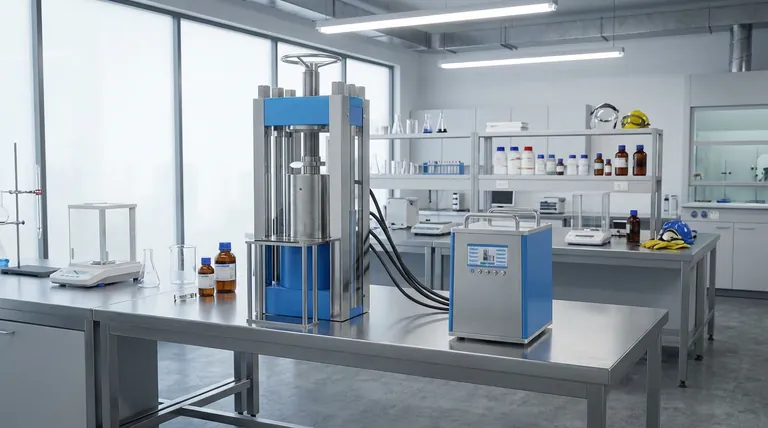
The Limitations of Uniaxial Pressing
The Directional Force Problem
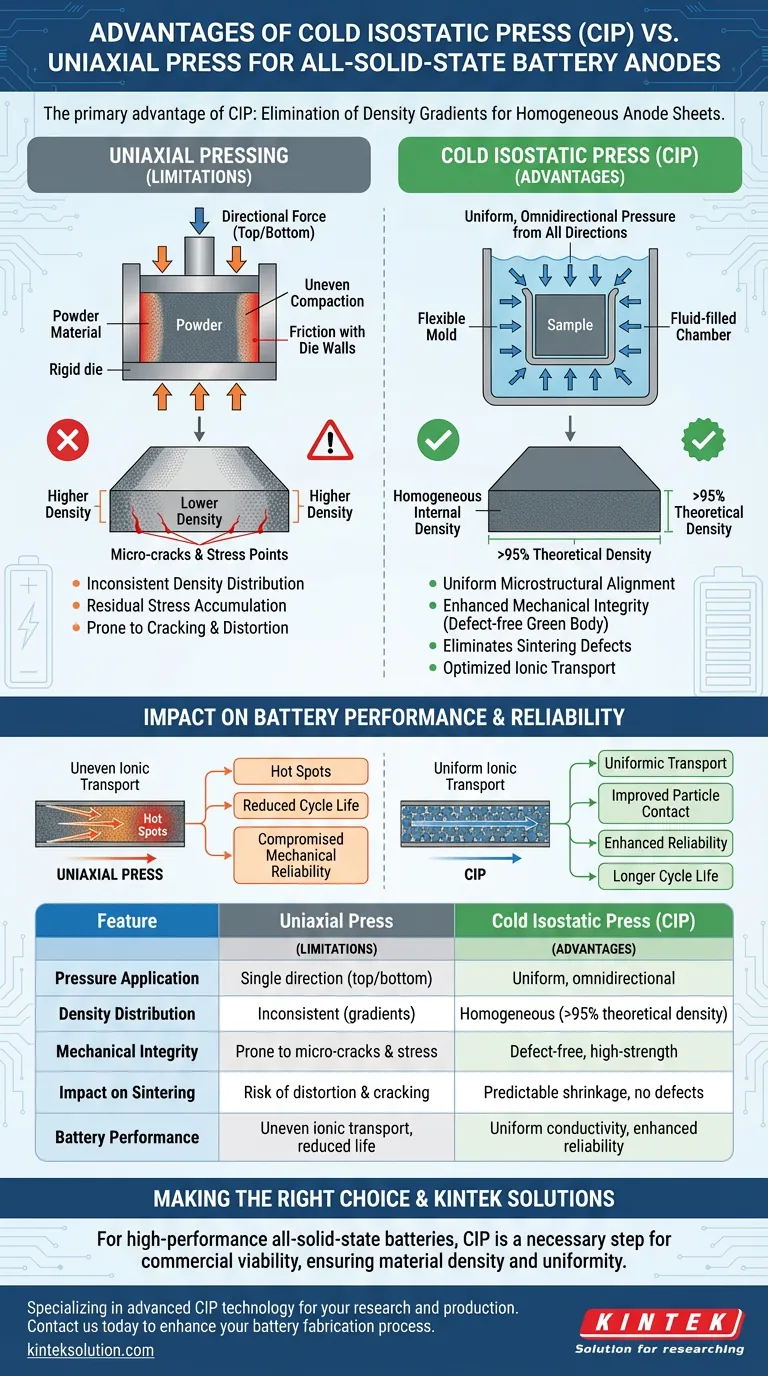
Uniaxial pressing relies on rigid dies to apply pressure along a single axis (top and bottom). This creates a fundamental mechanical limitation for sensitive materials like battery anodes.
Inconsistent Density Distribution
Friction between the powder and the die walls causes a pressure drop towards the center of the sample. This results in density gradients, where the edges of the anode sheet are denser than the center, creating weak points in the microstructure.
Residual Stress Accumulation
The uneven distribution of force traps internal stress within the compacted sheet. Upon release from the mold or during heat treatment, this stored energy often releases as micro-cracks or lamination defects, rendering the anode unusable.
The Isostatic Advantage in Anode Fabrication
Uniform Microstructural Alignment
CIP uses a fluid (liquid or gas) to transmit pressure equally to every point of the sample’s surface. This ensures that the composite particles are packed uniformly, often achieving over 95% of the theoretical density.
Enhanced Mechanical Integrity
Because the pressure is omnidirectional, the "green body" (the compacted powder before sintering) has superior strength and toughness. This homogeneity prevents deformation and warping, ensuring the anode sheet maintains its precise dimensions during firing or handling.
Elimination of Sintering Defects
The uniform density achieved by CIP is critical for the subsequent sintering phase. By removing density gradients, CIP ensures predictable shrinkage, effectively eliminating distortion and cracking when the material is heated.
Impact on Battery Performance
Optimized Ionic Transport
For all-solid-state batteries, the uniformity of the anode microstructure is directly linked to performance. A homogeneous density distribution promotes uniform ionic transport throughout the anode, preventing "hot spots" of current density that can degrade the battery.
Improved Contact and Cycle Life
The high density achieved through CIP ensures better particle-to-particle contact within the composite. This reduces internal resistance and enhances the mechanical reliability of the anode, leading to a longer cycle life and better wear resistance.
Understanding the Trade-offs
Process Complexity vs. Sample Quality
While CIP offers superior quality, it introduces a fluid medium and requires elastomeric molds, which is more complex than the rigid dies of uniaxial pressing. Uniaxial pressing is generally faster for simple shapes, but it sacrifices the structural fidelity required for high-performance solid-state electrolytes and anodes.
The "Green Body" Factor
CIP is most effective as a secondary step or a primary step for complex consolidation. It excels at creating a high-quality "green body," but it does not replace the need for sintering; rather, it ensures the sintering process is successful by providing a perfect starting template.
Making the Right Choice for Your Goal
If you are deciding between these two methods for your battery fabrication process, consider your specific end-goals:
- If your primary focus is electrochemical performance: Prioritize CIP to ensure uniform ionic conductivity and maximize the theoretical capacity of the anode.
- If your primary focus is mechanical reliability: Choose CIP to eliminate micro-cracking and ensure the sheet survives high-temperature sintering without deformation.
- If your primary focus is rapid, low-cost screening: Use uniaxial pressing for initial material testing where microstructural perfection is less critical than speed.
Ultimately, for high-performance all-solid-state batteries, CIP is not just an alternative; it is a necessary step to achieve the material density and uniformity required for commercial viability.
Summary Table:
| Feature | Uniaxial Press | Cold Isostatic Press (CIP) |
|---|---|---|
| Pressure Application | Single direction (top/bottom) | Uniform, omnidirectional |
| Density Distribution | Inconsistent (gradients due to friction) | Homogeneous (>95% theoretical density) |
| Mechanical Integrity | Prone to micro-cracks and stress points | Defect-free, high-strength green body |
| Impact on Sintering | Risk of distortion and cracking | Predictable shrinkage, no defects |
| Battery Performance | Uneven ionic transport, reduced cycle life | Uniform conductivity, enhanced reliability |
Ready to eliminate density gradients and cracking in your all-solid-state battery anodes?
At KINTEK, we specialize in lab press machines, including advanced Cold Isostatic Presses (CIP), designed to deliver the homogeneous density and mechanical integrity your high-performance batteries demand. Our CIP technology ensures uniform compaction, eliminates sintering defects, and optimizes ionic transport—critical for achieving commercial viability.
Don't let inconsistent pressing compromise your research or production. Contact us today to learn how our solutions can enhance your battery fabrication process.
Get in touch with our experts now!
Visual Guide
References
- Zongqi He, Kengo Shimanoe. Cosintering the Anode Active Material with Li <sub>7</sub> La <sub>3</sub> Zr <sub>2</sub> O <sub>12</sub> Solid Electrolyte for the All-Solid-State Battery: How to Predict the Interfacial Reaction at Elevated Temperatures. DOI: 10.1021/acsaem.5c02930
This article is also based on technical information from Kintek Solution Knowledge Base .
Related Products
- Automatic Lab Cold Isostatic Pressing CIP Machine
- Electric Lab Cold Isostatic Press CIP Machine
- Electric Split Lab Cold Isostatic Pressing CIP Machine
- Manual Cold Isostatic Pressing CIP Machine Pellet Press
- Lab Isostatic Pressing Molds for Isostatic Molding
People Also Ask
- What are the key features of automated laboratory Cold Isostatic Press (CIP) systems? Achieve Precise, High-Pressure Powder Consolidation
- Why is an Isostatic Press (CIP) Necessary After Uniaxial Pressing? Achieve Transparency in Nd:Y2O3 Ceramics
- How does a Cold Isostatic Press (CIP) facilitate the preparation of CaO-doped silicon carbide (SiC) green bodies?
- How does a Cold Isostatic Press (CIP) increase Bi-2223/Ag current density? Boost Superconductivity with Uniform Pressure
- What is the primary function of a Cold Isostatic Press (CIP) in NASICON preparation? Achieve 96% Theoretical Density










