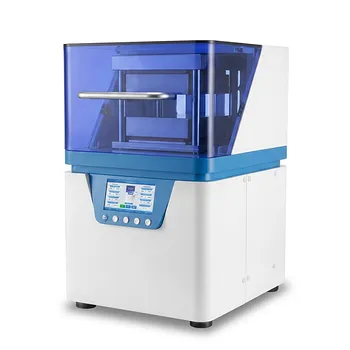
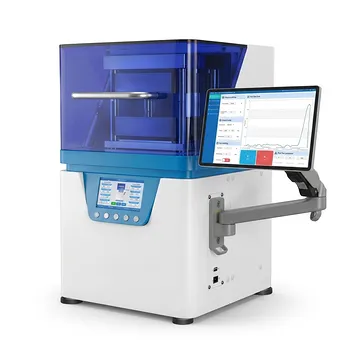
Using a hydraulic press for sample disc production fundamentally transforms the preparation workflow. It makes the process significantly quicker and easier compared to manual methods. Most importantly, it establishes a repeatable standard, ensuring that every disc produced creates reliable and efficient test conditions for subsequent analysis.
The core value of a hydraulic press lies in its ability to eliminate operator variability, delivering the consistent density and structural integrity required for high-precision analytical testing.
Achieving Analytical Precision
Unmatched Repeatability
The primary advantage of a hydraulic press is the ability to replicate exact conditions for every sample. Unlike manual preparation, which is subject to human variation, a hydraulic press ensures that the force applied is uniform across every cycle. This consistency is vital for creating reliable test conditions.
Precise Force Control
Modern hydraulic presses allow operators to dial in specific pressure requirements, such as a precise 10 MPa application. This level of control ensures the pressure is tailored exactly to the material's needs. It prevents the inconsistencies that lead to skewed analytical data.
Superior Densification
For powder samples, hydraulic presses excel at "dry-pressing molding," which physically reduces the distance between particles. This compaction creates a "green body" with a defined density. This step is essential for establishing the strength required for subsequent processes, such as sintering, preventing cracks or deformation.
Enhancing Laboratory Efficiency
Speed and Throughput
Hydraulic presses significantly increase the speed of sample preparation. The mechanical advantage allows for rapid compression cycles, which is particularly noticeable in high-volume environments. Faster sample switching means a laboratory can process more discs in less time.
Reduced Operator Effort
Despite the high force output, these machines require very little physical effort from the technician. This ease of use reduces operator fatigue during long shifts. It allows laboratory personnel to focus on analysis rather than the physical exertion of preparation.
Operational Safety
These devices are designed with integrated safety features to handle immense pressures securely. Mechanisms that prevent overloading protect both the user and the equipment. This makes the generation of high tonnage forces generally safe for the laboratory environment.
Versatility and Advanced Applications
Adaptability to Materials
Hydraulic presses are highly versatile and capable of handling a wide variety of sample types. Operators can adjust speeds, forces, and dwell times to accommodate different raw materials. This operational flexibility makes a single machine useful for diverse testing protocols.
Thermal Capabilities (Hot Pressing)
Advanced hydraulic presses can apply heat and pressure simultaneously. This effectively utilizes the thermoplastic properties of materials like biomass, resulting in higher density and stability. For example, hot pressing can activate lignin in biomass, creating pellets that are less prone to breakage and moisture absorption.
Understanding Operational Considerations
Maintenance of Hydraulic Systems
While hydraulic presses are generally cost-effective and require minimal maintenance, they are not maintenance-free. To ensure consistent force output, the hydraulic fluid levels and seals must be monitored. Neglecting these basic checks can lead to a loss of pressure precision over time.
Preventing Over-Compaction
The high force output of a hydraulic press is an advantage, but it must be managed carefully. Applying excessive pressure beyond a material's limit can crush particle structures rather than compacting them. Users must utilize the machine's precision controls to stay within the optimal pressure range for their specific sample.
Making the Right Choice for Your Goal
To maximize the benefits of a hydraulic press, align the machine's capabilities with your specific laboratory requirements:
- If your primary focus is high-volume testing: Prioritize the speed and ease of use to maximize throughput and minimize operator fatigue.
- If your primary focus is complex material research: Leverage the adjustable force and heating capabilities to control density and activate material properties.
- If your primary focus is data reliability: Rely on the machine's precise repeatability to eliminate variables and ensure identical test conditions.
Ultimately, a hydraulic press acts as a stabilizer in the laboratory, converting variable raw materials into uniform, analysis-ready samples.
Summary Table:
| Benefit | Key Advantage | Impact on Analysis |
|---|---|---|
| Repeatability | Consistent force application | Eliminates operator variability for reliable data |
| Precision Control | Dial-in exact pressure (e.g., 10 MPa) | Prevents material damage and ensures optimal density |
| Efficiency | Rapid compression cycles | Increases sample throughput while reducing fatigue |
| Versatility | Adjustable speeds and thermal options | Accommodates diverse materials including biomass |
| Safety | Integrated overload protection | Ensures secure operation in high-tonnage environments |
Elevate Your Sample Preparation with KINTEK
Precision in analysis begins with precision in preparation. KINTEK specializes in comprehensive laboratory pressing solutions designed to meet the rigorous demands of modern research. Whether you are conducting advanced battery research or routine material testing, our range of manual, automatic, heated, and multifunctional hydraulic presses—including glovebox-compatible and isostatic models—ensures you achieve the perfect sample every time.
Ready to enhance your lab's data reliability and efficiency?
Contact KINTEK Today to Find Your Ideal Pressing Solution
Related Products
- Automatic Hydraulic Hot Press with Large Plate and Precision Temperature Control for Advanced Material Sample Preparation and Industrial Research
- Automatic Hydraulic Heat Press Machine with Multi Stage Programmable Control and Integrated Water Cooling Plate Size 180x180mm
- Automatic High Temperature Heated Hydraulic Press Machine with Heated Plates for Lab
- Automatic Heated Hydraulic Lab Press with Programmable Touch Screen Controls and Precision Temperature Regulation
- Manual Heated Hydraulic Lab Press with Integrated Hot Plates Hydraulic Press Machine
People Also Ask
- What are the specific features and applications of hydraulic hot press machines? Precision Solutions for Modern Labs
- How does an automatic hydraulic press operate? Achieve Precision and Consistency in Lab Pelleting
- What are the advantages and common applications of an automatic hydraulic press? Elevate Your Lab's Precision
- What is the technical significance of setting a precise dwell time? Achieve Peak Material Density and Stability
- When is an automatic hydraulic press more suitable than a manual press? Scale Your Lab with Precision & Speed