
Cold Isostatic Pressing (CIP) is a critical manufacturing technology in the defense sector used to produce high-performance components that require absolute reliability under extreme stress.
Its primary applications in the military include the fabrication of lightweight armor, missile components, communication devices, and the consolidation of explosive materials. By applying uniform pressure from all directions, CIP creates parts with consistent density and high green strength, making it the preferred method for shaping complex ceramics, graphite, and carbides used in defense hardware.
Core Insight: The strategic value of CIP lies in its ability to achieve uniform density in complex shapes. Unlike uniaxial pressing, CIP eliminates internal stress gradients, ensuring that critical defense components behave predictably during sintering and withstand harsh operational environments without failure.
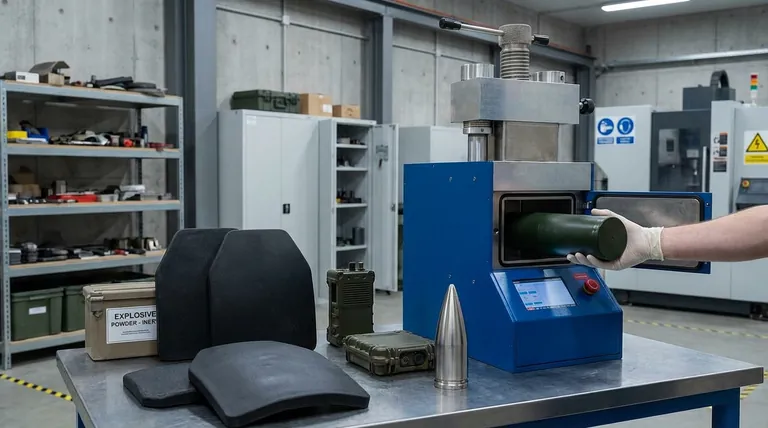
Critical Military Applications
Armor and Ballistic Protection
CIP is extensively used to manufacture durable, lightweight components for military armor. The process is ideal for consolidating advanced ceramic powders, such as silicon carbide and boron nitride, which are key materials in modern ballistic protection.
Because these materials are difficult to shape using traditional methods, CIP is essential for creating high-density ceramic plates that offer superior protection while minimizing weight burden on personnel and vehicles.
Missile and Propulsion Components
The technology plays a vital role in producing components for missiles. These parts must survive high-mechanical stresses and rapid acceleration.
CIP ensures that refractories and graphite components used in propulsion systems maintain structural integrity under high-temperature environments.
Explosives and Munitions
A specialized application of CIP within the defense sector is the consolidation of explosives.
The hydrostatic nature of the process allows for the safe and uniform compression of explosive powders into stable forms required for munitions, ensuring reliable performance and safety during handling.
Electronics and Communications
Military communication devices require robust internal components. CIP is utilized to produce ferrites and electrical insulators used in these systems.
It is also used to create sputtering targets and coatings for engine valve components, ensuring that the electronics and mechanical hardware supporting military operations remain operational in corrosive or high-wear environments.
The Engineering Advantages
Isotropic Uniformity
The "Isostatic" in CIP refers to applying pressure equally from every direction. This creates a "green body" (an unfired part) with uniform density throughout its entire volume.
This uniformity leads to predictable shrinkage during the subsequent sintering or Hot Isostatic Pressing (HIP) phases, significantly reducing the risk of defects or mechanical scatter in the final product.
Complex Geometries
CIP can form parts that are too complex for standard uniaxial die presses.
Because the pressure is applied via a fluid medium rather than rigid tooling, manufacturers can create intricate shapes that require minimal post-processing.
Machinability and Efficiency
Green bodies formed via CIP possess high green strength. This allows manufacturers to easily machine the parts into near-net shapes before the final firing process.
This capability decreases scrap loss and reduces the cost of machining hardened materials later, which is particularly valuable when working with expensive military-grade ceramics.
Understanding the Trade-offs
While CIP provides superior material properties, it is important to recognize its role within the wider manufacturing workflow.
It Is Often a Pre-Processing Step
CIP typically produces a green body that requires further densification. It is often a precursor to sintering or Hot Isostatic Pressing (HIP). It is not always a "one-step" solution for finished parts but rather the foundation for high-integrity manufacturing.
Processing Speed vs. Quality
CIP creates high-quality parts with isotropic properties, but it can be slower than automated uniaxial pressing. It is chosen when performance and complexity outweigh the need for high-speed, low-cost mass production.
Making the Right Choice for Your Project
If you are evaluating manufacturing methods for defense-related components, consider the following:
- If your primary focus is Ballistic Performance: CIP is essential for achieving the uniform density required in high-hardness ceramic armor to prevent shattering under impact.
- If your primary focus is Complex Geometry: CIP allows you to form intricate shapes for internal missile or engine components that standard die pressing cannot achieve.
- If your primary focus is Material Consistency: CIP eliminates density gradients, making it the safest choice for consolidating sensitive materials like explosives or ferrites.
CIP remains the standard for converting advanced powders into mission-critical hardware where failure is not an option.
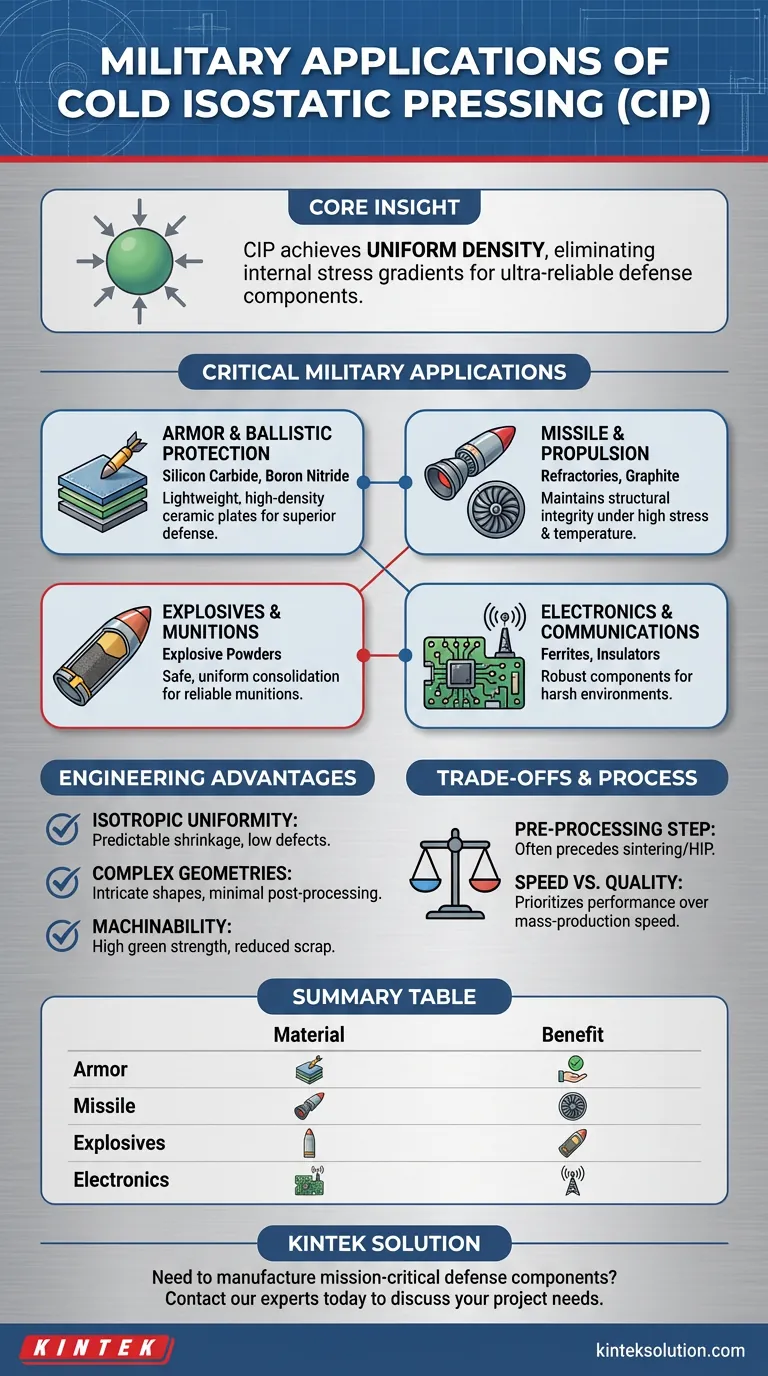
Summary Table:
| Application | Key Material | Key Benefit |
|---|---|---|
| Armor & Ballistic Protection | Silicon Carbide, Boron Nitride | Lightweight, high-density ceramic plates |
| Missile & Propulsion Components | Refractories, Graphite | Structural integrity under high stress |
| Explosives & Munitions | Explosive Powders | Safe, uniform consolidation |
| Electronics & Communications | Ferrites, Insulators | Robust components for harsh environments |
Need to manufacture mission-critical defense components with absolute reliability?
KINTEK specializes in advanced lab press machines, including isostatic presses, designed to meet the rigorous demands of military and laboratory applications. Our technology ensures the uniform density and complex geometries required for high-performance armor, propulsion systems, and sensitive materials.
Let us help you enhance your manufacturing process for superior results. Contact our experts today to discuss your specific project needs.
Visual Guide
Related Products
- Automatic Lab Cold Isostatic Pressing CIP Machine
- Electric Split Lab Cold Isostatic Pressing CIP Machine
- Electric Lab Cold Isostatic Press CIP Machine
- Manual Cold Isostatic Pressing CIP Machine Pellet Press
- Lab Isostatic Pressing Molds for Isostatic Molding
People Also Ask
- What are the key features of automated laboratory Cold Isostatic Press (CIP) systems? Achieve Precise, High-Pressure Powder Consolidation
- Why is an Isostatic Press (CIP) Necessary After Uniaxial Pressing? Achieve Transparency in Nd:Y2O3 Ceramics
- How does a Cold Isostatic Press (CIP) facilitate the preparation of CaO-doped silicon carbide (SiC) green bodies?
- How does a Cold Isostatic Press (CIP) increase Bi-2223/Ag current density? Boost Superconductivity with Uniform Pressure
- What is the primary function of a Cold Isostatic Press (CIP) in NASICON preparation? Achieve 96% Theoretical Density










