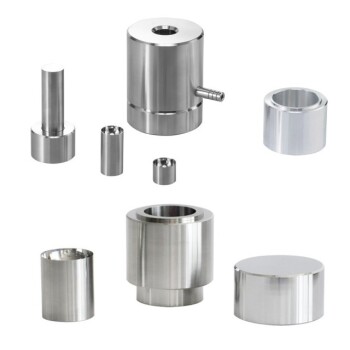
High-purity, high-strength graphite molds serve as the critical interface between extreme processing conditions and the delicate microstructure of Oxide Dispersion-Strengthened (ODS) iron alloys. Specifically, these molds function simultaneously as a containment vessel and a pressure transmission medium, maintaining structural stability at temperatures up to 1373 K. Beyond mere containment, the graphite actively assists in the vacuum degassing process, significantly reducing porosity and ensuring the final alloy achieves high density and uniform strength.
Core Insight: Graphite molds are not passive containers; they are active thermal and chemical participants in the sintering process. Their ability to facilitate degassing while ensuring uniform thermal distribution is the defining factor in transforming loose powder into a defect-free, high-performance solid.
Thermal and Structural Integrity
Stability at Extreme Temperatures
The consolidation of ODS alloys requires aggressive processing environments to achieve preliminary densification. High-strength graphite maintains exceptional dimensional stability even under the extreme conditions of 1373 K and axial pressures of 80 MPa.
Prevention of Deformation
Unlike metallic molds which might soften or warp, graphite retains its mechanical stiffness at high heat. This ensures the geometric accuracy of the pressed briquette is preserved throughout the sintering cycle.
Uniform Heating
Graphite possesses superior thermal conductivity. This property ensures that heat is distributed evenly throughout the specimen, preventing thermal gradients that could lead to uneven sintering or internal stresses in the alloy.
The Role in Defect Reduction
Active Degassing
One of the most distinct advantages of using graphite in a vacuum environment (typically 1 x 10^-5 torr) is its interaction with adsorbed gases. The graphite mold assists in the degassing of oxygen and other volatiles trapped within the powder particles.
Minimizing Porosity
By facilitating the removal of these gases before the pores close, the mold helps eliminate the root cause of porosity defects. This results in a final product with improved material density and superior mechanical integrity.
Operational Advantages
Dual-Functionality
The mold acts as both the vessel for the powder and the medium for pressure transmission. It efficiently transfers the axial force necessary to consolidate the milled composite powder into a bulk material.
Ease of Removal
Graphite is chemically inert and inherently self-lubricating. This ensures that once the sintering process is complete, the pressed briquette can be easily removed from the mold without sticking or damaging the surface finish.
Understanding the Trade-offs
Vacuum Dependency
Graphite is highly susceptible to oxidation at the temperatures used for ODS consolidation (1373 K). It must be used within a vacuum or inert atmosphere; any breach in the vacuum will result in rapid degradation of the mold.
Mechanical Brittleness
While graphite has high compressive strength, it has low tensile strength and is brittle. Molds must be handled with care during loading and unloading to avoid catastrophic fracture caused by impact or misalignment.
Making the Right Choice for Your Goal
To maximize the quality of your ODS iron alloys, align your process parameters with the capabilities of the mold material.
- If your primary focus is Microstructural Homogeneity: rely on the thermal conductivity of the graphite to prevent hot/cold spots that could alter the fine grain structure developed during milling.
- If your primary focus is Maximum Density: leverage the degassing interaction in the vacuum stage to ensure all pore-forming gases are evacuated before applying peak axial pressure.
- If your primary focus is Process Efficiency: utilize the self-lubricating properties of graphite to streamline the ejection phase and reduce cycle times between presses.
By exploiting the thermal and chemical properties of high-purity graphite, you ensure the structural integrity of your ODS alloys starts at the very first stage of consolidation.
Summary Table:
| Feature | Benefit for ODS Iron Alloys |
|---|---|
| High Thermal Conductivity | Ensures uniform heating and prevents internal stresses |
| High-Temperature Stability | Maintains geometric accuracy at 1373 K and 80 MPa |
| Active Degassing | Reduces porosity by facilitating gas removal in vacuum |
| Self-Lubricating Property | Allows easy removal of the pressed briquette without damage |
| Chemical Inertness | Prevents unwanted reactions with the alloy during sintering |
Maximize Your Material Density with KINTEK Pressing Solutions
Achieving the perfect microstructure in ODS alloys requires precision at every stage. KINTEK specializes in comprehensive laboratory pressing solutions, offering a versatile range of equipment including manual, automatic, heated, multifunctional, and glovebox-compatible models, as well as cold and warm isostatic presses widely applied in battery research and advanced metallurgy.
Whether you are refining oxide-dispersion alloys or advancing battery technology, our high-performance systems ensure uniform pressure and temperature control for defect-free results.
Ready to elevate your research? Contact us today to find the perfect press for your lab!
References
- Sung-In Hahn, Seung‐Joon Hwang. Mechanical Properties of ODS Fe Alloys Produced by Mechano-Chemical Cryogenic Milling. DOI: 10.12656/jksht.2012.25.3.138
This article is also based on technical information from Kintek Solution Knowledge Base .
Related Products
- Lab Heat Press Special Mold
- Lab Anti-Cracking Press Mold
- Special Shape Lab Press Mold for Laboratory Applications
- XRF KBR Plastic Ring Lab Powder Pellet Pressing Mold for FTIR
- XRF KBR Steel Ring Lab Powder Pellet Pressing Mold for FTIR
People Also Ask
- How is a laboratory heat press used to evaluate bio-based aliphatic polyesters? Prepare Reliable Samples for Analysis
- How is a laboratory heat press utilized in MEA preparation? Achieve High-Efficiency Iron-Chromium Redox Flow Batteries
- Why is a laboratory heat press necessary for biodegradable films? Unlock Precision Bonding and Barrier Performance
- What is the purpose of incorporating cartridge heaters into a lab press mold for MLCC block compression? Optimize Results
- Why is a laboratory heated press utilized in the preparation of PPC-PCLT copolymer films? Master Uniform Film Production