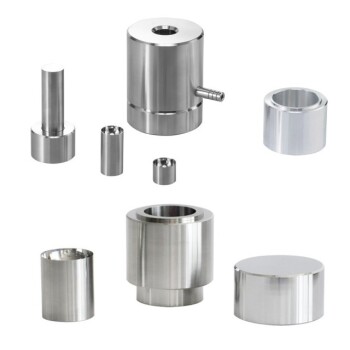
High-strength Polyether Ether Ketone (PEEK) molds serve as the premier solution for pressing all-solid-state organic battery electrodes because they combine extreme mechanical durability with essential insulating properties. Specifically, these molds withstand pressing forces of up to 300 MPa without deformation while simultaneously enabling direct, in-situ electrochemical testing of the battery cell.
Core Takeaway PEEK molds solve the dual challenge of fabrication and analysis in solid-state battery research. By acting as both a high-pressure forming container and an electrically insulating test chassis, they eliminate the need to transfer fragile pellets, thereby preserving interface integrity and ensuring data accuracy.
Mechanical Resilience Under Load
Withstanding Extreme Pressure
The fabrication of solid-state electrolytes requires immense force to ensure proper density. High-strength PEEK molds are engineered to withstand pressures reaching several hundred megapascals (up to 300 MPa). This allows researchers to apply the necessary tonnage to compact powder materials effectively.
Resisting Deformation
Unlike standard plastics that warp under stress, high-strength PEEK maintains its shape and dimensional stability during the pressing process. It can endure repeated high-pressure cycles without suffering from plastic deformation. This ensures that the resulting electrode pellets and electrolyte separators maintain consistent thickness and structural integrity.
Ensuring Data Integrity
Superior Electrical Insulation
One of the most critical features of PEEK is its status as an excellent electrical insulator. When conducting electrochemical tests, the mold isolates the test system from the external environment. This guarantees that the measured signals originate solely from the internal processes of the battery, preventing external short circuits that could invalidate experimental data.
Chemical Inertness
All-solid-state batteries often utilize reactive materials, such as sulfide solid electrolytes or organic components like Indigo dyes. PEEK is chemically inert, meaning it does not react with these sensitive materials. This stability preserves the chemical composition of the sample and ensures that no foreign byproducts skew the results.
Prevention of Contamination
Using PEEK eliminates the risk of metal contamination that is common with metallic molds. The material's surface smoothness and stability prevent impurities from entering the electrode or electrolyte layers. This is vital for maintaining the high purity required for accurate electrochemical performance testing.
Operational Efficiency and In-Situ Testing
The "Press-and-Test" Capability
PEEK molds function as both a forming tool and a testing platform. Because the material is insulating and chemically stable, researchers can perform in-situ electrochemical cycling directly within the mold immediately after pressing.
Eliminating Sample Transfer
Transferring a pressed solid-state pellet from a mold to a separate test cell is a high-risk procedure that often damages the delicate contact interfaces between layers. By testing directly inside the PEEK mold, you avoid this risk entirely. This ensures that the impedance analysis and cycling tests reflect the true performance of the battery without artifacts caused by handling damage.
Understanding the Trade-offs
While PEEK is the superior choice for electrochemical compatibility, it is important to recognize its limitations compared to other materials mentioned in engineering contexts.
PEEK vs. Hardened Steel or Ceramic
Hardened steel and ceramic molds offer higher ultimate stiffness and surface hardness than any polymer, including PEEK. If your specific protocol requires pressures significantly exceeding 300 MPa, or if absolute rigidity with zero lateral compliance is the only priority, PEEK may approach its mechanical limits. However, using steel or conductive ceramic forfeits the ability to perform in-situ electrical testing, forcing a risky sample transfer.
Making the Right Choice for Your Goal
To maximize the success of your all-solid-state battery experiments, align your mold selection with your specific testing phase:
- If your primary focus is Data Accuracy: Choose PEEK to prevent chemical reactions with sulfide electrolytes and eliminate electrical noise during testing.
- If your primary focus is Workflow Efficiency: Choose PEEK to enable in-situ testing, allowing you to press and cycle the battery in the same vessel without moving the sample.
- If your primary focus is Extreme Compaction: Verify that your required pressure does not exceed the 300 MPa threshold of standard high-strength PEEK to avoid mold deformation.
By utilizing PEEK molds, you effectively turn your fabrication tooling into a precision analytical instrument, streamlining your research while protecting your samples.
Summary Table:
| Feature | PEEK Mold Benefit | Impact on Research |
|---|---|---|
| Pressure Limit | Up to 300 MPa | Enables high-density compaction of powders |
| Electrical Prop. | High Insulation | Permits direct in-situ electrochemical testing |
| Chemical Stability | Inert to Sulfides/Organics | Prevents sample contamination and reactions |
| Structural Integrity | Resists Deformation | Ensures consistent pellet thickness and shape |
| Workflow | Press-and-Test Design | Eliminates damage risk during sample transfer |
Elevate Your Battery Research with KINTEK
Maximize your data accuracy and operational efficiency with KINTEK’s specialized laboratory pressing solutions. As experts in the field, we provide high-performance PEEK molds and comprehensive pressing systems—including manual, automatic, heated, and isostatic models—perfectly suited for battery electrode fabrication.
Don't compromise your results with risky sample transfers or electrical interference. Contact KINTEK today to find the ideal mold or press for your specific research needs and ensure the integrity of every pellet you produce.
References
- Qihang Yu, Xia Li. An active bifunctional natural dye for stable all-solid-state organic batteries. DOI: 10.1038/s41467-025-62301-z
This article is also based on technical information from Kintek Solution Knowledge Base .
Related Products
- Carbide Lab Press Mold for Laboratory Sample Preparation
- Lab Infrared Press Mold for Laboratory Applications
- Warm Isostatic Press for Solid State Battery Research Warm Isostatic Press
- Lab Cylindrical Press Mold for Laboratory Use
- Lab Isostatic Pressing Molds for Isostatic Molding
People Also Ask
- What is the purpose of incorporating cartridge heaters into a lab press mold for MLCC block compression? Optimize Results
- What is the function of a pressing tool in thermoplastic panels? Master Precision Shaping & Fusion Bonding
- Why is precise cooling management of the lab press mold necessary? Protect Core Integrity in Thermoforming
- How does the geometry of laboratory molds influence mycelium-based composites? Optimize Density and Strength
- What is the significance of standardized molds in lab presses? Ensure Precise Seal Material Evaluation