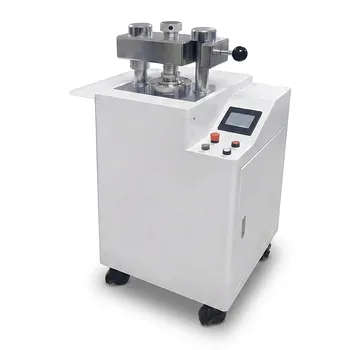
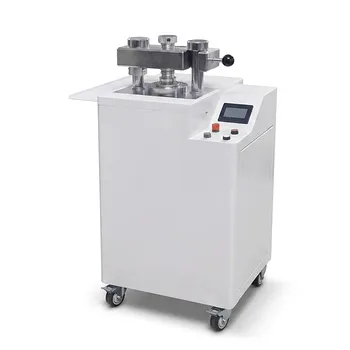
The KBr pellet method is a classic, highly sensitive technique for the Fourier Transform Infrared (FTIR) analysis of solid samples. It involves mixing a small amount of the sample with potassium bromide (KBr) powder and compressing the mixture into a thin, transparent disc. This allows infrared light to pass directly through the matrix, providing high-quality spectral data with minimal interference.
The KBr pellet remains a critical tool in spectroscopy because it offers distinct advantages over modern techniques like ATR, particularly regarding sensitivity and the detection of trace components.
The Optical Advantage
Transparency to Infrared Radiation
The defining characteristic of KBr is its optical transparency. Potassium bromide does not absorb infrared radiation in the standard analysis range.
This ensures that the resulting spectrum represents the sample alone, without background noise or interference from the matrix material.
High Sensitivity for Trace Analysis
Because this is a transmission technique (light passes through the sample rather than reflecting off it), it interacts with the entire path length of the pellet.
This allows for the detection of trace amounts of material. The distribution of the sample within the pellet maximizes the signal-to-noise ratio.
Physical Specifications for Success
The Importance of Geometry
A properly formed pellet is a cylindrical disc with flat ends and uniform thickness.
This geometry is ideal for quantitative analysis. It ensures that the path length of the infrared light is consistent, leading to reproducible results across different measurements.
Visual Clarity and Thickness
The physical appearance of the pellet is a quality control indicator. The final disc should be approximately 2 mm thick and appear clear or transparent.
If the pellet is opaque or cloudy, it typically indicates that the sample concentration is too high or the pressing process was insufficient.
Critical Preparation Characteristics
The Dilution Ratio
Success relies on a specific mixture ratio. You must mix approximately 1 part sample to 100 parts KBr.
This dilution ensures the sample falls within the detection range of the instrument. Too much sample results in total absorption (opaque peaks), while too little yields a weak signal.
The Role of Dryness
Moisture is the primary enemy of KBr analysis. Potassium bromide is hygroscopic and will absorb water from the air, which introduces unwanted peaks in the spectrum.
To prevent this, you must use dry KBr powder and heat the anvils and die set before pressing. All components must be at the same temperature to avoid condensation.
Compressive Force
Creating the pellet requires a hydraulic press capable of applying significant force.
A load of 10 tonnes applied through a 13 mm diameter die is the standard standard requirement. This pressure fuses the powder into a solid, glass-like lattice.
Understanding the Trade-offs
Sensitivity to Moisture
While KBr is optically excellent, its chemical nature poses a challenge. Because it absorbs atmospheric water easily, your spectrum may show water bands even if your sample is dry.
You must work quickly and store pellets in a desiccator to maintain data integrity.
Preparation Intensity
Compared to modern methods like Attenuated Total Reflectance (ATR), KBr pellet preparation is labor-intensive.
It requires precise weighing, grinding, and hydraulic pressing. It is not a "drop-and-measure" technique; it requires skill to produce a clear, usable pellet.
Making the Right Choice for Your Goal
While ATR is dominant for routine work, KBr pellets offer specific benefits that modern shortcuts cannot match.
- If your primary focus is high sensitivity or trace analysis: Choose KBr pellets, as the transmission mode maximizes the signal from small sample quantities.
- If your primary focus is quantitative comparison: Choose KBr pellets, as the uniform path length and geometry allow for highly reproducible measurements.
- If your primary focus is analyzing inorganic compounds or polymers: Choose KBr pellets for their versatility across a wide range of solid material types.
Mastering the KBr pellet technique ensures you can extract accurate spectral data even when modern reflection techniques fall short.
Summary Table:
| Characteristic | Specification/Value | Benefit to Analysis |
|---|---|---|
| Transparency | IR Transparent (KBr) | Zero background interference from the matrix |
| Sample Ratio | 1:100 (Sample to KBr) | Prevents total absorption for clear peaks |
| Pellet Thickness | ~2 mm | Ideal path length for quantitative accuracy |
| Pressing Force | 10 Tonnes | Creates a solid, glass-like lattice for transmission |
| Moisture Control | Hygroscopic nature | Requires dry KBr and heated dies to avoid water bands |
Elevate Your FTIR Accuracy with KBr Pressing Excellence
Are you struggling with signal-to-noise ratios or seeking precise trace analysis? KINTEK specializes in comprehensive laboratory pressing solutions designed for spectroscopy.
Our range of manual, automatic, and heated hydraulic presses ensures you achieve the perfectly uniform, moisture-free 2 mm pellets required for high-fidelity FTIR data. Whether you are conducting battery research or polymer analysis, our tools—including glovebox-compatible and isostatic models—provide the stability and force necessary for consistent results.
Ready to optimize your sample preparation? Contact us today to find the perfect press for your lab's needs!
Related Products
- XRF KBR Plastic Ring Lab Powder Pellet Pressing Mold for FTIR
- XRF KBR Steel Ring Lab Powder Pellet Pressing Mold for FTIR
- Laboratory Hydraulic Press 2T Lab Pellet Press for KBR FTIR
- Laboratory Hydraulic Pellet Press for XRF KBR FTIR Lab Press
- Automatic Laboratory Hydraulic Press for XRF and KBR Pellet Pressing
People Also Ask
- What is the purpose of making KBr pellets for FTIR? Achieve Precise Molecular Analysis with Solid Samples
- What factors should be considered when choosing a lab press for XRF pellet preparation? Ensure Accurate and Consistent Results
- Why are pellets used in XRF analysis, and what is their limitation? Boost Accuracy and Speed in Your Lab
- How are pellets prepared for XRF analysis and what is a potential drawback? Master XRF Sample Prep and Accuracy
- What should be included in a checklist for making XRF pellets? Ensure Accurate and Repeatable XRF Analysis