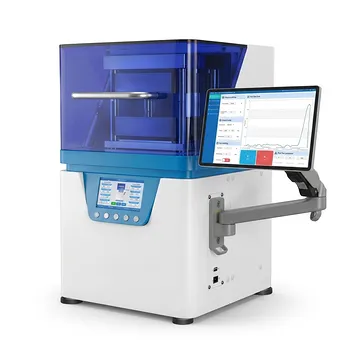
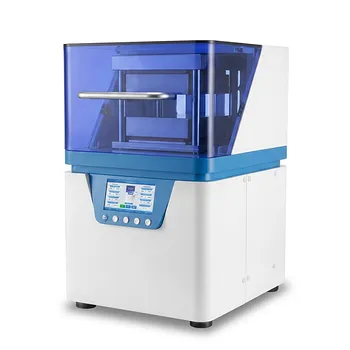
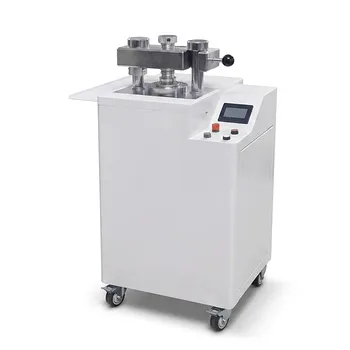
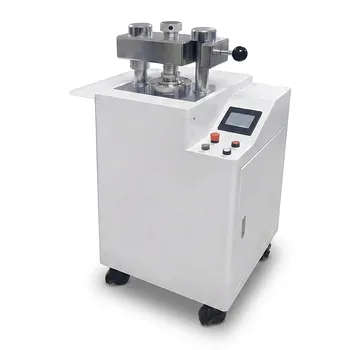
Specialized high-throughput hydraulic presses streamline XRF workflows by combining rapid cycle times with integrated pellet dies to accelerate sample preparation. These systems allow high-volume laboratories to produce uniform, analytical-grade pellets quickly, ensuring the equipment is immediately ready for the next sample without sacrificing the physical consistency required for accurate analysis.
The core value of these presses lies in their ability to resolve the conflict between speed and precision. By integrating the die assembly and automating the pressure cycle, they eliminate manual bottlenecks while ensuring the uniform density necessary to minimize X-ray scattering errors.
Enhancing Laboratory Workflow and Efficiency
Integrated Die Systems
Standard presses often require the manual assembly and disassembly of molds for every single sample. High-throughput presses feature integrated pellet dies.
This engineering choice allows for the automatic ejection and quick extraction of the finished pellet. It removes the time-consuming step of handling separate die components between cycles.
Rapid Operational Cycles
Efficiency in a high-volume lab is measured by the "ready-to-read" time. These presses are designed for rapid operational cycles.
Once a sample is extracted, the system is immediately ready for the next powder mixture. This minimizes downtime and maximizes the number of samples that can be processed per hour.
Ensuring Analytical Precision and Accuracy
While speed is the operational benefit, the scientific benefit is the production of a sample that yields reliable data.
Achieving Uniform Density
High-stability hydraulic control compresses powder into a state of uniform density.
This eliminates voids and porosity within the sample. A consistent internal structure is critical because it ensures that the X-ray penetration and fluorescence are uniform across the entire sample volume.
Creating an Ideal Surface
XRF analysis relies heavily on the geometry of the sample. These presses apply high pressure (often up to several tons) to create a perfectly flat, smooth surface.
Surface irregularities can cause scattering errors and alter the distance between the sample and the detector. A flat pellet minimizes these variables, leading to higher repeatability.
Reducing Matrix and Particle Effects
By compressing ground powders—such as basalt, soil, or silicate minerals—into a dense solid, the press reduces particle size effects.
This homogenization ensures a linear relationship between signal intensity and elemental concentration. This is fundamental for obtaining accurate quantitative results for specific elements, such as iron or potassium oxide.
Understanding the Trade-offs
The Necessity of Binders
While the press applies the force, the chemistry must still be correct. Many samples, such as soils, require a wax-based binding agent to form a stable pellet.
A high-throughput press cannot compensate for a poor mixture. If the binder ratio is incorrect, the pellet may crumble upon rapid extraction, negating the speed advantage.
Maintenance of Integrated Parts
The efficiency of an integrated die system comes with increased mechanical complexity.
Unlike simple manual dies that can be easily replaced, integrated systems require careful maintenance to ensure the surfaces remain unblemished. A damaged die surface in a high-throughput machine can compromise the surface quality of every subsequent pellet.
Making the Right Choice for Your Goal
- If your primary focus is Volume and Throughput: Prioritize a press with integrated pellet dies and automated ejection to remove the manual bottleneck of mold assembly.
- If your primary focus is Quantitative Precision: Ensure the press offers high-stability hydraulic control to guarantee uniform density, which is the key to reducing scattering errors and matrix effects.
Ultimately, a specialized hydraulic press transforms sample preparation from a manual variable into a constant, reproducible standard.
Summary Table:
| Feature | High-Throughput Press Benefit | Impact on XRF Analysis |
|---|---|---|
| Integrated Die System | Eliminates manual mold assembly | Increases sample processing speed |
| Rapid Cycle Times | Immediate readiness for next sample | Maximizes hourly laboratory output |
| Hydraulic Stability | Achieves uniform pellet density | Minimizes X-ray scattering errors |
| Surface Quality | Creates perfectly flat/smooth faces | Ensures consistent detector distance |
| Automation | Reduces manual handling variables | Enhances data repeatability |
Elevate Your XRF Workflow with KINTEK
Is your laboratory struggling with sample preparation bottlenecks? KINTEK specializes in comprehensive laboratory pressing solutions designed to turn manual variables into reproducible standards.
Whether you require manual, automatic, heated, or multifunctional models, our equipment—including specialized cold and warm isostatic presses—is engineered for the rigorous demands of battery research and elemental analysis.
Our Value to You:
- Precision: Achieve the uniform density and smooth surfaces required for analytical accuracy.
- Efficiency: Streamline high-volume workflows with integrated die systems.
- Versatility: Solutions tailored for glovebox-compatible and specialized research environments.
Contact KINTEK Today to Find Your Perfect Pressing Solution
Related Products
- Automatic High Temperature Heated Hydraulic Press Machine with Heated Plates for Lab
- Automatic Hydraulic Hot Press with Large Plate and Precision Temperature Control for Advanced Material Sample Preparation and Industrial Research
- Laboratory Hydraulic Press 2T Lab Pellet Press for KBR FTIR
- Automatic Large Format Laboratory Heated Hydraulic Press 400x400mm Plate Capacity
- Laboratory Hydraulic Press Lab Pellet Press Machine for Glove Box
People Also Ask
- Function of a Laboratory Hydraulic Press with Heated Platens in SSE? Enhance Battery Density & Conductivity
- What are the requirements for electrode pressing with high-viscosity ionic liquids like EMIM TFSI? Optimize Performance
- How does a laboratory heated hydraulic press facilitate PBN sample prep for WAXS? Achieve Precise X-Ray Scattering
- What are the industrial applications of heated hydraulic presses? Master Heat & Force for Precision Manufacturing
- Why is a laboratory hydraulic press with heating plates required for PLA/TEC films? Achieve Precise Sample Integrity