
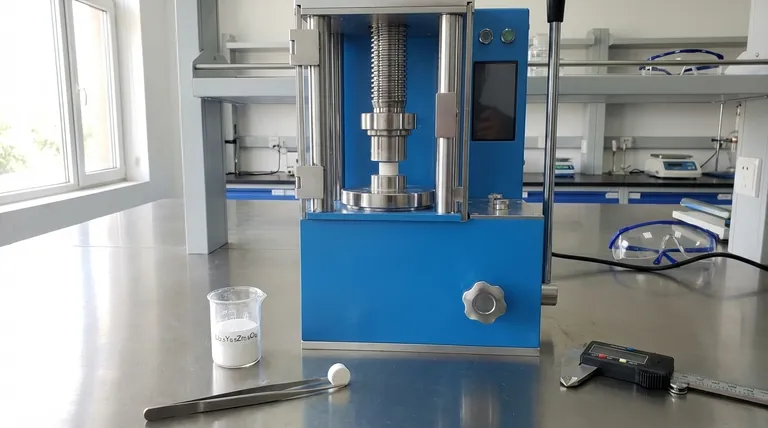
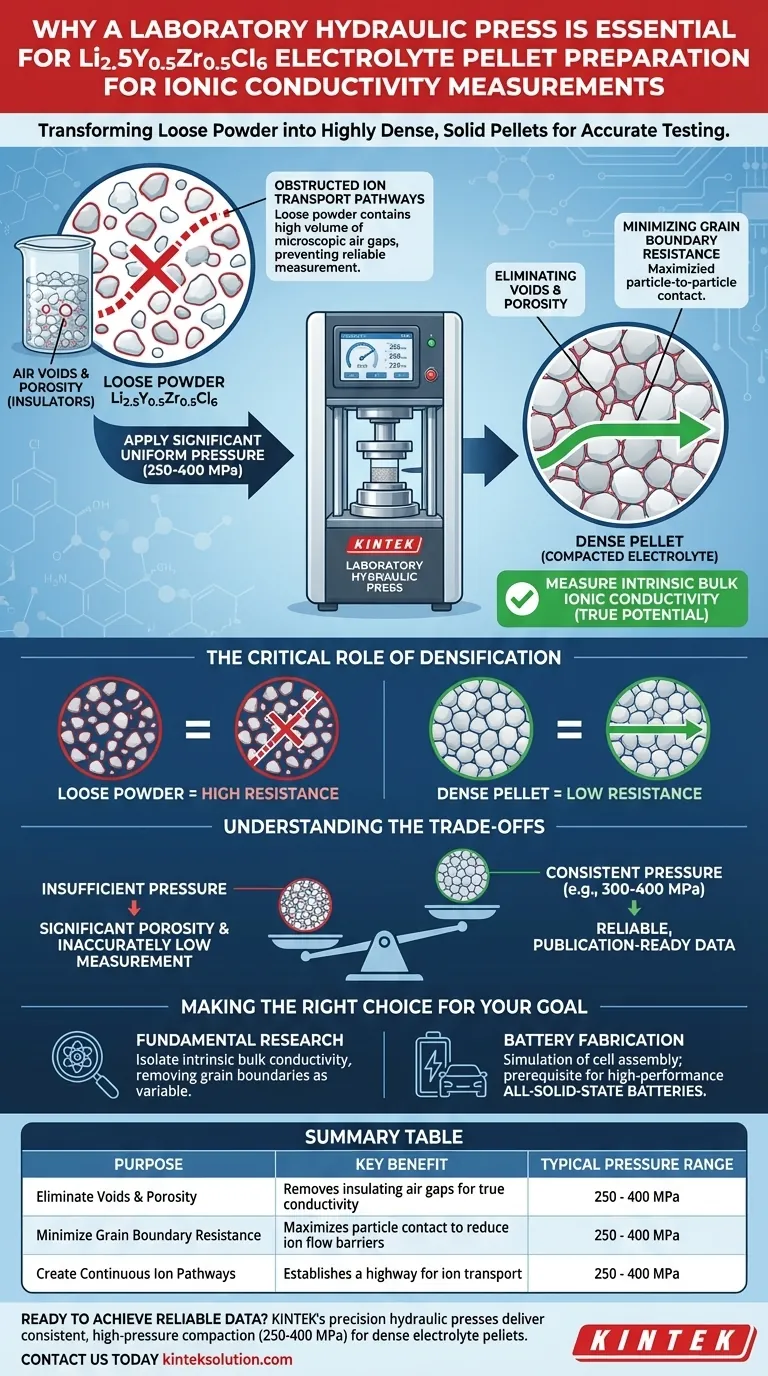
The primary purpose of using a laboratory hydraulic press is to transform loose Li2.5Y0.5Zr0.5Cl6 powder into a highly dense, solid pellet by applying significant uniform pressure, often ranging from 250 to 400 MPa. This mechanical densification is a prerequisite for accurate testing because it eliminates the air gaps and voids that otherwise act as insulators, preventing reliable measurement of the material's conductive properties.
By compacting the electrolyte powder, the hydraulic press minimizes interfacial resistance and ensures intimate particle-to-particle contact. This allows researchers to measure the material's intrinsic bulk ionic conductivity, ensuring the data reflects the material's true potential rather than the artifacts of a loosely packed sample.
The Critical Role of Densification
To understand why the press is necessary, one must look beyond the machine itself and look at the physics of ion transport within solid electrolytes. Accurate data depends entirely on the physical microstructure of the sample being tested.
Eliminating Voids and Porosity
Loose electrolyte powder naturally contains a high volume of microscopic air gaps, known as voids or porosity. These voids effectively break the circuit on a microscopic level.
Porosity severely obstructs ion transport pathways, leading to artificially low conductivity measurements. The hydraulic press applies massive uniaxial force to physically collapse these voids, forcing the powder particles to pack tightly together.
Minimizing Grain Boundary Resistance
In a loose powder, individual grains have very limited contact points. This creates high "grain boundary resistance"—an energy barrier that impedes the flow of ions from one particle to the next.
The press forces the material into intimate physical contact. By maximizing the contact area between grains, the interfacial resistance is drastically reduced, ensuring the measurement current encounters minimal obstruction at the particle boundaries.
Creating Continuous Transport Pathways
For a Lithium-ion electrolyte like Li2.5Y0.5Zr0.5Cl6 to function, ions must have a continuous "highway" to travel through.
High-pressure compaction creates these effective and continuous pathways. Without this step, the electrical impedance spectroscopy (EIS) results would be dominated by the noise of the gaps between particles, rather than the signal of the ions moving through the crystal structure.
Understanding the Trade-offs
While the hydraulic press is essential, the process relies on the correct application of force to generate reliable data.
The Risk of Insufficient Pressure
If the applied pressure is too low, the pellet will retain significant porosity. This leads to inaccurately low measurement results because the ions are forced to navigate around voids rather than moving directly through the bulk material.
Consistency is Key
References suggest specific pressure targets (e.g., 300 MPa or 400 MPa) to achieve the necessary density. Deviating from these set points can result in inconsistent data, making it difficult to compare results across different batches or different electrolyte materials.
Making the Right Choice for Your Goal
Using a laboratory hydraulic press is not just a preparatory step; it is a quality control measure that defines the validity of your electrochemical data.
- If your primary focus is Fundamental Research: Use high, consistent pressure to isolate the material's intrinsic bulk conductivity, removing grain boundaries as a variable.
- If your primary focus is Battery Fabrication: View the pressing stage as a simulation of cell assembly, as high density is a vital prerequisite for constructing high-performance all-solid-state batteries.
The hydraulic press effectively bridges the gap between a theoretical powder and a functional electrolyte by physically establishing the continuous structure necessary for ion flow.
Summary Table:
| Purpose | Key Benefit | Typical Pressure Range |
|---|---|---|
| Eliminate Voids & Porosity | Removes insulating air gaps for true conductivity measurement | 250 - 400 MPa |
| Minimize Grain Boundary Resistance | Maximizes particle contact to reduce ion flow barriers | 250 - 400 MPa |
| Create Continuous Ion Pathways | Establishes a highway for ion transport through the material | 250 - 400 MPa |
Ready to achieve reliable and publication-ready data for your solid-state battery research?
KINTEK's precision laboratory hydraulic presses (including automatic, isostatic, and heated models) are engineered to deliver the consistent, high-pressure compaction (250-400 MPa) essential for preparing dense Li2.5Y0.5Zr0.5Cl6 and other solid electrolyte pellets. By eliminating porosity and minimizing grain boundary resistance, our presses help you accurately measure the intrinsic bulk ionic conductivity that is critical for developing high-performance all-solid-state batteries.
Contact us today via our [#ContactForm] to discuss how our lab press solutions can enhance the validity and impact of your electrochemical research.
Visual Guide
References
- Han Xu, Jianwen Liang. Mechanically robust halide electrolytes for high-performance all-solid-state batteries. DOI: 10.1038/s41467-025-64726-y
This article is also based on technical information from Kintek Solution Knowledge Base .
Related Products
- Laboratory Hydraulic Split Electric Lab Pellet Press
- Automatic Laboratory Hydraulic Press for XRF and KBR Pellet Pressing
- Laboratory Hydraulic Pellet Press for XRF KBR FTIR Lab Press
- Laboratory Hydraulic Press 2T Lab Pellet Press for KBR FTIR
- Automatic Laboratory Hydraulic Press Lab Pellet Press Machine
People Also Ask
- What are the emerging trends in the design and materials of lab pellet presses? Modernize Your Lab Efficiency
- What are common lab pellet press issues? Expert Troubleshooting Guide for Reliable Material Research
- How do lab pellet presses support customization and flexibility? Optimize Your Sample Prep for Any Material
- What are the common operational types of lab pellet presses? Choosing the Right Manual, Automatic, or Hydraulic System
- Why use a laboratory pellet press for solid-state battery evaluation? Ensure Accuracy in Interface Stability Testing



















