
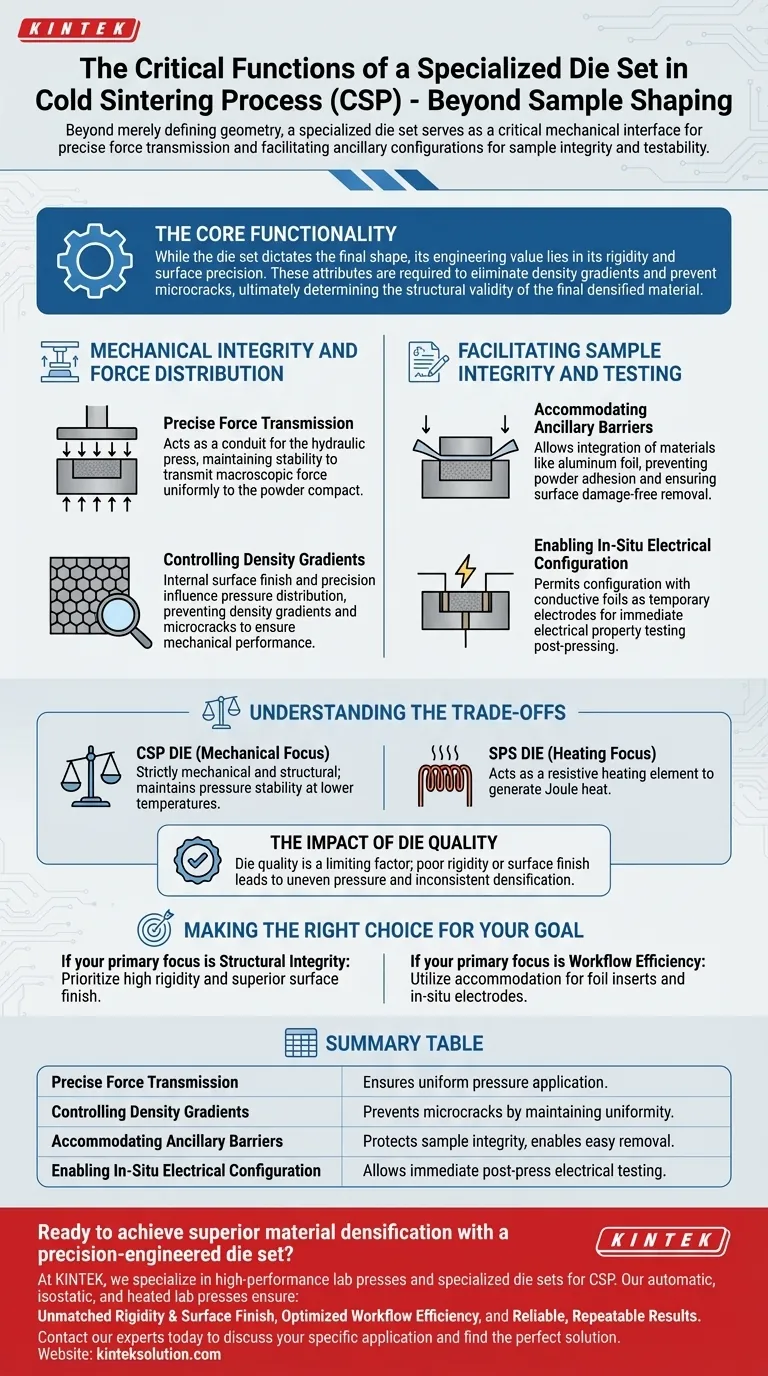
Beyond merely defining geometry, a specialized die set in the Cold Sintering Process (CSP) serves as a critical mechanical interface. Its primary functions beyond shaping are the precise transmission of macroscopic force from the hydraulic press and the facilitation of ancillary configurations that ensure sample integrity and testability.
The Core Functionality While the die set dictates the final shape, its engineering value lies in its rigidity and surface precision. These attributes are required to eliminate density gradients and prevent microcracks, ultimately determining the structural validity of the final densified material.
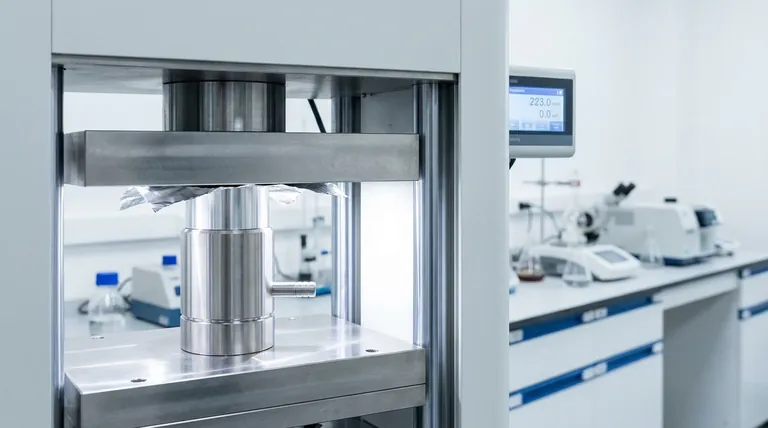
Mechanical Integrity and Force Distribution
Precise Force Transmission
The most fundamental role of the die set is to act as a conduit for the hydraulic press. It must be robust enough to withstand high loads without deformation.
By maintaining mechanical stability, the die ensures that the macroscopic force applied by the press is transmitted uniformly to the powder compact.
Controlling Density Gradients
The internal surface finish and precision of the die directly influence how pressure is distributed across the sample.
High-precision components prevent the formation of density gradients. This uniformity is essential for avoiding microcracks, which compromise the mechanical performance of the final device.
Facilitating Sample Integrity and Testing
Accommodating Ancillary Barriers
The die set design allows for the integration of ancillary materials, such as aluminum foil, between the sample and the plungers.
This setup prevents the powder from adhering to the press components. By acting as a non-stick barrier, the die set ensures the sample can be removed without surface damage.
Enabling In-Situ Electrical Configuration
Beyond protection, the die set permits the configuration of the sample for subsequent analysis during the pressing stage.
When conductive foils are used within the die, they serve as temporary electrodes. This allows the final pressed sample to be immediately tested for electrical properties, ensuring both integrity and functional verifiability.
Understanding the Trade-offs
Mechanical Robustness vs. Active Heating
It is critical to distinguish the function of a CSP die from those used in techniques like Spark Plasma Sintering (SPS).
In SPS, the die (often graphite) acts as a resistive heating element. In Cold Sintering, the die's function is strictly mechanical and structural; it is not designed to generate Joule heat through electrical current, but rather to maintain pressure stability at lower temperatures.
The Impact of Die Quality
The quality of the die set is a limiting factor in the process.
If the die lacks rigidity or has a poor surface finish, pressure transmission becomes uneven. This leads to inconsistent densification, rendering the sample useless regardless of the chemical composition of the powder.
Making the Right Choice for Your Goal
To maximize the effectiveness of your Cold Sintering Process, consider how the die set supports your specific objectives:
- If your primary focus is Structural Integrity: Prioritize a die set with high rigidity and superior surface finish to prevent microcracking and ensure uniform density.
- If your primary focus is Workflow Efficiency: Utilize the die's ability to accommodate foil inserts to prevent sticking and integrate electrodes for immediate post-press testing.
The die set is not just a container; it is the primary tool for translating applied force into material performance.
Summary Table:
| Function | Key Benefit |
|---|---|
| Precise Force Transmission | Ensures uniform pressure application for consistent densification. |
| Controlling Density Gradients | Prevents microcracks by maintaining sample uniformity. |
| Accommodating Ancillary Barriers | Protects sample integrity and enables easy removal. |
| Enabling In-Situ Electrical Configuration | Allows for immediate post-press electrical property testing. |
Ready to achieve superior material densification with a precision-engineered die set?
At KINTEK, we specialize in manufacturing high-performance lab press machines and specialized die sets designed for the exacting demands of the Cold Sintering Process. Our automatic lab presses, isostatic presses, and heated lab presses are engineered to work seamlessly with our dies, ensuring:
- Unmatched Rigidity & Surface Finish: For perfect force transmission and elimination of density gradients.
- Optimized Workflow Efficiency: Designs that accommodate foil barriers and in-situ electrode configurations.
- Reliable, Repeatable Results: High-quality components that are the foundation of valid experimental data.
Let us help you enhance your lab's capabilities. Contact our experts today to discuss your specific application and find the perfect press and die set solution for your laboratory needs.
Visual Guide
Related Products
- Lab Cylindrical Press Mold with Scale
- Assemble Lab Cylindrical Press Mold for Laboratory Use
- Lab Ring Press Mold for Sample Preparation
- Laboratory Hydraulic Split Electric Lab Pellet Press
- Automatic Lab Cold Isostatic Pressing CIP Machine
People Also Ask
- What is the purpose of incorporating cartridge heaters into a lab press mold for MLCC block compression? Optimize Results
- What is the function of a pressing tool in thermoplastic panels? Master Precision Shaping & Fusion Bonding
- Why is precise cooling management of the lab press mold necessary? Protect Core Integrity in Thermoforming
- Why is a standardized cylindrical mold necessary when testing electrode materials? Ensure Data Precision & Consistency
- What is the technical significance of specific cylindrical molds in aluminum foaming? Achieve Near-Net-Shape Precision










