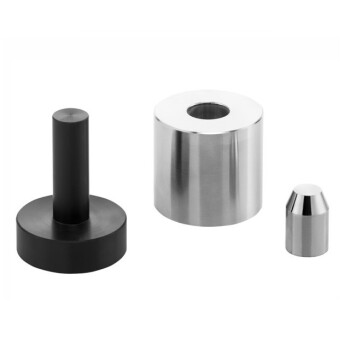
In specialized battery testing, the integrity of your data relies heavily on the mechanical properties of the cell assembly. Grade 5 titanium pillars are utilized to provide high-strength pressure transmission and ensure electrochemical stability, while PEEK (polyetheretherketone) mold sleeves serve as robust electrical insulators capable of withstanding high stack pressures.
The combination of Grade 5 titanium and PEEK creates a stable mechanical environment that maintains constant physical contact pressure during battery cycling. This assembly eliminates mechanical variables, enabling the objective evaluation of a material's electrochemical performance under specific pressure conditions.
The Role of Grade 5 Titanium Pillars
High-Strength Pressure Transmission
The primary mechanical function of the Grade 5 titanium pillars is to act as a conduit for force. They are engineered to transmit high pressure directly to the active materials within the cell.
Because of their high tensile strength, these pillars do not deform under the intense loads required for specialized testing. This ensures that the applied pressure remains consistent throughout the experiment.
Electrochemical Stability
Beyond mechanical strength, the material interacting with the battery chemistry must be inert. Grade 5 titanium provides excellent electrochemical stability.
This prevents unwanted chemical reactions between the current collector and the battery materials. Such stability is vital for ensuring that the data collected reflects the battery's performance, not side reactions with the test cell hardware.
The Function of PEEK Mold Sleeves
Critical Electrical Insulation
The PEEK mold sleeve serves as the primary barrier preventing electrical shorts. It provides essential electrical insulation between the positive and negative terminals of the cell assembly.
Without this isolation, the conductive components would bypass the battery material, rendering the test results invalid.
Withstanding High Stack Pressures
Standard insulating materials often crack or deform under heavy physical loads. PEEK sleeves are specifically selected for their ability to withstand high stack pressures without compromising their structural integrity.
This durability ensures the sleeve maintains its shape and insulating properties even when the cell is compressed to simulate extreme operating conditions.
The Combined Impact on Data Integrity
Maintaining Constant Contact
The synergy between the rigid titanium and the durable PEEK allows the assembly to maintain constant physical contact pressure during cycle testing.
Battery materials often expand and contract during charging and discharging. This specialized assembly accommodates these changes without losing the mechanical pressure required for optimal operation.
Enabling Objective Evaluation
The ultimate goal of using these specific materials is to remove mechanical instability as a variable. By stabilizing the pressure and preventing chemical interference, researchers can perform an objective evaluation of the material.
This allows for a clear understanding of how the electrochemical performance changes strictly as a function of the applied pressure conditions.
Operational Considerations and Trade-offs
The Risk of Material Substitution
A common pitfall in pellet cell testing is substituting these specialized materials with lower-grade alternatives. If the pillars lack the strength of Grade 5 titanium, pressure transmission becomes inconsistent.
Similarly, if the sleeve cannot withstand the stack pressure, it may fail mechanically, leading to electrical shorts or pressure loss.
Dependence on Precise Assembly
The effectiveness of these components relies entirely on maintaining the specified pressure. The assembly is designed for constant contact; if the stack pressure is not calibrated correctly, the benefits of the PEEK and Titanium components are negated.
Users must ensure the test setup allows these components to function within their mechanical limits to achieve valid data.
Making the Right Choice for Your Testing Goals
When configuring your specialized pellet cells, your material choice dictates the reliability of your results.
- If your primary focus is mechanical consistency: Ensure you utilize Grade 5 titanium pillars to guarantee high-strength pressure transmission without deformation.
- If your primary focus is safety and isolation: rely on high-strength PEEK sleeves to provide robust electrical insulation that survives high-pressure environments.
Reliable electrochemical data is impossible without a test assembly that guarantees both chemical stability and constant mechanical pressure.
Summary Table:
| Component | Material | Key Function | Primary Benefit |
|---|---|---|---|
| Pillar | Grade 5 Titanium | High-strength pressure transmission | Constant physical contact without deformation |
| Sleeve | PEEK (Polyetheretherketone) | Electrical insulation | Prevents shorts under high stack pressures |
| Assembly | Combined System | Mechanical & chemical stability | Objective electrochemical data collection |
Maximize Your Battery Research Precision with KINTEK
Don't let mechanical instability compromise your data. KINTEK specializes in comprehensive laboratory pressing solutions, offering a range of manual, automatic, heated, and multifunctional models, as well as cold and warm isostatic presses.
Whether you are conducting battery material research or specialized pellet testing, our Grade 5 titanium and PEEK-compatible systems ensure constant contact pressure and superior chemical stability for your most demanding applications.
Ready to upgrade your lab's performance? Contact us today to find the perfect solution for your research!
References
- Jaehee Park, Ying Shirley Meng. Realizing Low‐Pressure Operation of All‐Solid‐State Lithium–Sulfur Batteries Enabled by Carbon‐Coated Current Collectors. DOI: 10.1002/aenm.202504272
This article is also based on technical information from Kintek Solution Knowledge Base .
Related Products
- Lab Cylindrical Press Mold for Laboratory Use
- Laboratory Hydraulic Press Lab Pellet Press Button Battery Press
- Lab Button Battery Tablet Press Sealing Mold
- Lab Button Battery Disassembly and Sealing Mold
- Manual Button Battery Sealing Machine for Battery Sealing
People Also Ask
- What is the purpose of incorporating cartridge heaters into a lab press mold for MLCC block compression? Optimize Results
- Why is precise cooling management of the lab press mold necessary? Protect Core Integrity in Thermoforming
- What is the function of a pressing tool in thermoplastic panels? Master Precision Shaping & Fusion Bonding
- Why is a high-performance laboratory molding press critical for in-situ electrolyte formation? Unlock Battery Success
- How does the geometry of laboratory molds influence mycelium-based composites? Optimize Density and Strength