
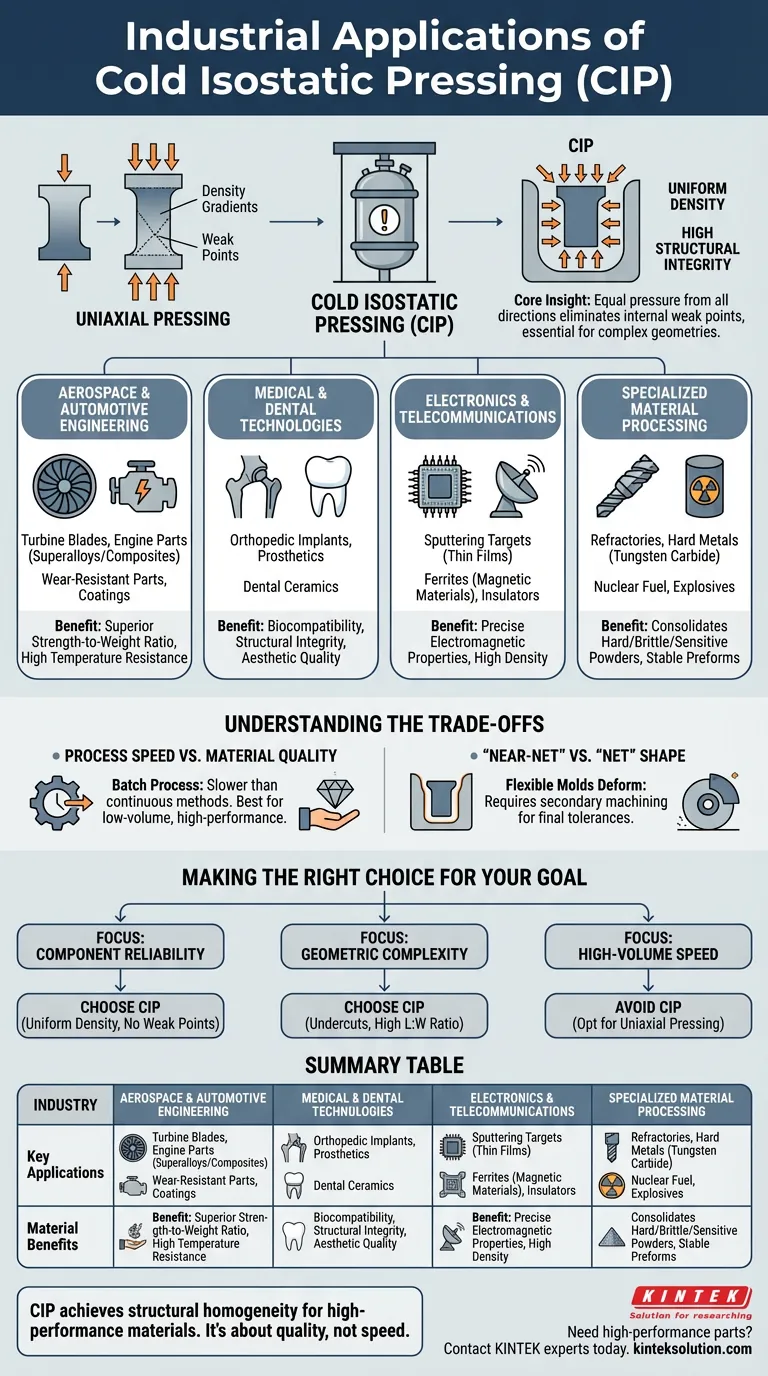
Cold Isostatic Pressing (CIP) is an industrial manufacturing process used primarily to consolidate metal, ceramic, and composite powders into high-density solid components. It is the standard solution for producing parts that require uniform internal density and high structural integrity, such as aerospace turbine blades, medical implants, and electronic sputtering targets.
Core Insight: The primary value of CIP is its ability to apply pressure equally from all directions. Unlike traditional uniaxial pressing, which creates density gradients that weaken a part, CIP produces materials with uniform density, making it indispensable for complex geometries or critical components where failure is not an option.
High-Performance Manufacturing Applications
Aerospace and Automotive Engineering
The aerospace sector relies on CIP to manufacture large, complex components that demand an exceptional strength-to-weight ratio. This includes turbine blades and engine parts made from superalloys or composites.
In the automotive industry, CIP is used to create wear-resistant parts and coatings for engine valve components. The process ensures these parts can withstand high temperatures and mechanical stress, significantly extending the lifespan of heavy machinery and reducing maintenance costs.
Medical and Dental Technologies
CIP is essential for producing biocompatible components where material purity and density are critical for patient safety. This includes orthopedic implants and prosthetics that must integrate seamlessly with the human body.
The technology is also widely used to manufacture fine ceramics for dental applications. These materials require precise consolidation to ensure aesthetic quality and structural durability in bridges and crowns.
Electronics and Telecommunications
A niche but vital application of CIP is the production of sputtering targets. These are high-density blocks of material used to coat microchips and other electronic components with thin films.
Additionally, the industry uses CIP to manufacture ferrites (magnetic materials) and electrical insulators. The process allows these materials to achieve the specific electromagnetic properties required for telecommunications equipment.
Specialized Material Processing
Refractories and Hard Metals
CIP is uniquely suited for materials that are difficult to mold using conventional methods, such as tungsten carbides, graphite, and refractory ceramics. These materials are often too hard or brittle for standard die pressing.
Industries use CIP to form these powders into "green" (unsintered) bodies, such as molds, tooling, and large ceramic tubes. This provides a stable preform that can be machined or sintered without cracking.
Energy and Hazardous Materials
The nuclear sector utilizes CIP for the consolidation of nuclear fuel. The process allows for the safe compression of fuel powders into pellets with precise densities.
Similarly, CIP is employed in the processing of explosives and volatile chemical compounds. The isostatic nature of the pressure application offers a controlled environment for consolidating these sensitive materials.
Understanding the Trade-offs
Process Speed vs. Material Quality
CIP is typically a batch process, meaning it is slower than continuous manufacturing methods like extrusion or uniaxial pressing. It is generally not cost-effective for high-volume, low-cost parts where simple geometry allows for faster production.
"Near-Net" vs. "Net" Shape
While CIP produces excellent internal density, it creates a "near-net" shape. The flexible molds used in the process deform, meaning the resulting part usually requires secondary machining or grinding to achieve final dimensional tolerances. You are trading dimensional precision for microstructural perfection.
Making the Right Choice for Your Goal
To determine if Cold Isostatic Pressing is the correct solution for your manufacturing needs, consider your specific constraints:
- If your primary focus is component reliability: Choose CIP for parts that face high stress or fatigue, as the uniform density eliminates internal weak points.
- If your primary focus is geometric complexity: Choose CIP if your part has undercuts or a high length-to-width ratio that would cause density gradients in standard pressing.
- If your primary focus is high-volume speed: Avoid CIP and opt for uniaxial pressing, provided the part geometry is simple enough to be ejected from a rigid die.
CIP is not about speed; it is about achieving structural homogeneity in materials that demand the highest possible performance.
Summary Table:
| Industry | Key Applications | Material Benefit |
|---|---|---|
| Aerospace/Automotive | Turbine blades, engine components | Superior strength-to-weight ratio, wear resistance |
| Medical/Dental | Orthopedic implants, dental ceramics | Biocompatibility, structural integrity |
| Electronics | Sputtering targets, ferrites | Precise electromagnetic properties |
| Specialized Materials | Tungsten carbide tooling, nuclear fuel | Consolidation of hard/brittle/sensitive powders |
Need to produce high-performance parts with uniform density and complex geometries? KINTEK specializes in lab press machines, including isostatic presses, to meet the demanding needs of laboratories and R&D departments. Our expertise ensures you achieve the material homogeneity required for critical applications in aerospace, medical, and electronics. Contact our experts today to discuss how our CIP solutions can enhance your manufacturing process.
Visual Guide
Related Products
- Automatic Lab Cold Isostatic Pressing CIP Machine
- Electric Split Lab Cold Isostatic Pressing CIP Machine
- Electric Lab Cold Isostatic Press CIP Machine
- Manual Cold Isostatic Pressing CIP Machine Pellet Press
- Lab Isostatic Pressing Molds for Isostatic Molding
People Also Ask
- What are the key features of automated laboratory Cold Isostatic Press (CIP) systems? Achieve Precise, High-Pressure Powder Consolidation
- Why is an Isostatic Press (CIP) Necessary After Uniaxial Pressing? Achieve Transparency in Nd:Y2O3 Ceramics
- How does a Cold Isostatic Press (CIP) facilitate the preparation of CaO-doped silicon carbide (SiC) green bodies?
- How does a Cold Isostatic Press (CIP) increase Bi-2223/Ag current density? Boost Superconductivity with Uniform Pressure
- What is the primary function of a Cold Isostatic Press (CIP) in NASICON preparation? Achieve 96% Theoretical Density










