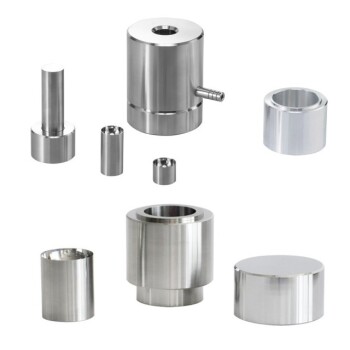
Exceptional mechanical strength and chemical stability at elevated temperatures are the primary drivers for selecting graphite or carbonaceous molds for hot pressing TiAl (Titanium Aluminide) alloys. These materials are uniquely capable of maintaining their shape and integrity while subjected to temperatures exceeding 1200°C and the significant mechanical pressures exerted by hot-press machinery.
The selection of mold material is not just about containment; it is about process control. Graphite is chosen because it simultaneously withstands extreme thermal environments without deformation and provides the lubrication necessary for the precise formation of TiAl components.
Ensuring Structural Integrity at Extremes
Withstanding High-Temperature Environments
The fundamental requirement for these molds is the ability to operate in environments exceeding 1200 degrees Celsius.
Standard mold materials often lose strength or melt at these temperatures. Graphite maintains excellent mechanical strength under this intense heat, ensuring the process remains stable.
Resistance to Deformation
Hot pressing involves transmitting significant force through the mold to the alloy.
Graphite and carbonaceous materials possess the structural rigidity required to withstand these pressures. This prevents significant deformation of the mold, which is critical for maintaining the dimensional accuracy of the final part.
Chemical Stability
At high temperatures, reactivity between the mold and the alloy can be a catastrophic failure mode.
Graphite is selected for its high chemical stability. It resists reacting with the TiAl alloy even under heat and pressure, preventing contamination and preserving the integrity of both the tool and the part.
Optimizing Process Performance
Inherently Superior Lubrication
The physical interaction between the mold and the alloy defines the quality of the pressing.
Graphite offers superior lubrication characteristics. This property facilitates the smooth flow of TiAl alloy plates within the mold, reducing friction and preventing the material from sticking or tearing during formation.
Uniform Thermal Conductivity
Inconsistent heating can lead to warped parts or internal stresses.
Graphite provides thermal conductivity uniformity. This ensures that heat is distributed evenly throughout the mold and the alloy, promoting a consistent metallurgical structure across the entire component.
Critical Operational Outcomes
Achieving High Surface Quality
The combination of smooth material flow and chemical inertness directly impacts the finish of the product.
Because the alloy flows smoothly without adhering to the mold walls, the formed parts exhibit high surface quality. This reduces the need for extensive post-processing or machining.
Extending Mold Service Life
Durability is a key economic factor in hot pressing operations.
The resistance to thermal shock, deformation, and chemical wear contributes to extending the service life of the molds. This ensures repeatable performance over more cycles, optimizing the cost-effectiveness of the manufacturing process.
Making the Right Choice for Your Goal
Selecting the correct mold material is a balance of thermal capability and physical interaction.
- If your primary focus is Dimensional Accuracy: Prioritize graphite for its ability to resist deformation under high pressures at temperatures above 1200°C.
- If your primary focus is Surface Finish: Leverage the superior lubrication characteristics of carbonaceous materials to ensure smooth alloy flow and minimal defects.
- If your primary focus is Cost Efficiency: Rely on the chemical stability and durability of graphite to maximize the service life of your tooling.
Graphite remains the definitive choice for TiAl hot pressing because it acts as both a robust structural container and an active process facilitator.
Summary Table:
| Key Consideration | Performance Benefit | Impact on TiAl Components |
|---|---|---|
| High-Temp Strength | Resists heat >1200°C | Ensures structural integrity and stability |
| Deformation Resistance | Maintains rigidity under pressure | High dimensional accuracy of parts |
| Chemical Stability | Low reactivity with TiAl alloy | Prevents contamination and tool wear |
| Natural Lubrication | Reduced friction during flow | High surface quality; no sticking |
| Thermal Conductivity | Uniform heat distribution | Consistent metallurgical structure |
Optimize Your Lab’s Material Synthesis with KINTEK
Precision in TiAl alloy hot pressing requires more than just high temperatures—it demands the right equipment and tooling expertise. At KINTEK, we specialize in comprehensive laboratory pressing solutions designed to meet the rigorous demands of advanced battery research and materials science.
Whether you need manual, automatic, heated, or multifunctional models, or specialized cold and warm isostatic presses, our equipment ensures uniform pressure and thermal control for superior results.
Ready to elevate your research efficiency? Contact us today to find the perfect press for your application!
References
- Toshimitsu Tetsui. Practical Use of Hot-Forged-Type Ti-42Al-5Mn and Various Recent Improvements. DOI: 10.3390/met11091361
This article is also based on technical information from Kintek Solution Knowledge Base .
Related Products
- Lab Heat Press Special Mold
- Cylindrical Lab Electric Heating Press Mold for Laboratory Use
- Special Shape Lab Press Mold for Laboratory Applications
- Lab Anti-Cracking Press Mold
- Lab Round Bidirectional Press Mold
People Also Ask
- How is a laboratory heat press used to evaluate bio-based aliphatic polyesters? Prepare Reliable Samples for Analysis
- How is a laboratory heat press utilized in MEA preparation? Achieve High-Efficiency Iron-Chromium Redox Flow Batteries
- Why is a laboratory heat press necessary for biodegradable films? Unlock Precision Bonding and Barrier Performance
- What is the purpose of incorporating cartridge heaters into a lab press mold for MLCC block compression? Optimize Results
- What is the significance of pressure and temperature control in a laboratory heated press for ZIF-8/NF coatings?