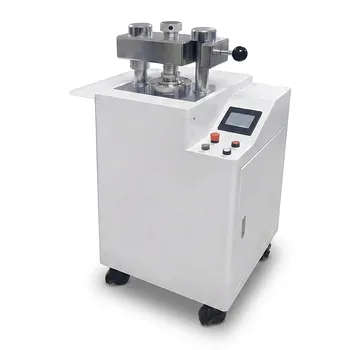
A high-quality XRF pellet die requires construction from high-grade stainless steel with pressing faces polished to a mirror finish. The pressing surfaces that contact the sample must be perfectly flat and smooth to ensure the final pellet is free of surface irregularities that could interfere with analysis.
Core Takeaway The physical quality of your die directly dictates the analytical quality of your sample. A robust stainless steel construction ensures durability under high pressure, while a mirror-polished face is non-negotiable for producing the perfectly smooth sample surface required for accurate X-ray detection.
Material Construction: The Foundation
High-Grade Stainless Steel
The primary requirement for an XRF pellet die is the use of high-quality stainless steel. This material provides the necessary hardness to resist deformation and prevents chemical contamination of the sample during the pressing process.
Mechanical Integrity Under Load
The die must be engineered to withstand significant force without warping. For standard applications, the die must handle loads between 10 to 20 tonnes, while difficult samples may require pressures up to 40 tonnes.
Surface Finish: The Critical Interface
The Mirror Polish Requirement
The pressing faces—the internal components that directly touch your sample powder—must feature a mirror finish. This is not for aesthetics; it is a functional requirement to transfer that smoothness onto the sample pellet.
Achieving Perfect Flatness
Any imperfection in the die face will be imprinted onto the sample. To ensure the X-ray beam interacts with a uniform surface, the die faces must be perfectly flat and smooth.
Common Pitfalls to Avoid
Mismatched Die Sizes
A high-quality die is useless if it is the wrong size for your instrument. Standard diameters are 32 mm and 40 mm, chosen to match the sample cup of the XRF instrument and provide sufficient surface area for the X-ray beam.
Ignoring Sample Hardness
While the die material is hard, the sample material can be abrasive. Hard geological samples should be ground to a fine powder and mixed with a binding agent (like cellulose or boric acid) to protect the die faces and ensure proper adhesion.
Making the Right Choice for Your Goal
To ensure your equipment delivers reliable analytical results, align your die selection with your specific operational needs:
- If your primary focus is standard laboratory analysis: Ensure your die diameter (typically 32 mm or 40 mm) strictly matches your XRF instrument's sample cup requirements.
- If your primary focus is analyzing hard geological samples: Verify that the stainless steel construction is rated to withstand higher pressure loads (up to 40 tonnes) to accommodate difficult binders and powders.
Investing in a precision-engineered die is not merely a hardware decision; it is a prerequisite for generating trustworthy analytical data.
Summary Table:
| Feature | Requirement | Benefit |
|---|---|---|
| Material | High-Grade Stainless Steel | Prevents contamination; resists deformation under high pressure |
| Surface Finish | Mirror Polish | Ensures a perfectly smooth pellet surface for accurate X-ray detection |
| Geometry | Perfect Flatness | Eliminates surface irregularities that could interfere with analysis |
| Load Capacity | 10 to 40 Tonnes | Maintains mechanical integrity under extreme pressing forces |
| Standard Sizes | 32 mm or 40 mm | Ensures compatibility with standard XRF instrument sample cups |
Elevate Your Sample Preparation with KINTEK
Don’t let poor pellet quality compromise your research. KINTEK specializes in comprehensive laboratory pressing solutions, providing high-precision XRF pellet dies and a wide range of manual, automatic, and heated presses designed for ultimate durability. Whether you are conducting advanced battery research or routine geological analysis, our team offers the technical expertise and equipment—including cold and warm isostatic presses—to ensure your samples are flawless every time.
Ready to achieve superior analytical results? Contact us today to find the perfect pressing solution for your lab!
Related Products
- XRF KBR Steel Ring Lab Powder Pellet Pressing Mold for FTIR
- Lab XRF Boric Acid Powder Pellet Pressing Mold for Laboratory Use
- XRF KBR Plastic Ring Lab Powder Pellet Pressing Mold for FTIR
- Automatic XRF Pellet Press for Laboratory Spectrometry Sample Preparation
- Automatic Fluorescence Sample Preparation Press 40 Ton Lab Pellet Press for XRF Analysis
People Also Ask
- What considerations are important regarding the die size of an XRF pellet press? Optimize for Your XRF Spectrometer and Sample
- Why are pellets used in XRF analysis, and what is their limitation? Boost Accuracy and Speed in Your Lab
- What is the general process for preparing a sample pellet for XRF? Master Consistency for Accurate Analysis
- What are the differences between manual and automatic XRF pellet presses? Choose the Right Press for Your Lab's Needs
- What are the different types of XRF pellet preparation methods available? Manual, Hydraulic, and Automated Presses Explained