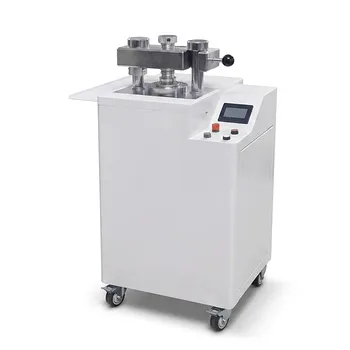
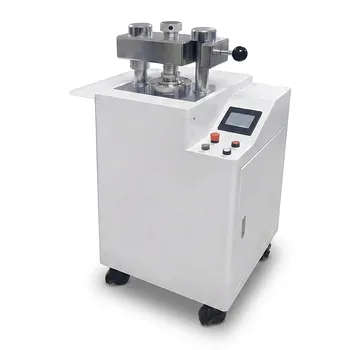
Laboratory press pellets serve as the critical foundation for accurate spectroscopic analysis by transforming loose powders into solid, consistent samples. In this process, a laboratory press applies stable, high pressure to compress a mixture of sample and matrix material into a dense, homogeneous disc, eliminating environmental variables that could distort your data.
The primary role of a pressed pellet is to standardize the physical state of a sample—eliminating air gaps and surface irregularities—to ensure the analytical beam interacts purely with the material, yielding clear and reproducible data.
The Mechanics of Sample Compression
Elimination of Physical Gaps
The fundamental role of the press is physical compression. By applying uniform static pressure, the machine forces ground powder particles together. This process eliminates the microscopic gaps and air pockets that naturally exist between loose particles.
Creating a Stable Matrix
The press turns a volatile powder into a stable solid. This creates a dense, thin disc that is easy to handle and mount in analytical instruments. It ensures the sample remains static during the entire testing duration.
Application in Infrared (IR) Spectroscopy
The Role of Potassium Bromide (KBr)
For IR spectroscopy, samples are typically pressed into pellets using Potassium Bromide (KBr) as a matrix. Using a solid KBr pellet allows you to analyze the sample without using liquid solvents. This prevents solvent absorption bands from interfering with the sample's spectral clarity.
Inducing Plastic Flow
To achieve high-quality IR results, the press must induce "plastic flow" within the KBr crystals. Continuous static pressure causes the fine crystal particles to merge and compact. This specific physical change is what expels trapped microscopic air bubbles.
Achieving Optical Transparency
The result of this plastic flow is an optically transparent disc. Because the pellet is free of scattering centers (air bubbles or voids), the infrared beam passes through effectively. This transparency is essential for obtaining a stable baseline.
Improving Signal-to-Noise Ratio
A well-pressed pellet significantly reduces light scattering. By minimizing background noise, the resulting spectrum displays clearer, sharper peaks. This creates a high signal-to-noise ratio suitable for high-level chemical research.
Application in X-Ray Fluorescence (XRF)
Ensuring Surface Flatness
In XRF spectroscopy, the geometry of the sample is paramount. The laboratory press is used to create a perfectly flat surface. Irregularities in the surface height can alter the distance to the detector, skewing results.
Promoting Homogeneity
XRF relies on the sample being uniform throughout. Pressing the sample creates a homogeneous distribution of elements. This uniformity enhances the accuracy of elemental analysis and quantification.
Critical Factors for Success
The Necessity of Uniform Pressure
Not all pressure is created equal; the pressure applied must be stable and uniform. If the pressure is uneven, the pellet will have density gradients. This leads to inconsistent transparency and unreliable data regions.
Avoiding Scattering Centers
If the compression process is incomplete, "scattering centers" remain within the pellet. These are microscopic imperfections that deflect the analytical beam. This results in a noisy spectrum that may obscure critical chemical details.
Making the Right Choice for Your Goal
To maximize the quality of your spectroscopic data, focus on the specific physical requirement of your analytical method.
- If your primary focus is Infrared (IR) Spectroscopy: Ensure your press induces sufficient plastic flow in the KBr to create a fully transparent disc with no air bubbles to minimize light scattering.
- If your primary focus is X-Ray Fluorescence (XRF): Prioritize the flatness and homogeneity of the pellet surface to ensure geometric consistency for accurate elemental analysis.
Mastering the physical preparation of the pellet is the first step toward mastering the accuracy of the spectrum.
Summary Table:
| Feature | IR Spectroscopy Role | XRF Spectroscopy Role |
|---|---|---|
| Primary Goal | Optical transparency & plastic flow | Surface flatness & density homogeneity |
| Matrix Material | Commonly Potassium Bromide (KBr) | Pure sample or binding agents |
| Physical Effect | Eliminates light-scattering air bubbles | Standardizes distance to detector |
| Data Benefit | Sharp peaks & high signal-to-noise ratio | Accurate elemental quantification |
Elevate Your Research with KINTEK Precision Pressing
Don't let sample preparation be the weak link in your spectroscopic analysis. KINTEK specializes in comprehensive laboratory pressing solutions designed to meet the rigorous demands of modern material science.
Whether you are conducting delicate battery research or high-throughput chemical analysis, our range of manual, automatic, heated, multifunctional, and glovebox-compatible models, alongside our advanced cold and warm isostatic presses, ensures perfectly homogeneous and transparent pellets every time.
Ready to eliminate scattering and noise from your data? Contact KINTEK today to find the ideal pressing solution for your laboratory’s unique needs.
Related Products
- Laboratory Hydraulic Pellet Press for XRF KBR FTIR Lab Press
- Automatic Laboratory Hydraulic Press Lab Pellet Press Machine
- Laboratory Hydraulic Split Electric Lab Pellet Press
- Manual Laboratory Hydraulic Pellet Press Lab Hydraulic Press
- Laboratory Hydraulic Press 2T Lab Pellet Press for KBR FTIR
People Also Ask
- Laboratory Pellet Press for Solar PV Recycling: Ensuring High-Precision Material Analysis and Purity
- Why is a professional laboratory pellet press required for XRF of silica sand? Achieve +/- 0.10% Precision
- Why is precise pressure-holding control critical for biomass pellets? Master Your Densification Results
- What is the necessity of a laboratory pellet press for alcohol by-product fuels? Maximize Energy Density & Consistency
- What are the different types of pellet-making tools available for labs? Choose the Right Press for Your Sample