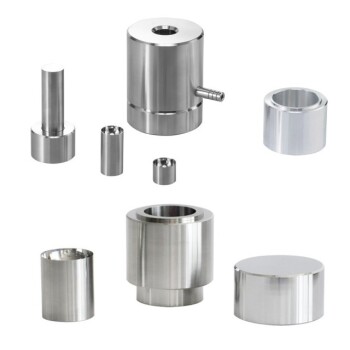
In ultrasonic-assisted pressing, a high-strength mold set functions as both a precision container and a critical energy transmission medium. It bears the primary responsibility of shaping the cemented carbide sample and constraining the powder, while simultaneously acting as the conduit for high-frequency vibration waves to pass from the system into the material.
Core Takeaway The mold set is not merely a static vessel; it is a dynamic interface that couples mechanical pressure with ultrasonic energy. Its surface hardness and fit precision are the deciding factors in how effectively vibration waves propagate to break particle bridging and increase green compact density.
The Dual Mechanics of the Mold Set
Constraining Powder Under Pressure
The most fundamental role of the mold set is to act as the container for shaping the sample. In the context of cemented carbide (WC-Co) production, the powder is subjected to immense force.
The mold must possess extremely high surface hardness. This allows it to withstand significant static pressure without deforming, ensuring the final dimensions of the sample are accurate.
Preventing Material Leakage
Beyond simple containment, the mold relies on fit precision to manage the powder. Because the process involves applying pressure to fine particles, any gap or misalignment would lead to powder leakage.
A high-strength mold maintains tight tolerances even under load, effectively sealing the powder within the die cavity to maintain consistent mass and geometry.
Facilitating Wave Propagation
Perhaps the most distinct role of the mold in this specific process is its coordination with the ultrasonic vibration system. The mold serves as the bridge between the transducer and the powder.
It ensures that vibration waves are transmitted effectively rather than being absorbed or dampened by the tool itself. This transmission is what allows the ultrasonic energy to enhance powder fluidity and break the "bridging effect" between particles.
Understanding the Trade-offs
Hardness vs. Brittleness
While high surface hardness is essential to prevent wear from abrasive Tungsten Carbide particles, it introduces a challenge regarding brittleness.
If the mold material is too brittle, the combination of high static pressure and high-frequency ultrasonic vibration can cause catastrophic failure or cracking. The material selection must balance hardness with sufficient toughness to survive the oscillatory stress.
Precision vs. Cost
Achieving the close coordination required for effective wave propagation demands exceptional manufacturing tolerances.
Looser tolerances reduce tooling costs but create acoustic impedance mismatches. This results in poor energy transfer, meaning the powder will not achieve the desired fluidity or pore-filling benefits, ultimately compromising the quality of the green compact.
Making the Right Choice for Your Goal
When selecting or designing a mold set for ultrasonic-assisted pressing, prioritize based on your specific quality metrics:
- If your primary focus is Maximum Density: Prioritize fit precision and acoustic coupling to ensure 100% of the ultrasonic energy reaches the powder to break particle bridges.
- If your primary focus is Dimensional Consistency: Prioritize surface hardness and rigidity to prevent mold deformation under the high static pressures required for cemented carbide.
The success of the entire pressing operation hinges on the mold's ability to remain rigid under pressure while remaining transparent to ultrasonic energy.
Summary Table:
| Feature | Primary Role | Impact on Cemented Carbide |
|---|---|---|
| Surface Hardness | Resists static pressure | Prevents tool deformation & ensures dimensional accuracy |
| Fit Precision | Material containment | Eliminates powder leakage & maintains consistent mass |
| Acoustic Coupling | Wave transmission | Enables energy to break particle bridging for higher density |
| Material Toughness | Stress management | Prevents mold cracking under high-frequency oscillation |
Maximize Your Material Density with KINTEK Solutions
Achieving the perfect green compact for battery research or cemented carbide production requires more than just pressure—it requires precision engineering. KINTEK specializes in comprehensive laboratory pressing solutions, including manual, automatic, heated, and multifunctional models designed to handle the most demanding ultrasonic-assisted applications.
Whether you need cold isostatic presses for uniform density or glovebox-compatible models for sensitive materials, our high-strength tooling ensures optimal energy transmission and durability. Contact KINTEK today to discover how our laboratory presses and precision mold sets can elevate your material research and production efficiency.
References
- Yuhang Chen, Youwen Yang. Investigating the Microscopic Mechanism of Ultrasonic-Vibration-Assisted-Pressing of WC-Co Powder by Simulation. DOI: 10.3390/ma16145199
This article is also based on technical information from Kintek Solution Knowledge Base .
Related Products
- Carbide Lab Press Mold for Laboratory Sample Preparation
- XRF KBR Steel Ring Lab Powder Pellet Pressing Mold for FTIR
- XRF KBR Plastic Ring Lab Powder Pellet Pressing Mold for FTIR
- Lab Polygon Press Mold
- Lab Infrared Press Mold for No Demolding
People Also Ask
- What is the purpose of incorporating cartridge heaters into a lab press mold for MLCC block compression? Optimize Results
- What is the function of a pressing tool in thermoplastic panels? Master Precision Shaping & Fusion Bonding
- Why is precise cooling management of the lab press mold necessary? Protect Core Integrity in Thermoforming
- How does the geometry of laboratory molds influence mycelium-based composites? Optimize Density and Strength
- What is the significance of standardized molds in lab presses? Ensure Precise Seal Material Evaluation