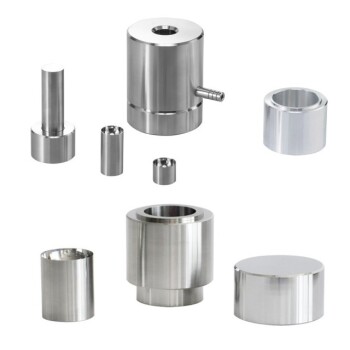
The design of a specialized forming die acts as the critical interface between raw material potential and final component quality in Iron-Aluminum (Fe-Al) metallurgy. A precisely engineered die ensures the application of uniform mechanical forces during compression, directly reducing density gradients within the green compact and defining the component's structural integrity.
Core Takeaway The quality of Fe-Al parts relies on a die design that balances high stiffness with exceptional surface smoothness. This combination minimizes internal stress concentrations and friction during ejection, preventing fatal defects like micro-cracks and delamination.
Achieving Structural Homogeneity
Controlling Density Distribution
The primary function of a specialized die is to ensure that pressure is applied evenly across the powder volume. This uniformity reduces density gradients, which are differences in compaction levels within the part that lead to weak points.
Ensuring Dimensional Accuracy
Proper die design locks in the geometric precision of the final component. Whether producing small 10mm samples or larger cylindrical components (e.g., 30mm diameter by 50mm height), the die determines the consistency of the shape.
Minimizing Deformation Under Load
To maintain this accuracy, the die itself must utilize high-strength materials capable of withstanding several tons of pressure. High die stiffness prevents the tool from deforming during the pressing phase, ensuring the part matches the intended specifications exactly.
Critical Surface Mechanics
Reducing Demolding Resistance
The internal finish of the die walls is as important as its structural rigidity. Internal wall smoothness significantly lowers friction between the compacted powder and the die surface.
Preventing Micro-Cracking
High friction during the ejection (demolding) phase is a primary cause of defects. By minimizing resistance, the design prevents the formation of micro-cracks that compromise the mechanical properties of the part.
Avoiding Surface Delamination
Smooth walls and proper geometry also mitigate the risk of surface delamination. This ensures that the outer layers of the Fe-Al part remain intact and cohesive as they are pushed out of the mold.
Common Pitfalls in Die Engineering
The Risk of Insufficient Stiffness
If a die lacks the necessary stiffness, it will flex under the immense pressure of compaction. This results in dimensional deviations that render physical property testing inaccurate or invalidate the part for practical use.
Overlooking Ejection Dynamics
Focusing solely on the compression shape without considering the ejection path leads to failure. A design that does not account for friction reduction will cause the green compact to tear or crumble upon removal.
Making the Right Choice for Your Goal
To maximize the quality of your Iron-Aluminum powder metallurgy parts, prioritize the following design parameters based on your specific objectives:
- If your primary focus is Dimensional Precision: Ensure the die utilizes high-stiffness materials that resist deformation under multi-ton pressure loads.
- If your primary focus is Structural Integrity: Prioritize internal wall smoothness to minimize friction and prevent micro-cracks during the ejection phase.
A specialized forming die is not merely a container for powder; it is a precision tool that dictates the density, durability, and fidelity of the final alloy.
Summary Table:
| Design Feature | Impact on Fe-Al Part Quality | Critical Benefit |
|---|---|---|
| High Material Stiffness | Prevents die deformation under multi-ton pressure | Ensures dimensional accuracy and precise geometry |
| Wall Smoothness | Reduces friction during the ejection (demolding) phase | Prevents micro-cracks, tearing, and surface delamination |
| Force Distribution | Minimizes internal density gradients | Ensures structural homogeneity and eliminates weak points |
| Geometry Locking | Maintains consistent shape for 10mm to 50mm components | Guarantees repeatability in physical property testing |
Elevate Your Powder Metallurgy Precision with KINTEK
Unlock the full potential of your Iron-Aluminum (Fe-Al) research with laboratory equipment designed for excellence. KINTEK specializes in comprehensive laboratory pressing solutions, offering a versatile range of manual, automatic, heated, multifunctional, and glovebox-compatible models, alongside advanced cold and warm isostatic presses.
Whether you are focusing on battery research or structural alloy development, our high-stiffness dies and precision presses ensure uniform density and defect-free results every time. Don't let poor die mechanics compromise your innovation.
Ready to optimize your lab's workflow? Contact us today to find the perfect pressing solution for your specific application!
References
- Ahmed Nassef, Medhat A. El-Hadek. Characteristics of Cold and Hot Pressed Iron Aluminum Powder Metallurgical Alloys. DOI: 10.3390/met7050170
This article is also based on technical information from Kintek Solution Knowledge Base .
Related Products
- XRF KBR Steel Ring Lab Powder Pellet Pressing Mold for FTIR
- Square Bidirectional Pressure Mold for Lab
- XRF KBR Plastic Ring Lab Powder Pellet Pressing Mold for FTIR
- Lab Ring Press Mold for Sample Preparation
- Lab Cylindrical Press Mold with Scale
People Also Ask
- What considerations are important regarding the die size of an XRF pellet press? Optimize for Your XRF Spectrometer and Sample
- Why are pellets used in XRF analysis, and what is their limitation? Boost Accuracy and Speed in Your Lab
- What is the general process for preparing a sample pellet for XRF? Master Consistency for Accurate Analysis
- How should one choose between a manual and automatic XRF pellet press? Maximize Accuracy and Efficiency in Your Lab
- What are the primary factors to consider when deciding between a manual and an automatic XRF pellet press? Optimize Your Lab's Efficiency