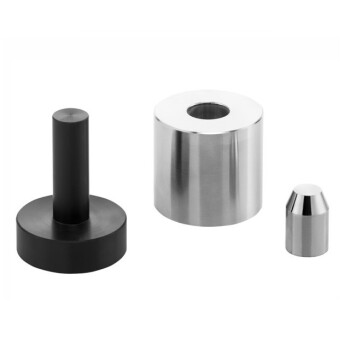
A split die design is critical for laboratory-scale ECAP primarily because it enables the physical disassembly of the tooling for specimen retrieval. Given the extreme pressures and friction involved in processing copper, a split configuration eliminates the need to force the sample out after processing, preventing damage to both the specimen and the expensive tool steel die.
The immense friction generated during Equal Channel Angular Pressing (ECAP) often causes materials to seize within the channel. A split die design solves this by decoupling the extrusion process from the extraction process, ensuring sample integrity and significantly extending the lifespan of the tooling.
Solving the Mechanical Challenges of ECAP
Managing High Extrusion Pressures
ECAP involves forcing copper through a sharply angled channel to induce severe plastic deformation. This process generates extremely high internal pressures.
A split die must be robust enough to contain this pressure during the stroke, yet capable of separating once the load is removed. This dual capability allows researchers to handle the intense forces required for copper deformation without permanently locking the sample inside the tool.
Overcoming Friction and Sticking
Friction is a major adversary in ECAP. Under high loads, copper tends to adhere to the channel walls.
In a solid die, extracting a stuck sample requires significant force, which often worsens the jamming. A split structure removes this barrier entirely, allowing the operator to open the tool and bypass the friction that resists extraction.
Ensuring Sample and Tool Integrity
Preventing Secondary Surface Damage
The primary goal of lab-scale ECAP is often to analyze the material's microstructure or mechanical properties.
Forcing a specimen out of a solid die via back-extrusion or ejection punches frequently causes scratches, scoring, or deformation. By splitting the die, you can simply lift the specimen out, preserving its surface quality for accurate metallurgical analysis.
Extending Die Service Life
ECAP dies are typically machined from high-hardness tool steel. While durable, these materials can be brittle under tensile stress or improper loading.
Repeatedly forcing stuck samples out of a solid channel increases wear and the risk of cracking the die. The split design reduces mechanical stress on the tool during the unloading phase, protecting the investment in high-precision machining.
Operational Considerations and Maintenance
Facilitating Maintenance and Lubrication
Consistent lubrication is vital for successful ECAP passes.
A split die grants full access to the internal channels. This facilitates thorough cleaning of debris and allows for precise re-lubrication between passes, ensuring consistent processing conditions and reducing the likelihood of galling.
Understanding the Trade-offs
While the split die is superior for retrieval, it introduces operational steps that must be managed.
- Disassembly Time: The process requires unbolting or unclamping the die after every single pass. This increases the total cycle time compared to continuous extrusion methods.
- Structural Containment: Because the die is split, it relies entirely on external containment (such as a heavy-duty sleeve or bolts) to prevent it from opening during the high-pressure extrusion stroke.
Making the Right Choice for Your Goal
When designing or selecting tooling for copper ECAP, the split design is generally the standard for laboratory success.
- If your primary focus is sample quality: Use a split die to ensure the specimen surface remains pristine for microscopy and hardness testing.
- If your primary focus is tooling longevity: Rely on the split design to prevent the excessive wear and potential cracking associated with ejecting stuck billets.
The split die design transforms ECAP from a high-risk mechanical struggle into a repeatable, controlled scientific process.
Summary Table:
| Feature | Split Die Design | Solid Die Design |
|---|---|---|
| Specimen Retrieval | Manual disassembly (Safe) | Forceful ejection (Risk of damage) |
| Friction Management | Decouples extraction from extrusion | High risk of samples seizing |
| Surface Quality | Preserves microstructure/finish | High risk of scratches and scoring |
| Tool Longevity | Reduced stress during unloading | Higher risk of cracking and wear |
| Maintenace | Easy cleaning and lubrication | Difficult access to internal channels |
Maximize Your Material Research Precision with KINTEK
Elevate your laboratory's capabilities with KINTEK’s specialized pressing solutions. Whether you are conducting Equal Channel Angular Pressing (ECAP) or advanced battery research, our comprehensive range—including manual, automatic, heated, and multifunctional models—is designed to handle extreme pressures with ease.
Our isostatic presses (cold and warm) and glovebox-compatible systems provide the structural integrity and precision required for delicate copper deformation and metallurgical analysis. Don't let tool failure or sample damage stall your innovation. Contact KINTEK today to find the perfect laboratory pressing solution for your specific application.
References
- Paula Cibely Alves Flausino, Paulo Roberto Cetlin. The Structural Refinement of Commercial‐Purity Copper Processed by Equal Channel Angular Pressing with Low Strain Amplitude. DOI: 10.1002/adem.202501058
This article is also based on technical information from Kintek Solution Knowledge Base .
Related Products
- Lab Infrared Press Mold for No Demolding
- Lab Cylindrical Press Mold with Scale
- XRF KBR Plastic Ring Lab Powder Pellet Pressing Mold for FTIR
- Lab XRF Boric Acid Powder Pellet Pressing Mold for Laboratory Use
- Square Bidirectional Pressure Mold for Lab
People Also Ask
- What is the purpose of incorporating cartridge heaters into a lab press mold for MLCC block compression? Optimize Results
- What is the function of a pressing tool in thermoplastic panels? Master Precision Shaping & Fusion Bonding
- Why is precise cooling management of the lab press mold necessary? Protect Core Integrity in Thermoforming
- What role do precision positioning and pressure molds play in single-lap joints? Ensure 100% Data Integrity
- Why is a lab press used for KBr pellet preparation in polyurethane FTIR? Achieve High-Resolution Spectral Data