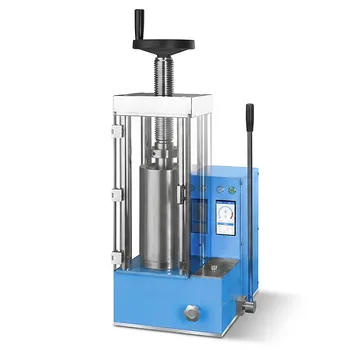
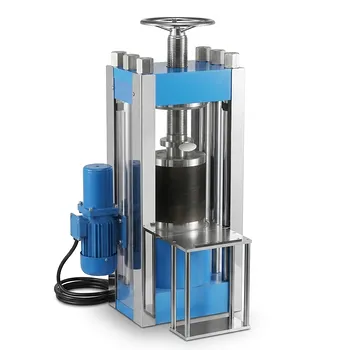
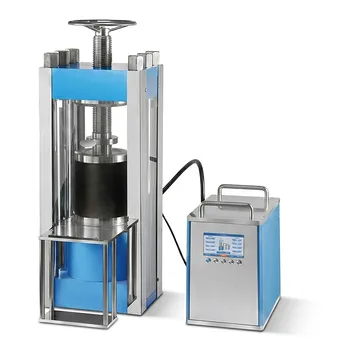
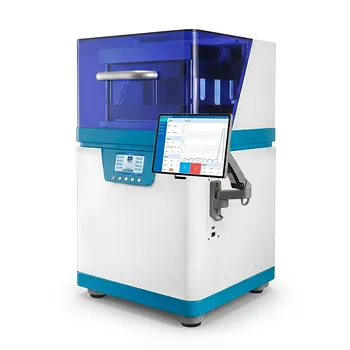
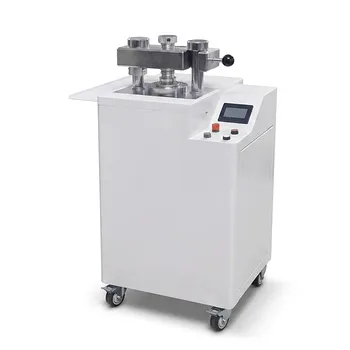
The primary advantages of isostatic pressing stem from its unique ability to apply pressure from all directions simultaneously using a fluid medium. The most significant benefits are the achievement of uniform compaction pressure, resulting in consistent high density across the entire part, and the efficient utilization of difficult or expensive materials.
Core Takeaway Unlike traditional unidirectional pressing, isostatic pressing eliminates density gradients by transmitting force equally through a liquid or gas medium. This results in superior mechanical strength, reduced internal defects, and the ability to densify complex shapes with minimal material waste.
The Mechanics of Uniformity
Elimination of Density Gradients
In traditional molding, pressure often comes from one or two directions, leading to uneven density. Isostatic pressing uses a fluid (liquid or gas) to transmit force isotropically.
This ensures the powder material experiences the exact same force from every angle. Consequently, density gradients—areas where the material is less compacted than others—are significantly reduced or eliminated.
Reduction of Microscopic Defects
By applying equal pressure continuously, the process minimizes microscopic pores and cracks within the material.
The encapsulation of powder in a flexible membrane allows the pressure to force particles together tightly. This leads to a substantial enhancement in the mechanical strength and reliability of the final product.
Consistent Firing and Stability
Parts created through isostatic pressing exhibit very little distortion when fired or sintered. Because the internal stress is low and the density is uniform, the shrinkage is predictable and even.
This stability leads to "near-net-shape" compacts, which often require minimal machining compared to parts produced by other methods.
Material and Geometric Flexibility
Compacting Difficult Materials
The primary reference highlights the method's applicability for compacting difficult and expensive materials.
Because the process relies on hydrostatic pressure rather than rigid die friction, it effectively consolidates powders that are otherwise hard to bind. This ensures highly efficient material utilization, reducing waste for costly raw materials.
Independence from Geometric Complexity
The fundamental principle of isostatic pressing applies pressure to the product surface regardless of its shape.
This allows for the formation of complex geometries that would be impossible with unidirectional tools. Constraints associated with aspect ratios or intricate features in rigid die compaction are largely eliminated.
Performance Implications for Critical Applications
Enhanced Ionic Conductivity
In specific applications like battery research (solid-state electrolytes), the high level of uniformity is critical.
By eliminating internal pores, the process increases ionic conductivity and improves the interface contact between electrode and electrolyte. This prevents issues like delamination or lithium dendrite penetration during battery cycles.
Improved Experimental Accuracy
For research and development, particularly with composite electrodes, the removal of stress defects improves the accuracy of experimental data.
Samples produced this way possess stable mechanical properties, ensuring that test results reflect the material's true nature rather than artifacts of a flawed manufacturing process.
Understanding the Trade-offs
Process Complexity
Isostatic pressing involves placing and sealing powder within a flexible mold (such as polyurethane) or hermetic container before submerging it in a pressure fluid.
This "wet bag" or encapsulation process is generally more complex and time-intensive than high-speed, automated dry pressing used for simpler parts.
Surface Finishing Requirements
While the process minimizes heavy machining, the use of flexible molds means the surface finish may not be as precise as that of a polished rigid die.
As noted in the references, the process may require subsequent finishing. Final grinding or polishing is often necessary to achieve exact dimensional tolerances or surface smoothness.
Making the Right Choice for Your Goal
- If your primary focus is Material Performance: Choose isostatic pressing to achieve maximum density and eliminate internal voids that compromise mechanical or electrical properties.
- If your primary focus is Complex Geometry: Use this method to uniformly densify parts with irregular shapes or high aspect ratios without density variations.
- If your primary focus is Cost of Raw Materials: Leverage this technique to minimize waste when working with expensive or exotic powders.
Isostatic pressing transforms loose powder into a high-performance solid by prioritizing internal structural integrity over processing speed.
Summary Table:
| Advantage | Key Benefit | Impact on Quality |
|---|---|---|
| Uniform Pressure | Eliminates density gradients via fluid transmission | Consistent mechanical strength & low distortion |
| Structural Integrity | Minimizes microscopic pores and internal cracks | Enhanced durability and reliable performance |
| Geometric Freedom | Pressing force is independent of part shape | Ability to form complex geometries and high aspect ratios |
| Material Efficiency | Effective consolidation of difficult/expensive powders | Reduced raw material waste and 'near-net-shape' results |
| Performance | Improves ionic conductivity and interface contact | Vital for advanced battery research and solid electrolytes |
Elevate Your Material Research with KINTEK
Maximize your laboratory efficiency and achieve unparalleled material density with KINTEK’s specialized pressing solutions. Whether you are advancing battery research or developing high-performance ceramics, our comprehensive range—including manual, automatic, heated, multifunctional, and glovebox-compatible models, as well as cold and warm isostatic presses—is designed to meet your precise needs.
Why choose KINTEK?
- Precision Engineering: Eliminate internal defects and density variations.
- Versatile Solutions: Systems tailored for complex shapes and difficult materials.
- Expert Support: We help you select the right pressing technology to ensure stable, accurate experimental data.
Ready to transform your powder consolidation process? Contact us today to find the perfect press for your lab!
Related Products
- Electric Isostatic Pressing Machine 40 Tons Automatic Laboratory Powder Compacting Press
- Warm Isostatic Press for Solid State Battery Research Warm Isostatic Press
- Automatic Lab Cold Isostatic Pressing CIP Machine
- Lab Isostatic Pressing Molds for Isostatic Molding
- Split Warm Isostatic Lab Press 200 Ton Powder Compaction Chamber for Battery Research and Material Science
People Also Ask
- What are the key characteristics of the isostatic pressing process? Unlock Uniform Density and Complex Geometries
- Why is vacuum-sealed packaging necessary before isostatic pressing of CuPc thin films? Protect Integrity & Uniformity
- How is pressure applied to the material during isostatic pressing? Master Uniform Density and Complex Geometries
- How does pressure distribute during isostatic pressing of aluminum? Achieve Uniform Density for Your Lab Materials
- What are the applications of isostatic pressing in the automotive industry? Precision Manufacturing for High-Performance Parts