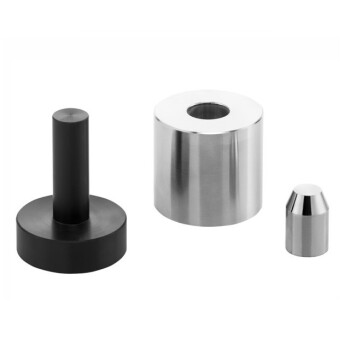
The primary function of a Precision Die Joining Device is to establish the geometric integrity required for successful Transient Liquid Phase (TLP) bonding. Specifically, it accurately aligns copper chips onto substrates and applies a controlled initial mounting force to ensure uniform joint thickness before the high-temperature bonding process begins.
Success in TLP bonding relies heavily on the initial assembly quality. The Precision Die Joining Device acts as a foundational tool, transforming loose components into a stable, precisely aligned configuration ready to withstand the rigors of high-pressure sintering.
Establishing Geometric Precision
To achieve a reliable bond, the physical positioning of components must be exact before any heat is applied. The Precision Die Joining Device manages this critical spatial relationship.
Coordinate Accuracy
The device is engineered to place copper (Cu) chips at precise coordinates.
This ensures that the chips are not merely placed on the substrate, but are positioned exactly where the design dictates relative to the underlying circuitry.
Component Alignment
The device specifically targets the alignment of copper chips coated with composite solder paste onto Direct Bonded Copper (DBC) substrates.
Proper alignment at this stage is non-negotiable, as it prevents short circuits or structural weaknesses in the final power module.
Ensuring Mechanical Stability
Beyond simple placement, the device plays an active role in the mechanical preparation of the joint.
Controlled Mounting Force
The device applies an initial mounting force to the assembly.
This pressure is distinct from the final bonding pressure; its purpose is to secure the components in place so they do not shift during transfer to the bonding chamber.
Achieving Uniform Thickness
By applying this initial force, the device ensures the joint configuration has a uniform thickness.
Uniformity is vital for the TLP process, as variations in paste thickness can lead to uneven bonding or voids during the subsequent sintering phase.
The Foundation for Bonding
The ultimate goal of this assembly stage is to prepare the materials for extreme conditions.
Enabling High-Temperature Processing
The precise alignment and pressing create a geometric foundation for the next steps.
This stable configuration allows the assembly to endure the high-temperature and high-pressure environments required to finalize the TLP bond without deforming.
Critical Considerations and Trade-offs
While the Precision Die Joining Device is essential for accuracy, understanding its role within the wider process reveals certain constraints.
Dependency on Initial Setup
The quality of the final bond is entirely dependent on this initial geometric foundation.
If the device is miscalibrated, no amount of subsequent heat or pressure can correct the misalignment or uneven thickness.
The Limits of "Initial" Force
It is critical to distinguish between the mounting force applied here and the final bonding pressure.
This device creates a stable configuration, not the final metallurgical bond. Relying on this stage for permanent adhesion rather than just placement and uniformity is a common misconception.
Making the Right Choice for Your Goal
To maximize the effectiveness of your TLP bonding experiments, focus on the specific output you need from this assembly stage.
- If your primary focus is process reliability: Ensure the device's coordinate system is calibrated to handle the specific tolerances of your DBC substrates to prevent misalignment.
- If your primary focus is joint homogeneity: Prioritize the control of the initial mounting force to guarantee the composite solder paste is compressed to a perfectly uniform thickness.
The Precision Die Joining Device is not just a placement tool; it is the gatekeeper of joint uniformity and alignment, determining the potential success of the entire bonding operation.
Summary Table:
| Function | Key Mechanism | Benefit to TLP Process |
|---|---|---|
| Coordinate Accuracy | Precise X/Y placement | Prevents short circuits and ensures circuit alignment |
| Component Alignment | Cu chip-to-DBC substrate registration | Guarantees structural integrity of the power module |
| Initial Mounting Force | Controlled mechanical pressure | Secures components for transport without shifting |
| Uniformity Control | Consistent paste compression | Eliminates voids and ensures even metallurgical bonding |
Elevate Your Sintering Success with KINTEK
Precision in the assembly stage is the foundation of high-performance power modules. KINTEK specializes in comprehensive laboratory pressing solutions designed for the most demanding research environments. Whether you are conducting TLP bonding, battery research, or material synthesis, our range of manual, automatic, heated, and multifunctional presses—including advanced cold and warm isostatic models—provide the controlled force and uniformity your experiments require.
Don't let misalignment compromise your results. Contact KINTEK today to find the perfect pressing solution for your lab’s unique needs.
References
- Byungwoo Kim, Yoonchul Sohn. Transient Liquid Phase Bonding with Sn-Ag-Co Composite Solder for High-Temperature Applications. DOI: 10.3390/electronics13112173
This article is also based on technical information from Kintek Solution Knowledge Base .
Related Products
People Also Ask
- How does a sealed battery mold facilitate the assembly and testing of asymmetric supercapacitors using VO2?
- Why use standardized CR2032 components & high-precision presses? Ensure reliability in lithium metal battery research.
- Why is a laboratory battery sealing press essential for desolvation energy testing? Ensure Reliable Kinetic Data
- What is the function of specialized battery molds and sealing consumables? Optimize Your In-situ XRD Testing Today
- What role does a laboratory sealing press play in thermal analysis of solid dispersion films? Ensure Data Integrity