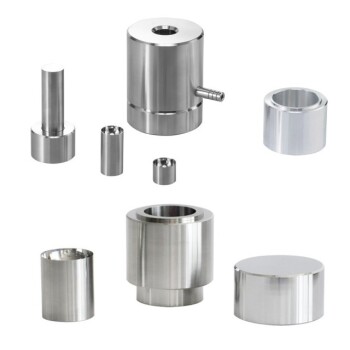
High-purity graphite molds serve as the critical interface between the hot-pressing equipment and the Al2O3-SiC nanocomposite material. They primarily function as a robust containment vessel while simultaneously executing the dual tasks of transferring mechanical pressure and conducting thermal energy to the sample.
The unique value of high-purity graphite lies in its ability to maintain structural integrity under extreme heat and pressure. This allows the Al2O3-SiC composite to overcome internal resistance to sintering and achieve deep densification, a feat difficult to accomplish with other mold materials.
The Core Mechanisms of Action
1. Mechanical Pressure Transmission
The graphite mold acts as a piston-and-cylinder assembly that must transmit force without yielding.
During hot-pressing, the mold transfers axial mechanical pressure directly to the Al2O3-SiC powder.
Because graphite retains exceptional strength at high temperatures, it can sustain the continuous compression required to density the material, often withstanding pressures of tens of megapascals without deforming.
2. Thermal Energy Conduction
Graphite is highly effective at conducting heat, which is vital for the sintering process.
The mold facilitates the rapid and uniform transfer of thermal energy from the heating elements to the composite sample.
This ensures the Al2O3-SiC reaches the necessary sintering temperatures (often exceeding 1400°C) evenly, preventing thermal gradients that could crack the ceramic.
3. Structural Containment
At its most fundamental level, the mold defines the geometry of the final product.
It acts as a container that holds the loose powder or pre-formed green body in a specific shape during the transition from solid-powder to dense-solid.
This containment is maintained even as the material undergoes significant shrinkage and densification.
Why Graphite is Critical for Al2O3-SiC
Overcoming Sintering Resistance
Al2O3-SiC nanocomposites are notoriously difficult to densify because silicon carbide particles inhibit the movement of grain boundaries (the "pinning effect").
To overcome this, the process requires simultaneous high temperature and high pressure.
Graphite is essential here because it is one of the few materials that can apply the necessary mechanical load at sintering temperatures to force particle rearrangement and diffusion.
Creating a Micro-Reducing Atmosphere
Graphite offers a secondary chemical benefit during the heating process.
At high temperatures, the graphite die generates a micro-reducing environment.
This helps prevent the oxidation of sensitive components within the matrix, working in tandem with inert gases like argon to maintain material purity.
Understanding the Trade-offs
Oxidation Vulnerability
While graphite is excellent in vacuum or inert atmospheres, it degrades rapidly in air at high temperatures.
If the sintering chamber is not properly purged with inert gas (like argon), the mold will oxidize and erode, potentially ruining the sample geometry.
Carbon Diffusion Risk
There is a potential for chemical interaction at the interface between the mold and the sample.
While the reducing atmosphere is generally beneficial, excessive carbon diffusion from the mold into the ceramic composite can alter surface properties.
This often necessitates post-processing steps, such as grinding or polishing, to remove the carbon-contaminated surface layer.
Making the Right Choice for Your Goal
When selecting mold materials and process parameters for Al2O3-SiC composites, consider your specific objectives:
- If your primary focus is Maximum Density: Prioritize the high-temperature strength of the graphite grade to ensure it can withstand the high axial pressures (35+ MPa) needed to overcome the pinning effect of SiC particles.
- If your primary focus is Dimensional Precision: Monitor the number of reuse cycles for your graphite molds carefully, as gradual erosion and creep over repeated heating cycles can compromise the final shape tolerances.
Ultimately, high-purity graphite is the enabler of deep densification, translating raw heat and force into a structurally sound nanocomposite.
Summary Table:
| Function | Description | Key Benefit |
|---|---|---|
| Pressure Transmission | Transfers axial mechanical force to the powder | Achieves deep densification at high temperatures |
| Thermal Conduction | Uniformly transfers heat from elements to sample | Prevents thermal gradients and ceramic cracking |
| Structural Containment | Defines the geometry of the final product | Maintains shape integrity during material shrinkage |
| Chemical Protection | Creates a micro-reducing atmosphere | Prevents oxidation of sensitive composite components |
Elevate Your Material Research with KINTEK Precision Solutions
Unlock the full potential of your Al2O3-SiC nanocomposites with KINTEK’s industry-leading laboratory pressing technology. As specialists in comprehensive pressing solutions, we offer a diverse range of manual, automatic, heated, multifunctional, and glovebox-compatible models, as well as cold and warm isostatic presses designed for high-performance battery research and advanced ceramics.
Don't let sintering resistance hold back your innovation. Partner with KINTEK to achieve superior material density and structural integrity.
Contact KINTEK Today to Find Your Perfect Pressing Solution
References
- Alireza Moradkhani, Ali Naserifar. Effect of Sintering Temperature on the Grain Size and Mechanical Properties of Al2O3-SiC Nanocomposites. DOI: 10.4191/kcers.2019.56.3.01
This article is also based on technical information from Kintek Solution Knowledge Base .
Related Products
- Lab Heat Press Special Mold
- Special Shape Lab Press Mold for Laboratory Applications
- Lab Round Bidirectional Press Mold
- Lab Anti-Cracking Press Mold
- Lab Polygon Press Mold
People Also Ask
- How is a laboratory heat press used to evaluate bio-based aliphatic polyesters? Prepare Reliable Samples for Analysis
- How is a laboratory heat press utilized in MEA preparation? Achieve High-Efficiency Iron-Chromium Redox Flow Batteries
- Why is a laboratory heat press necessary for biodegradable films? Unlock Precision Bonding and Barrier Performance
- What is the purpose of incorporating cartridge heaters into a lab press mold for MLCC block compression? Optimize Results
- Why is a laboratory heated press utilized in the preparation of PPC-PCLT copolymer films? Master Uniform Film Production