
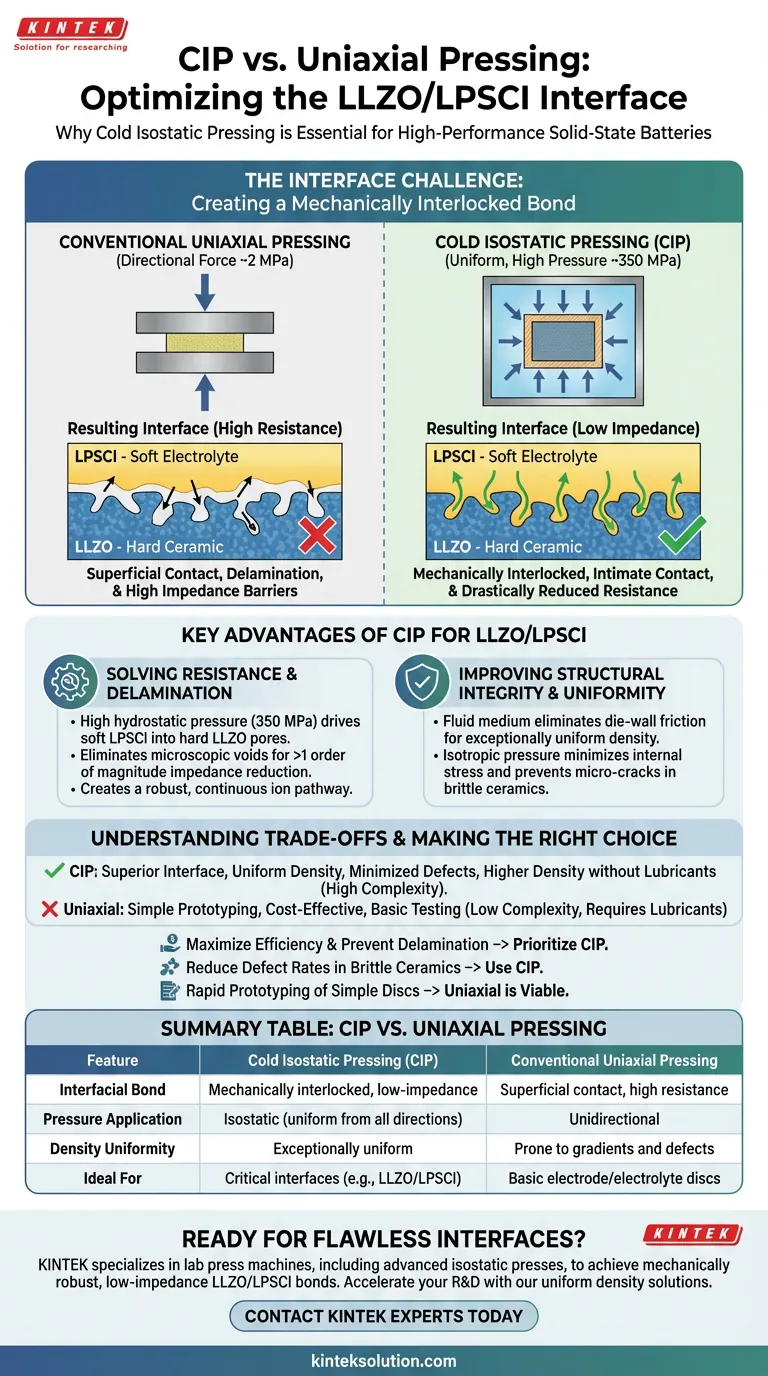
The primary advantage of Cold Isostatic Pressing (CIP) over uniaxial pressing for the LLZO/LPSCl interface is the creation of a mechanically interlocked, low-impedance bond. While uniaxial pressing often results in superficial contact and high resistance, CIP utilizes high, multidirectional pressure to drive the softer sulfide electrolyte (LPSCl) into the microscopic pores of the harder oxide electrolyte (LLZO).
Core Takeaway The interface between LLZO and LPSCl is prone to delamination and high electrical resistance when processed with standard uniaxial methods. CIP solves this by applying uniform, high-magnitude pressure (e.g., 350 MPa), which physically embeds the softer material into the harder surface, reducing total battery resistance by more than an order of magnitude.
Solving the Interface Resistance Challenge
The Failure of Uniaxial Pressing
Conventional uniaxial pressing typically applies pressure in a single direction at relatively low magnitudes (e.g., 2 MPa). This directional force often fails to establish a cohesive bond between chemically distinct layers.
Consequently, this method frequently leads to poor interfacial contact and delamination. The resulting gaps between layers act as barriers to ion flow, causing extremely high internal resistance in the battery cell.
Leveraging Material Hardness Differences
CIP succeeds by exploiting the physical differences between the electrolytes. LLZO is a hard ceramic, while LPSCl is comparatively soft and malleable.
When subjected to the high hydrostatic pressures of CIP (up to 350 MPa), the softer LPSCl flows plastically. It effectively embeds itself into the microscopic surface pores of the harder LLZO, creating a tight physical seal that uniaxial pressing cannot achieve.
Drastic Reduction in Impedance
This process of mechanical interlocking creates a robust, continuous pathway for ions.
By eliminating microscopic voids and ensuring intimate contact, CIP can reduce total battery resistance by more than an order of magnitude. This step is critical for ensuring the stable operation and efficiency of dual-electrolyte solid-state systems.
Improving Structural Integrity and Uniformity
Eliminating Die-Wall Friction
In uniaxial pressing, friction between the powder and the die walls causes uneven density gradients. The edges may be denser than the center, or vice versa.
CIP uses a fluid medium to apply pressure from all directions simultaneously. This eliminates die-wall friction, resulting in a component with exceptionally uniform density throughout its volume.
Minimizing Internal Stress and Defects
Because the pressure is isotropic (uniform in all directions), the compact experiences lower internal stress during formation.
This reduction in stress is advantageous for brittle ceramic powders, as it minimizes the formation of micro-cracks. The result is a mechanically reliable component with uniform ionic transport properties, free from the distortions common in uniaxially pressed parts.
Understanding the Trade-offs
Process Complexity vs. Simplicity
While CIP produces superior interfaces, it is inherently more complex than uniaxial pressing. Uniaxial methods are straightforward and utilize simple upper and lower dies, making them the standard for basic electrode or electrolyte disc preparation where high-performance interfaces are not the limiting factor.
Lubricants and Binders
Uniaxial pressing often requires lubricants to mitigate die friction, which must be removed later. CIP eliminates the need for die-wall lubricants and allows for higher pressed densities without the risk of contamination or the need for binder burnout steps. However, the equipment setup for CIP (involving fluid chambers) represents a higher initial complexity than a simple mechanical press.
Making the Right Choice for Your Goal
To maximize the performance of your solid-state battery architecture, evaluate your specific requirements:
- If your primary focus is maximizing cell efficiency: Prioritize CIP to achieve the lowest possible interfacial resistance and prevent delamination between dual electrolytes.
- If your primary focus is reducing defect rates in brittle ceramics: Use CIP to ensure uniform density distribution and minimize micro-cracking caused by stress gradients.
- If your primary focus is rapid prototyping of simple discs: Uniaxial pressing remains a viable, cost-effective option for basic material testing where interfacial impedance is not the primary variable.
For dual-electrolyte systems like LLZO/LPSCl, Cold Isostatic Pressing is not just an alternative; it is an enabling technology for achieving functional performance levels.
Summary Table:
| Feature | Cold Isostatic Pressing (CIP) | Conventional Uniaxial Pressing |
|---|---|---|
| Interfacial Bond | Mechanically interlocked, low-impedance | Superficial contact, high resistance |
| Pressure Application | Isostatic (uniform from all directions) | Unidirectional |
| Density Uniformity | Exceptionally uniform | Prone to gradients and defects |
| Ideal For | Critical interfaces (e.g., LLZO/LPSCl) | Basic electrode/electrolyte discs |
Ready to build high-performance solid-state batteries with flawless interfaces? KINTEK specializes in lab press machines, including advanced isostatic presses, to help you achieve mechanically robust, low-impedance bonds like the LLZO/LPSCl interface. Our equipment ensures uniform density and minimizes defects, enabling you to push the boundaries of battery efficiency. Contact our experts today to discuss how our pressing solutions can accelerate your R&D!
Visual Guide
References
- Matthias Klimpel, Maksym V. Kovalenko. Dual-Layer Li Metal All-Solid-State Battery Based on an Argyrodite-type Li <sub>6</sub> PS <sub>5</sub> Cl Catholyte and a Garnet-type Li <sub>7</sub> La <sub>3</sub> Zr <sub>2</sub> O <sub>12</sub> Separator. DOI: 10.1021/acsaem.5c02435
This article is also based on technical information from Kintek Solution Knowledge Base .
Related Products
- Electric Lab Cold Isostatic Press CIP Machine
- Electric Split Lab Cold Isostatic Pressing CIP Machine
- Automatic Lab Cold Isostatic Pressing CIP Machine
- Manual Cold Isostatic Pressing CIP Machine Pellet Press
- Lab Isostatic Pressing Molds for Isostatic Molding
People Also Ask
- What are the applications of electric lab cold isostatic presses in research settings? Advance Material R&D with High-Pressure CIPs
- What role do electric lab cold isostatic presses play in industrial contexts? Bridge R&D and Manufacturing with Precision
- How does electrical Cold Isostatic Pressing (CIP) contribute to cost savings? Unlock Efficiency and Reduce Expenses
- What are some research applications of electric lab CIPs? Unlock Uniform Powder Densification for Advanced Materials
- What are the characteristics of standard off-the-shelf electric lab CIP solutions? Achieve Immediate, Cost-Effective Processing
















