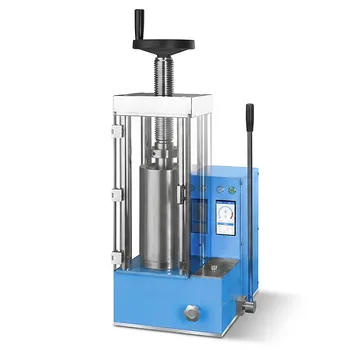
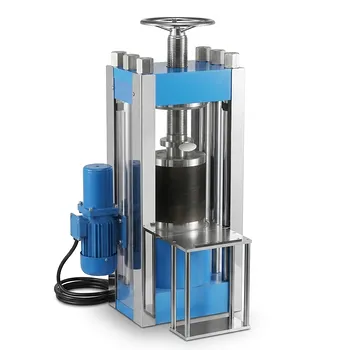
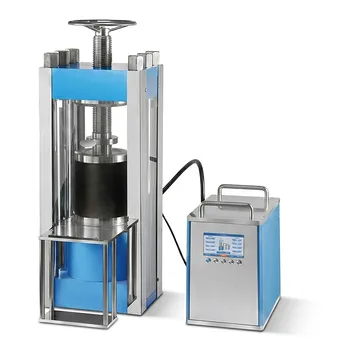
The primary stated advantages of Cold Isostatic Pressing (CIP) for pellet formation are the ability to apply uniform pressure from all sides to create denser components and the flexibility to produce irregular shapes, including long aspect ratio cylinders.
Core Takeaway Unlike uniaxial pressing, which can create uneven density gradients, CIP utilizes omnidirectional hydrostatic pressure to compact materials uniformly. This results in pellets and components with superior internal integrity, higher density, and predictable shrinkage during sintering, making it ideal for complex geometries and high-performance materials.
Achieving Superior Material Density
Omnidirectional Pressure Application
The fundamental advantage of CIP is the application of pressure from all directions simultaneously. By submerging the flexible mold in a fluid medium, pressure is distributed equally across the entire surface of the pellet.
Elimination of Internal Defects
This uniform compression effectively crushes internal pores and eliminates micro-voids. In specific applications, such as Ti(C,N) cermets, CIP has been shown to eliminate voids caused by uneven drainage during previous processing steps.
High-Density Results
The process significantly increases the density of the "green body" (the unfired compacted powder). CIP can achieve upwards of 95% of theoretical density, with some systems showing a density increase of approximately 15% compared to other methods.
Capabilities for Complex Geometries
Handling High Aspect Ratios
A distinct capability of CIP, highlighted in the primary reference, is the formation of long aspect ratio cylinders. Traditional pressing methods often struggle with long parts due to friction and pressure loss, but CIP maintains uniform force along the entire length.
Accommodating Irregular Shapes
CIP is not limited to simple pellets. It is well-suited for producing complex shapes and irregular geometries in a single molding step. This "near-net-shape" capability reduces the need for expensive and time-consuming post-process machining.
Scalability
There are few inherent size limitations beyond the dimensions of the pressure chamber itself. This allows for the production of everything from small research samples to very large components that would be impossible to press uniaxially.
Process Efficiency and Uniformity
Elimination of Gradient Properties
Uniaxial pressing often results in density gradients—parts are denser where the ram contacts the powder and less dense in the center. CIP creates uniform powder density throughout the entire pellet.
Reduction of Distortion
Because the density is uniform, the shrinkage that occurs during the firing (sintering) process is predictable and even. This significantly minimizes distortion and cracking in the final product.
Material and Cost Efficiency
The process is noted for low material loss, as it avoids the waste associated with melting or chemical reactions. Additionally, for complex parts, CIP can be more cost-effective for shorter production runs because it utilizes flexible molds rather than expensive rigid dies.
Understanding the Trade-offs
Production Speed vs. Complexity
While CIP is described as capable of mass production, its greatest efficiency gains are cited in specific contexts. It eliminates steps like drying or binder burnout, shortening some cycles. However, it is most uniquely advantageous for complex shapes or small runs where the high tooling cost of other methods is prohibitive.
Equipment Constraints
The size of the component is strictly limited by the pressure vessel dimensions. While large vessels exist (up to 60 inches in diameter), the component must fit within the specific chamber available.
Making the Right Choice for Your Goal
- If your primary focus is Structural Integrity: Choose CIP to achieve near-theoretical density and eliminate internal voids that compromise strength.
- If your primary focus is Geometry: Use CIP for parts with high aspect ratios (long cylinders) or complex shapes that cannot be ejected from a rigid die.
- If your primary focus is Dimensional Accuracy: Rely on CIP to ensure uniform shrinkage during sintering, preventing warping or cracking.
CIP transforms loose powder into high-performance components by ensuring that every millimeter of the material experiences the exact same compacting force.
Summary Table:
| Advantage | Impact on Pellet Quality | Key Benefit |
|---|---|---|
| Omnidirectional Pressure | Eliminates density gradients | Uniform internal integrity |
| High Aspect Ratios | Constant force over length | Ideal for long cylinders |
| Near-Net-Shape | Complex geometry capability | Reduced post-process machining |
| Void Elimination | Crushes internal micro-pores | Near-theoretical density (up to 95%) |
| Predictable Shrinkage | Uniform density distribution | Minimized distortion during sintering |
Elevate Your Material Research with KINTEK
Are you struggling with density gradients or fragile green bodies in your pellet formation? KINTEK specializes in comprehensive laboratory pressing solutions, offering a versatile range of equipment including manual, automatic, heated, and multifunctional models.
Our advanced Cold and Warm Isostatic Presses are specifically designed to meet the rigorous demands of battery research and high-performance ceramics. By partnering with KINTEK, you gain access to precision-engineered tools that ensure:
- Superior structural integrity for complex geometries.
- Scalable solutions from research samples to large components.
- Expert technical support for glovebox-compatible and specialized applications.
Ready to achieve near-theoretical density in your lab? Contact KINTEK today to find your perfect pressing solution!
Related Products
- Electric Lab Cold Isostatic Press CIP Machine
- Electric Split Lab Cold Isostatic Pressing CIP Machine
- Automatic Lab Cold Isostatic Pressing CIP Machine
- Manual Cold Isostatic Pressing CIP Machine Pellet Press
- Electric Isostatic Pressing Machine 40 Tons Automatic Laboratory Powder Compacting Press
People Also Ask
- What role do electric lab cold isostatic presses play in industrial contexts? Bridge R&D and Manufacturing with Precision
- What are the applications of electric lab cold isostatic presses in research settings? Advance Material R&D with High-Pressure CIPs
- How does electrical Cold Isostatic Pressing (CIP) contribute to cost savings? Unlock Efficiency and Reduce Expenses
- What are some research applications of electric lab CIPs? Unlock Uniform Powder Densification for Advanced Materials
- What are the characteristics of standard off-the-shelf electric lab CIP solutions? Achieve Immediate, Cost-Effective Processing