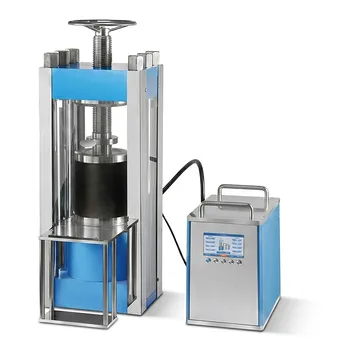
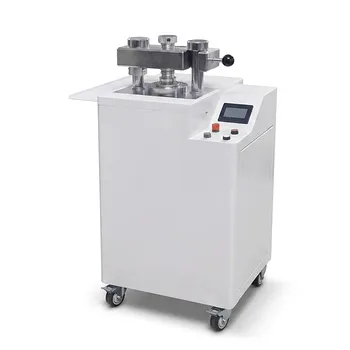
To produce high-quality Carbon Fiber Reinforced Polymer (CFRP) sheets, a laboratory heated press provides the simultaneous application of precisely controlled temperature and mechanical pressure. This dual-action environment triggers the chemical cross-linking of the resin matrix while forcing the resin to thoroughly infiltrate the carbon fiber layers, resulting in a dense, structural composite with a high fiber volume fraction.
Core Takeaway: The laboratory heated press is the critical tool for transforming loose fibers and liquid resins into high-performance solids by managing the "thermomolecular" curing process and the physical consolidation of the material structure. This ensures that the final CFRP sheet is free of voids and meets strict dimensional tolerances.
The Role of Precise Thermal Management
Triggering the Chemical Curing Reaction
The primary function of the heated platens is to provide the energy required to start and sustain the chemical cross-linking of the epoxy resin. Without exact temperature control, the resin may under-cure, leading to a brittle matrix, or over-cure at the surface, creating internal stresses.
Staged Heating for Resin Flow
Advanced laboratory presses allow for staged heating control, which is vital for guiding the resin through its different phases. By holding specific temperatures, operators can lower the resin's viscosity to its peak flow state before the final hardening begins, ensuring every fiber is coated.
Mechanical Pressure and Material Consolidation
Ensuring Full Resin Infiltration
Constant mechanical pressure, often reaching levels like 30 bar (435 psi) or higher, is necessary to force the resin into the microscopic gaps between carbon fiber bundles. This "wetting" process is what creates the strong interfacial bond needed for heavy-duty structural applications.
Expelling Air and Voids
As the press closes, the high-pressure environment works to expel entrapped air and residual gases from the laminate layers. Eliminating these internal pores is essential to prevent "delamination," where the layers of the composite peel apart under stress.
Achieving High Fiber Volume Fractions
By squeezing out excess resin, the press ensures the material reaches an ideal fiber-to-resin ratio. This consolidation results in a CFRP sheet that is lighter and stronger than those produced through manual methods, as it maximizes the structural contribution of the carbon fibers.
Understanding the Trade-offs
The Risk of Resin Starvation
Applying too much pressure too early in the heating cycle can lead to resin starvation. If the resin is forced out of the mold before it has effectively wetted the fibers, the resulting composite will have dry spots and significantly reduced mechanical strength.
Thermal Gradients and Internal Stress
If the platens do not heat uniformly, a thermal gradient can form across the sheet. This causes different parts of the resin to cure at different rates, which often leads to warping or "built-in" internal stresses that can cause the part to fail prematurely.
How to Optimize Your CFRP Production
Applying Precise Controls to Your Project
Achieving a laboratory-grade CFRP sheet requires balancing your material's specific chemistry with the physical capabilities of your press.
- If your primary focus is Maximum Tensile Strength: Prioritize high-pressure maintenance (e.g., 5.7 MPa or higher) and vacuum-assisted cycles to ensure the highest possible fiber density and zero porosity.
- If your primary focus is Dimensional Precision: Utilize a press with high-precision thickness stops and synchronized platen cooling to prevent warping as the material transitions from a molten to a solid state.
- If your primary focus is Complex Resin Chemistry (like Vitrimers): Focus on the precision of your temperature ramps and dwell times to ensure that the dynamic exchange reactions are fully activated throughout the curing cycle.
The synergy of heat and pressure within a controlled environment is the only way to transform raw carbon fiber into a predictable, industrial-grade structural component.
Summary Table:
| Key Condition | Primary Function | Impact on CFRP Quality |
|---|---|---|
| Precise Thermal Control | Triggers chemical cross-linking and manages resin viscosity. | Prevents brittle matrix or internal stresses; ensures full curing. |
| Mechanical Pressure | Forces resin into fiber bundles and expels entrapped air. | Eliminates voids/delamination and creates strong interfacial bonds. |
| Staged Heating | Lowers resin viscosity to peak flow state before hardening. | Ensures complete fiber wetting and uniform material consistency. |
| High Pressure (30+ Bar) | Squeezes out excess resin to increase fiber volume fraction. | Maximizes the strength-to-weight ratio and structural integrity. |
Elevate Your Composite Research with KINTEK Precision
Producing industrial-grade CFRP sheets requires absolute control over thermomolecular curing and structural consolidation. KINTEK specializes in comprehensive laboratory pressing solutions tailored for high-performance material science.
Whether you are conducting advanced battery research or developing lightweight structural composites, our equipment provides the accuracy you need:
- Manual & Automatic Heated Presses for precise thermal ramps.
- Multifunctional & Glovebox-Compatible Models for sensitive environments.
- Cold & Warm Isostatic Presses for superior material density.
Don't settle for inconsistent results. Let KINTEK help you achieve perfect resin infiltration and zero-porosity laminates.
Contact our laboratory specialists today to find the perfect press for your application!
References
- Gerald Singer, Helga C. Lichtenegger. Acid Free Oxidation and Simple Dispersion Method of MWCNT for High-Performance CFRP. DOI: 10.3390/nano8110912
This article is also based on technical information from Kintek Solution Knowledge Base .
Related Products
- Automatic High Temperature Heated Hydraulic Press Machine with Heated Plates for Lab
- Manual Heated Hydraulic Lab Press with Integrated Hot Plates Hydraulic Press Machine
- Automatic Heated Hydraulic Press Machine with Heated Plates for Laboratory
- Automatic Large Format Laboratory Heated Hydraulic Press 400x400mm Plate Capacity
- 24T 30T 60T Heated Hydraulic Lab Press Machine with Hot Plates for Laboratory
People Also Ask
- Function of a Laboratory Hydraulic Press with Heated Platens in SSE? Enhance Battery Density & Conductivity
- How does a laboratory heated hydraulic press facilitate PBN sample prep for WAXS? Achieve Precise X-Ray Scattering
- What are the requirements for electrode pressing with high-viscosity ionic liquids like EMIM TFSI? Optimize Performance
- What are the industrial applications of heated hydraulic presses? Master Heat & Force for Precision Manufacturing
- Why is a laboratory hydraulic press with heating plates required for PLA/TEC films? Achieve Precise Sample Integrity