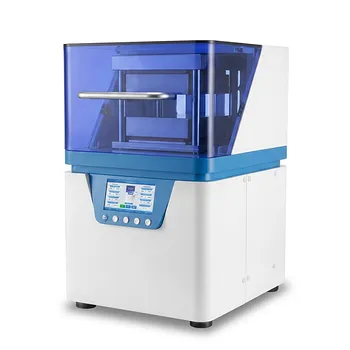
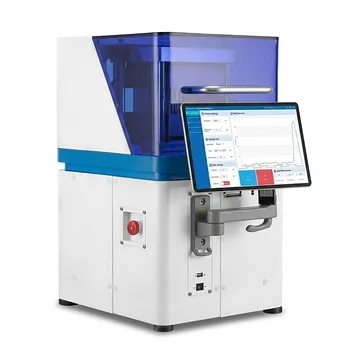
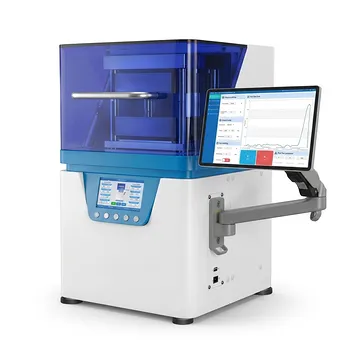
In the realm of material testing and research, the heated hydraulic press serves as a critical instrument for simulating extreme environmental conditions. By applying simultaneous high pressure and controlled heat, it allows researchers to rigorously evaluate the strength, durability, and mechanical behavior of materials in ways that standard ambient-temperature presses cannot.
The core value of a heated hydraulic press lies in its ability to replicate the complex stress factors found in real-world manufacturing and engineering environments. It moves beyond simple force application to investigate how thermal energy alters a material's structural integrity and physical properties under load.
Simulating Extreme Conditions
The primary function of this equipment is to bridge the gap between theoretical material properties and actual performance limits.
Testing Strength and Durability
Standard testing often fails to predict how a material will react when heat is introduced. A heated hydraulic press subjects samples to combined thermal and mechanical stress. This dual-variable testing is essential for determining the breaking points and deformation characteristics of materials intended for harsh operating environments.
Investigating Material Behavior
Researchers use these presses to observe how substances change phases or structural states. By maintaining precise control over temperature and pressure, scientists can map out specific behaviors, such as plasticity or brittleness. This data is fundamental to materials science and engineering research.
Advanced Sample Preparation
Beyond destructive testing, the heated hydraulic press is a vital tool for creating high-quality samples for analytical procedures.
Spectroscopic Analysis
For techniques like Fourier-transform infrared spectroscopy (FTIR) and X-ray fluorescence (XRF), sample quality dictates data accuracy. Heated presses are used to create KBr pellets and other general pellets. The addition of heat assists in the binding process, ensuring the pellet is solid and transparent enough for accurate spectral readings.
Ensuring Uniformity
Heat facilitates the flow of particles during compression. This ensures that powder mixtures and composite samples achieve a uniform distribution of components. A homogeneously compacted sample is crucial for avoiding outliers and ensuring reproducible results in compositional analysis.
Synthesis of Advanced Composites
In modern research, particularly nanotechnology and electronics, the heated press plays a constructive role in fabrication.
Optimizing Interfacial Adhesion
For complex devices, such as multilayer piezoelectric nanogenerators, layers must be bonded seamlessly. The press applies controllable pressure and temperature to merge piezoelectric polymer composites with graphene electrodes. This process ensures tight physical contact between distinct layers.
Improving Device Performance
The quality of the interface directly impacts the device's efficiency. By minimizing interfacial contact resistance, the press enhances mechanical stress transfer. This leads to improved long-term cyclic stability and overall performance of the synthesized device.
Understanding the Trade-offs
While invaluable, the use of a heated hydraulic press introduces variables that must be carefully managed to avoid data corruption.
Thermal Degradation Risks
Applying heat improves malleability but can also alter the chemical composition of sensitive materials. Researchers must ensure that the temperature required for physical shaping does not exceed the material's thermal degradation threshold. Overheating can lead to skewed durability data or ruined samples.
Complexity of Control
Testing with two variables (heat and pressure) is exponentially more complex than testing with pressure alone. Uniform heating across the platens is critical; thermal gradients can cause uneven expansion or compression in the sample. This requires rigorous calibration to ensure the conditions at the center of the sample match the sensor readings.
Making the Right Choice for Your Goal
To maximize the utility of a heated hydraulic press, align its application with your specific research objectives.
- If your primary focus is Materials Characterization: Prioritize the press's ability to maintain stable temperatures under peak loads to accurately map strength and durability limits.
- If your primary focus is Analytical Spectroscopy: Focus on the press's ability to produce optically clear, uniform pellets to ensure noise-free spectral data for FTIR or XRF.
- If your primary focus is Device Fabrication: Leverage the machine's precision to minimize interfacial resistance, ensuring strong adhesion between composite layers.
Ultimately, the heated hydraulic press is not just a crushing tool, but a sophisticated environmental simulator that validates whether a material is ready for the real world.
Summary Table:
| Application Category | Key Role/Function | Primary Benefit |
|---|---|---|
| Material Testing | Simulates simultaneous heat & pressure | Evaluates durability & breaking points under real-world stress |
| Sample Preparation | KBr & general pellet pressing | Ensures homogeneity & optical clarity for FTIR/XRF analysis |
| Device Fabrication | Bonding layers (e.g., nanogenerators) | Minimizes interfacial resistance & improves cyclic stability |
| Phase Research | Precise thermal & load control | Maps material plasticity, brittleness, and structural changes |
Elevate Your Research with KINTEK Precision Solutions
Don't settle for standard results when you can simulate real-world extremes. KINTEK specializes in comprehensive laboratory pressing solutions, offering a versatile range of manual, automatic, heated, multifunctional, and glovebox-compatible models, alongside advanced cold and warm isostatic presses widely applied in battery research and materials science.
Whether you need to produce flawless KBr pellets for spectroscopy or synthesize complex multilayer composites, our expert-engineered equipment provides the uniform heating and stable pressure control your breakthrough requires.
Ready to optimize your lab’s efficiency? Contact us today to find the perfect press for your application!
Related Products
- Heated Hydraulic Press Machine with Heated Plates for Vacuum Box Laboratory Hot Press
- Automatic High Temperature Heated Hydraulic Press Machine with Heated Plates for Lab
- Automatic Heated Hydraulic Lab Press with Programmable Touch Screen Controls and Precision Temperature Regulation
- Automatic Hydraulic Heat Press Machine with Multi Stage Programmable Control and Integrated Water Cooling Plate Size 180x180mm
- Automatic Hydraulic Hot Press with Large Plate and Precision Temperature Control for Advanced Material Sample Preparation and Industrial Research
People Also Ask
- What are the requirements for electrode pressing with high-viscosity ionic liquids like EMIM TFSI? Optimize Performance
- How does a laboratory heated hydraulic press facilitate PBN sample prep for WAXS? Achieve Precise X-Ray Scattering
- What are the industrial applications of heated hydraulic presses? Master Heat & Force for Precision Manufacturing
- Function of a Laboratory Hydraulic Press with Heated Platens in SSE? Enhance Battery Density & Conductivity
- How are heated hydraulic presses utilized in the preparation of thin films? Key Mechanisms and Applications