
In the assembly of all-solid-state batteries (ASSBs), laboratory hydraulic and hot presses serve a critical function: they utilize high mechanical pressure to bridge the physical gap between solid components, effectively replacing the "wetting" capability of liquid electrolytes found in traditional batteries.
Without the precise application of force—often ranging from 40 to 250 MPa—solid-state electrolytes and electrodes remain discrete, rough surfaces with poor connectivity. The press forces these materials to undergo plastic deformation or densification, transforming loose powders and rigid layers into a unified, conductive electrochemical system.
The Core Takeaway In solid-state battery fabrication, mechanical pressure is not just for shaping; it is a fundamental parameter for performance. The press eliminates microscopic voids and ensures intimate particle-to-particle contact, which is the single most important factor in lowering internal resistance and enabling ion transport.
Overcoming the Solid-Solid Interface Challenge
The primary obstacle in ASSBs is the high interfacial impedance caused by "point contacts"—where microscopic rough spots prevent full contact between layers. Hydraulic and hot presses solve this through three distinct mechanisms.
Densification of Powdered Materials
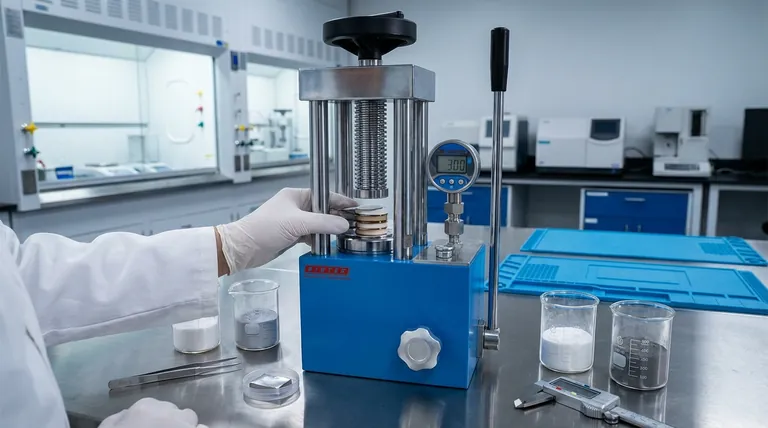
The foundation of a solid-state battery is often a composite pellet made of electrolyte and cathode powders. A uniaxial hydraulic press is used to cold-press these materials into dense discs.
By applying high pressure, the press drastically reduces internal porosity. This compaction forces particles closer together, maximizing the pathways available for ion conduction.
Optimizing Lithium Metal Interfaces
When using rigid electrolytes (such as garnet-type) alongside lithium metal anodes, the materials resist sticking to one another.
The press applies sufficient force to cause the soft lithium metal to undergo plastic deformation. The metal literally flows into the microscopic depressions of the hard electrolyte surface, increasing the effective contact area and ensuring uniform ion flux.
Stabilizing Bilayer Structures
Fabricating multi-layered cells requires a delicate balance of force. During bilayer fabrication (e.g., a cathode layer on a solid electrolyte), the press is used for pre-compaction.
This creates a flat, mechanically stable substrate for the subsequent layer. Proper pre-compaction is essential to prevent intermixing or delamination (layer separation) during high-temperature sintering or final assembly.
Ensuring Structural Integrity
Beyond the microscopic chemistry, the press plays a vital role in the macroscopic assembly of the prototype cell.
Sealing and Housing
A laboratory press provides the repeatable force necessary to seal the anode, cathode, separator, and casing tightly.
This mechanical clamping ensures the structural integrity of the test cell. It prevents the components from shifting during testing, which is critical for obtaining accurate, reproducible electrochemical data.
Understanding the Trade-offs
While pressure is essential, it must be applied with precision. Misapplication of force can damage the very components you are trying to assemble.
The Risk of Fracture
Solid-state electrolytes, particularly ceramics, are often brittle. Excessive or uneven pressure can cause micro-cracking within the pellet.
These cracks disrupt ion pathways and can lead to short circuits if dendrites grow through the fractures. The press must offer precise control to reach the density threshold without exceeding the material's fracture toughness.
Plasticity vs. Elasticity
In some scenarios, materials may deform elastically (bouncing back) rather than plastically (staying deformed) if the pressure or temperature (in hot pressing) is insufficient.
If the material "springs back" after the pressure is released, the contact area diminishes, and interfacial resistance spikes. This is why hot presses are often preferred for certain chemistries, as heat promotes better flow and permanent bonding.
Making the Right Choice for Your Goal
The specific role of the press changes depending on which stage of the battery development lifecycle you are currently addressing.
- If your primary focus is Material Synthesis: Prioritize a press capable of high-pressure ranges (up to 250 MPa) to maximize pellet density and minimize porosity in your electrolyte composites.
- If your primary focus is Cell Assembly: Focus on precision and control to ensure intimate contact between the anode and electrolyte without fracturing brittle ceramic layers.
- If your primary focus is Multi-layer Fabrication: Utilize a press that allows for distinct pre-compaction steps to create flat, stable interfaces that will survive sintering.
Ultimately, the press acts as the enabler of ionic conductivity, forcing solid materials to behave as a cohesive electrochemical unit.
Summary Table:
| Function | Key Benefit |
|---|---|
| Densification of Powders | Reduces porosity, maximizes ion conduction pathways |
| Optimizing Lithium Interfaces | Increases contact area via plastic deformation |
| Stabilizing Bilayer Structures | Prevents delamination during sintering |
| Sealing and Housing | Ensures structural integrity for accurate testing |
Ready to enhance your all-solid-state battery R&D? KINTEK specializes in laboratory press machines, including automatic, isostatic, and heated lab presses, designed to meet the precise pressure and temperature control demands of solid-state battery assembly. Our equipment helps you achieve the intimate particle contact and structural integrity critical for high-performance prototypes. Contact us today to discuss how our solutions can accelerate your battery development!
Visual Guide

Related Products
- 24T 30T 60T Heated Hydraulic Lab Press Machine with Hot Plates for Laboratory
- Manual Heated Hydraulic Lab Press with Integrated Hot Plates Hydraulic Press Machine
- Laboratory Split Manual Heated Hydraulic Press Machine with Hot Plates
- Automatic Heated Hydraulic Press Machine with Hot Plates for Laboratory
- Automatic High Temperature Heated Hydraulic Press Machine with Heated Plates for Lab
People Also Ask
- Function of a Laboratory Hydraulic Press with Heated Platens in SSE? Enhance Battery Density & Conductivity
- Why is a laboratory hydraulic press with heating plates required for PLA/TEC films? Achieve Precise Sample Integrity
- What role does a laboratory heated hydraulic press play in LTCC? Essential for High-Density Ceramic Lamination
- What is the primary function of a laboratory heated hydraulic press? Mastering Thermoplastic Carbon Fiber Composites
- Why is a laboratory heated hydraulic press utilized during the lamination stage of NASICON green tapes?



















