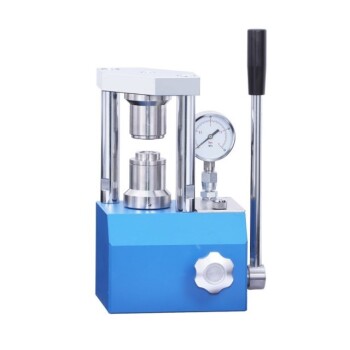
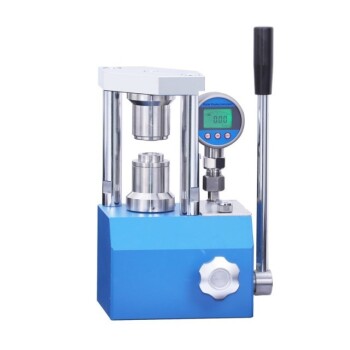
A laboratory precision sealing press creates the mechanical foundation for reliable battery data. It applies constant, precise pressure to bond the lithium metal electrode, glass fiber support, and in-situ generated gel electrolyte into a unified stack. This tight mechanical seal is the primary defense against interfacial resistance and environmental contamination, ensuring that the coin cell functions as a closed, stable system during testing.
Reliable cycling stability data depends as much on mechanical assembly as it does on material chemistry. By standardizing sealing pressure, a precision press ensures that any performance metrics you observe are the result of electrochemical reactions, not mechanical inconsistencies or seal failures.
Optimizing the Electrochemical Interface
Minimizing Interfacial Resistance
For a Li||Li symmetric cell to function correctly, the internal components must have intimate physical contact.
The press provides the mechanical force necessary to minimize interfacial resistance. Without this pressure, gaps between layers impede ion flow, leading to artificially high impedance readings that distort your data.
Ensuring Component Integration
In your specific configuration, you are bonding a lithium metal electrode with a glass fiber support and a gel electrolyte.
The sealing press ensures these distinct layers are physically compressed into a single, functional unit. This compression eliminates contact resistance and ensures the electrolyte creates a continuous path for ion transport.
Uniform Electrolyte Wetting
Standardized pressure is critical for how the electrolyte interacts with the porous structures within the cell.
By applying uniform compression, the press ensures the electrolyte sufficiently wets the porous framework of the separator and electrode interfaces. This uniformity is vital for guaranteeing the repeatability of rate performance evaluations.
Preserving the Chemical Environment
Preventing Electrolyte Dry-out
Long-term cycling stability testing places immense stress on the cell's volatile components.
A precision seal is the only barrier preventing the evaporation of liquid components within the electrolyte. If the seal fails or is loose, "dry-out" occurs, causing a rapid degradation of performance that mimics electrochemical failure but is actually a mechanical issue.
Blocking External Contamination
Lithium metal is highly reactive to moisture and oxygen.
The sealing press creates a hermetic environment that completely isolates the internal chemistry from the outside world. This prevents the infiltration of atmospheric moisture, which would otherwise react with the lithium anode and corrupt your cycling data.
Understanding the Trade-offs
The Cost of Inconsistent Pressure
The most common pitfall in coin cell assembly is the application of non-uniform pressure.
If the pressure is too low or uneven, you introduce "noise" into your electrochemical impedance spectroscopy (EIS) data. This interference masks the true kinetic data, such as charge transfer resistance, making it impossible to accurately assess the desolvation performance of your electrolyte.
Reproducibility vs. Variability
Using manual or low-precision crimping tools introduces a variable that ruins scientific reproducibility.
A precision press removes the "human element" from the assembly process. It ensures that every cell in a batch is subjected to the exact same radial pressure, making your data comparable across hundreds of cycles.
Making the Right Choice for Your Goal
To maximize the value of your testing equipment, align your assembly process with your specific research objectives:
- If your primary focus is Long-Term Cycling Stability: Prioritize the airtight integrity of the seal to strictly prevent electrolyte dry-out and moisture ingress over extended periods.
- If your primary focus is Kinetic Analysis (EIS/CV): Prioritize the uniformity of the compression to minimize contact noise and ensure accurate measurement of interfacial impedance.
Ultimately, the precision sealing press acts as a control for mechanical variables, allowing the true electrochemical performance of your materials to shine through.
Summary Table:
| Key Role of Precision Press | Impact on Battery Testing |
|---|---|
| Interfacial Resistance | Minimizes gaps to ensure smooth ion flow and accurate impedance readings. |
| Component Integration | Bonds lithium electrodes, separators, and gel electrolytes into a unified stack. |
| Airtight Hermetic Seal | Prevents electrolyte dry-out and blocks atmospheric moisture/oxygen contamination. |
| Standardized Pressure | Eliminates mechanical variability, ensuring data reproducibility across batches. |
| Kinetic Accuracy | Reduces contact noise for precise EIS and charge transfer resistance measurements. |
Elevate Your Battery Research with KINTEK Precision Solutions
In the competitive field of battery development, mechanical consistency is as vital as material chemistry. KINTEK specializes in comprehensive laboratory pressing solutions designed to eliminate variables and deliver repeatable, high-fidelity data. Whether you are focusing on long-term cycling stability or detailed kinetic analysis, our range of equipment—including manual, automatic, heated, multifunctional, and glovebox-compatible models, as well as cold and warm isostatic presses—is engineered to meet the rigorous demands of lithium-metal research.
Don't let mechanical inconsistencies mask your material's true potential. Contact KINTEK today to find the perfect precision sealing solution for your laboratory!
References
- Mingnan Li, Zhanhu Guo. Balancing Solvation Ability of Polymer and Solvent in Gel Polymer Electrolytes for Efficient Lithium Metal Batteries. DOI: 10.1002/ange.202513450
This article is also based on technical information from Kintek Solution Knowledge Base .
Related Products
- Button Battery Sealing Press Machine for Lab
- Lab Button Battery Tablet Press Sealing Mold
- Lab Polygon Press Mold
- Manual Button Battery Sealing Machine for Battery Sealing
- Button Battery Sealing Machine for Button Batteries
People Also Ask
- Why use standardized CR2032 components & high-precision presses? Ensure reliability in lithium metal battery research.
- Why is a laboratory battery sealing press essential for desolvation energy testing? Ensure Reliable Kinetic Data
- Why is a laboratory hydraulic press or battery sealing machine essential? Ensure Coin Cell Data Integrity
- How do laboratory battery sealing machines ensure performance consistency? Master Your Lithium and LFP Battery Assembly
- What role does a laboratory sealing press play in thermal analysis of solid dispersion films? Ensure Data Integrity