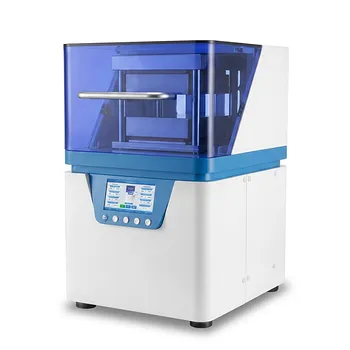
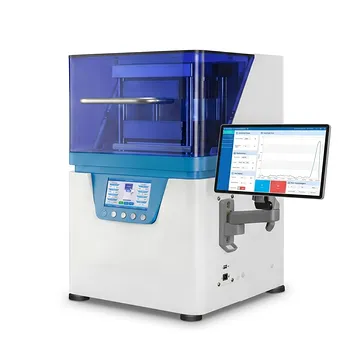
A screw press configuration is a specific type of laboratory pellet press that relies on a mechanical screw drive system to generate force, rather than hydraulic or pneumatic systems. This configuration is defined by its direct mechanical action, which translates rotational torque into linear pressure, offering distinct advantages in terms of control, durability, and maintenance.
The defining characteristic of a screw press is its mechanical simplicity. By utilizing a screw mechanism instead of hydraulic fluids, it delivers precise, repeatable pressure control while significantly reducing maintenance requirements.
The Operational Mechanics
The Core Mechanism
At the heart of this configuration is a threaded screw. As the screw is turned, it advances a platen or piston to compress the sample.
This direct mechanical linkage eliminates the need for oil, pumps, or seals found in hydraulic systems.
Robust Design Architecture
The primary reference highlights the robust design of these presses. Because they rely on solid mechanical components rather than fluid dynamics, there are fewer points of failure.
This results in a machine that is inherently durable and capable of withstanding the rigors of daily laboratory use.
Key Operational Advantages
Precise Pressure Control
One of the most significant benefits of a screw press is the precise control over applied pressure.
The screw mechanism allows for fine, incremental adjustments. This is critical for applications requiring high accuracy, where even slight deviations in pressure can alter sample density or integrity.
Ease of Adjustment
Operators benefit from easy adjustment of pressure settings. The mechanical nature of the press provides immediate tactile feedback and straightforward manipulation.
This allows researchers to quickly adapt the press to different sample types or experimental protocols without complex calibration.
Minimal Maintenance Requirements
The low maintenance profile of a screw press is a direct result of its simple mechanical design.
Without hydraulic oil to change or seals that may leak over time, the upkeep is minimal. This ensures higher uptime for the laboratory and lower long-term ownership costs.
Understanding the Trade-offs
Mechanical Constraints
While the simple mechanical design is a major advantage for reliability, it is important to understand the nature of the force application.
Because the system relies on a screw mechanism, the pressure application is strictly mechanical. Unlike hydraulic systems which might smooth out force application via fluid dynamics, the screw press delivers force directly. This requires the operator to rely on the mechanism's gearing and thread pitch for force multiplication.
Making the Right Choice for Your Goal
When deciding if a screw press is the right tool for your laboratory, consider your specific priorities regarding precision and maintenance.
- If your primary focus is High Accuracy: The screw press is ideal because it offers precise control over pressure application, ensuring consistent results for sensitive samples.
- If your primary focus is Reliability and Low Upkeep: The screw press is the superior choice due to its robust, simple mechanical design that eliminates the maintenance burden of hydraulic systems.
For laboratories prioritizing consistent performance with minimal downtime, the screw press configuration offers a highly effective, low-complexity solution.
Summary Table:
| Feature | Screw Press Configuration | Advantages |
|---|---|---|
| Mechanism | Direct Mechanical Screw Drive | Eliminates oil, pumps, and seal failures |
| Pressure Control | Manual/Incremental Rotation | High precision and repeatable results |
| Maintenance | Solid Mechanical Components | Minimal upkeep with no hydraulic fluid leaks |
| Durability | Robust Design Architecture | High uptime and long-term cost efficiency |
| Feedback | Tactile Mechanical Linkage | Immediate response for sensitive sample handling |
Elevate Your Material Research with KINTEK Precision
Are you looking for a reliable, low-maintenance solution for your laboratory pressing needs? KINTEK specializes in comprehensive laboratory pressing solutions, offering a wide range of manual, automatic, heated, and multifunctional models designed for high-accuracy battery research and material science.
Our screw press and isostatic press configurations are engineered to deliver the precise pressure control your experiments demand without the maintenance headaches of traditional systems. Whether you need glovebox-compatible models or advanced cold and warm isostatic presses, KINTEK has the expertise to support your goals.
Contact us today to find the perfect press for your lab!
Related Products
- Button Battery Sealing Press Machine for Lab
- Automatic Hydraulic Hot Press with Large Plate and Precision Temperature Control for Advanced Material Sample Preparation and Industrial Research
- Manual Cold Isostatic Pressing CIP Machine Pellet Press
- Laboratory Hydraulic Press Lab Pellet Press Machine for Glove Box
- Manual Heated Hydraulic Lab Press with Integrated Hot Plates Hydraulic Press Machine
People Also Ask
- Why use standardized CR2032 components & high-precision presses? Ensure reliability in lithium metal battery research.
- Why is a laboratory battery sealing press essential for desolvation energy testing? Ensure Reliable Kinetic Data
- Why is a laboratory hydraulic press or battery sealing machine essential? Ensure Coin Cell Data Integrity
- How do laboratory battery sealing machines ensure performance consistency? Master Your Lithium and LFP Battery Assembly
- What role does a laboratory sealing press play in thermal analysis of solid dispersion films? Ensure Data Integrity