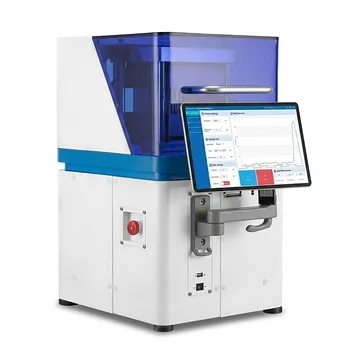
Selecting the right laboratory press requires a multidimensional evaluation of force requirements, physical dimensions, and operational control. You must balance the specific load and size constraints of your samples against the physical limitations of your workspace and budget.
Core Takeaway The ideal laboratory press is defined by the intersection of sample requirements and laboratory constraints. You must ensure the press provides sufficient force and physical space (daylight opening) for your application while fitting within your facility's energy, space, and budget limitations.
Core Performance Capabilities
Determining Load Requirements
The most fundamental factor is the amount of load or force required to process your sample. You must verify that the press can achieve and maintain the specific tonnage necessary for your application, whether it ranges from a few tons or up to hundreds of tons.
Controlling the Rate of Force
Beyond maximum force, consider the rate of ramping up to or down from the clamp force. Certain applications require precise control over how quickly pressure is applied or released to prevent sample damage. Evaluating whether the press offers programmable ramp rates is critical for consistency.
Assessing Energy Inputs
You must evaluate the energy required to pump the press to the necessary load. This refers to both the electrical power for automatic units and the physical effort required for manual hydraulic pumps.
Physical Dimensions and Capacity
Evaluating the Daylight Opening
The daylight opening is the vertical space available inside the press’s sample compartment. You must ensure this opening is large enough to accommodate not just the sample, but also any die sets, heating platens, or fixtures you intend to use.
Sizing the Platens
The platen size dictates the maximum horizontal dimensions of your sample. Larger platens offer flexibility for various sample sizes, but it is essential to confirm the platen area covers your largest potential mold or material.
Operational and Environmental Factors
Analyzing Laboratory Space
Practical considerations regarding available lab space are often overlooked but vital. Measure the footprint of the unit to ensure it fits comfortably within your designated work area without obstructing workflow.
Considering Portability
Determine whether the machine needs to be portable or if it will remain in a fixed location. If your lab workflow requires moving equipment between stations, a heavy, stationary press will be a significant hindrance.
Calculating Total Cost
Finally, evaluate the cost of required and optional features. While the base price is a factor, you must account for the cost of necessary add-ons, such as heated platens or digital controllers, to get a true picture of the investment.
Understanding the Trade-offs
Manual Effort vs. Automation
A critical trade-off exists between cost and operator effort. Manual presses are generally more cost-effective and portable but require significant physical strength and energy to operate, which can lead to operator fatigue and inconsistent results. Automated or electric systems provide higher precision and data logging capabilities but come at a significantly higher cost and larger footprint.
Complexity vs. Maintenance
Adding features like vacuum environments, precise temperature control, or programmable logic controllers (PLCs) increases the press's versatility but also its complexity. This often results in higher maintenance requirements and a steeper learning curve for operators compared to simpler, manual systems.
Making the Right Choice for Your Goal
To select the best press for your needs, align your choice with your primary objective:
- If your primary focus is budget and portability: Prioritize a manual press, but verify that the operator can physically manage the energy required to reach the necessary load.
- If your primary focus is process repeatability: Invest in an automatic or electric press with programmable ramp rates to remove operator variability from the force application.
- If your primary focus is versatility: Select a unit with a large daylight opening and interchangeable platens to accommodate a wide range of sample sizes and heights.
The successful selection of a laboratory press ultimately relies on accurately forecasting your maximum force needs and ensuring the physical equipment fits your lab's workflow.
Summary Table:
| Evaluation Factor | Key Considerations | Why It Matters |
|---|---|---|
| Load & Force | Max tonnage & programmable ramp rates | Ensures sample integrity and process consistency. |
| Physical Space | Daylight opening & platen size | Dictates maximum sample and die set dimensions. |
| Operational Mode | Manual vs. Automatic/Electric | Balances budget against precision and operator fatigue. |
| Lab Footprint | Unit dimensions & portability | Ensures the equipment fits your workflow and workspace. |
| Total Cost | Base price vs. optional features | Accounts for heated platens, controllers, and maintenance. |
Elevate Your Research with KINTEK Precision Pressing
Don't let the wrong equipment limit your lab's potential. KINTEK specializes in comprehensive laboratory pressing solutions, offering a versatile range of manual, automatic, heated, multifunctional, and glovebox-compatible models, alongside advanced cold and warm isostatic presses widely applied in battery research.
Whether you need precise repeatability for battery development or a portable solution for small-scale testing, our technical experts are ready to help you find the perfect match for your force and space requirements.
Maximize your lab's efficiency and accuracy today—Contact KINTEK for a Consultation!
Related Products
- Laboratory Hydraulic Press Lab Pellet Press Button Battery Press
- Laboratory Hydraulic Press Lab Pellet Press Machine for Glove Box
- Laboratory Hydraulic Pellet Press for XRF KBR FTIR Lab Press
- Laboratory Split Manual Heated Hydraulic Press Machine with Hot Plates
- Laboratory Hydraulic Split Electric Lab Pellet Press
People Also Ask
- How is a laboratory hydraulic press used for HAP composite gels? Master Mineral Substrate Standardization
- What role does a laboratory hydraulic press play in the preparation of piezoelectric ceramic discs for DC-PG? | KINTEK
- What role does a laboratory hydraulic press play in reaction pellets? Optimizing Lunar Soil and Metal Fuel Density
- Why is a laboratory hydraulic press required for PBAT and PLA sample preparation? Achieve Flawless Characterization
- What role does a laboratory hydraulic press play in the assembly of all-solid-state battery test cells? Expert Guide