Cold Isostatic Pressing (CIP) is a materials processing technique that compacts powders into solid components using fluid pressure applied from all directions. Unlike traditional uniaxial pressing, which compresses material from a single axis, CIP utilizes an elastomer (rubber) mold submerged in a high-pressure fluid to achieve uniform density. The two primary methods for executing this process are wet-bag isostatic pressing and dry-bag isostatic pressing.
Core Takeaway CIP is the definitive solution for achieving high-density, uniformly compacted parts when complex geometries or large sizes make standard mechanical pressing impossible. By applying pressure isostatically (equally from all sides), it eliminates internal density gradients and produces a robust "green body" ready for sintering.
The Mechanics of CIP
Pascal’s Law in Action
The fundamental principle of CIP is Pascal’s Law, which states that pressure applied to an enclosed fluid is transmitted equally in all directions.
In a CIP system, a fluid medium (typically water or oil) surrounds the mold. This ensures that every millimeter of the component’s surface receives the exact same amount of force, regardless of the part's shape.
The Flexible Mold
Unlike rigid metal dies used in other pressing methods, CIP uses elastomer molds made of rubber, polyurethane, or similar flexible materials.
This flexibility allows the mold to deform uniformly under the hydraulic pressure, transferring the force directly to the powder inside without the friction issues common in rigid die pressing.
Creating the "Green Body"
The result of this process is a "green body"—a compacted solid that holds its shape but has not yet been fully sintered (fired).
Depending on the material and pressure used, CIP typically achieves 60% to 80% of theoretical density, with some high-pressure applications reaching over 95%. This high green density reduces shrinkage and distortion during the final sintering phase.
The Two Primary Methods
Method 1: Wet-Bag Isostatic Pressing
In this approach, the powder is filled into the mold outside of the pressure vessel. The sealed mold is then physically submerged into the fluid within the pressure vessel.
This method is ideal for large, complex, or unusual shapes, as multiple molds of different geometries can be pressed in the same cycle. It is versatile but generally slower, operating as a batch process.
Method 2: Dry-Bag Isostatic Pressing
In the dry-bag method, the flexible mold is fixed inside the pressure vessel itself. The powder is poured into the mold, pressurized, and then the part is ejected without the mold ever leaving the vessel.
This method is designed for mass production and automation. It is faster than the wet-bag method but is limited to simpler shapes and requires specific tooling for each part geometry.
Why Choose CIP Over Uniaxial Pressing?
Superior Uniformity
Uniaxial pressing creates friction against the die walls, leading to density gradients—the center of the part may be less dense than the edges.
CIP eliminates this. Because pressure comes from all sides, the material structure is homogeneous, resulting in consistent strength and shrinkage throughout the part.
Complex and Large Geometries
CIP is not limited by a distinct vertical axis of compression. This allows for the production of intricate shapes, long rods, and parts with high aspect ratios that would crumble or crack in a standard press.
It is also the standard method for consolidating parts that are simply too large for uniaxial equipment, such as massive ceramic billets or refractory components.
Understanding the Trade-offs
Dimensional Precision
Because the mold is flexible, the outer dimensions of a CIP part are less precise than those produced by a rigid steel die.
CIP parts usually require secondary machining after pressing (in the green state) or after sintering to achieve tight final tolerances.
Production Speed
While dry-bag pressing offers some automation, CIP is generally slower than mechanical pressing. The cycle times for filling, pressurizing, and depressurizing fluid chambers are longer than the rapid-fire strokes of a uniaxial press.
Making the Right Choice for Your Goal
CIP is a powerful tool, but it is not a universal replacement for all pressing methods.
- If your primary focus is Mass Production of Simple Shapes: Stick to uniaxial pressing or Dry-Bag CIP if higher density uniformity is strictly required.
- If your primary focus is Material Quality and Uniformity: Choose CIP to eliminate internal defects and density gradients, ensuring reliable performance in critical applications.
- If your primary focus is Large or Complex Geometry: Use Wet-Bag CIP, as it allows for the consolidation of parts that cannot be formed by any other powder metallurgy method.
CIP transforms loose powder into a high-integrity solid by prioritizing internal structural uniformity over external dimensional precision.
Summary Table:
| Feature | Wet-Bag Isostatic Pressing | Dry-Bag Isostatic Pressing |
|---|---|---|
| Best For | Large, complex, or low-volume parts | Mass production of simple shapes |
| Automation | Low (Manual/Batch) | High (Automated/Fast) |
| Flexibility | Multiple shapes in one cycle | Fixed tooling for specific parts |
| Density | 60% - 95% theoretical density | 60% - 95% theoretical density |
| Key Benefit | Maximum geometric freedom | Rapid cycle times |
Elevate Your Materials Research with KINTEK
Precision and uniformity are the cornerstones of advanced material science. KINTEK specializes in comprehensive laboratory pressing solutions, offering a versatile range of equipment including manual, automatic, heated, multifunctional, and glovebox-compatible models, alongside high-performance cold and warm isostatic presses.
Whether you are advancing battery research or developing complex ceramic components, our technical experts are ready to help you eliminate density gradients and achieve superior green body integrity.
Ready to optimize your lab's workflow? Contact KINTEK Today to Find Your Perfect Pressing Solution
Related Products
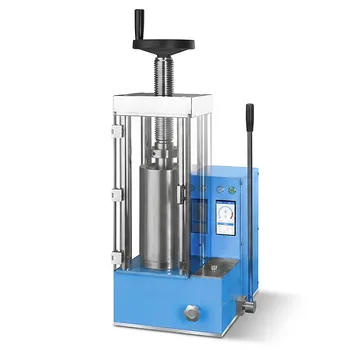
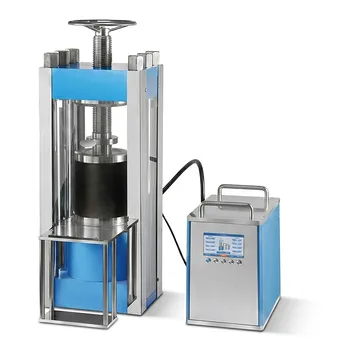
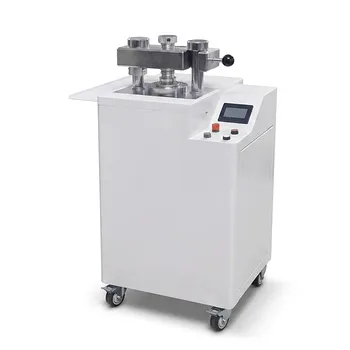
- Automatic Lab Cold Isostatic Pressing CIP Machine
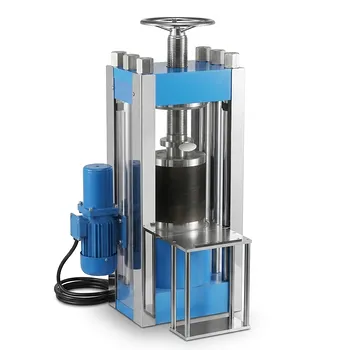
- Electric Lab Cold Isostatic Press CIP Machine
- Electric Split Lab Cold Isostatic Pressing CIP Machine
- Manual Cold Isostatic Pressing CIP Machine Pellet Press
- Electric Isostatic Pressing Machine 40 Tons Automatic Laboratory Powder Compacting Press
People Also Ask
- What are the key features of automated laboratory Cold Isostatic Press (CIP) systems? Achieve Precise, High-Pressure Powder Consolidation
- Why is an Isostatic Press (CIP) Necessary After Uniaxial Pressing? Achieve Transparency in Nd:Y2O3 Ceramics
- How does a Cold Isostatic Press (CIP) increase Bi-2223/Ag current density? Boost Superconductivity with Uniform Pressure
- How does a Cold Isostatic Press (CIP) facilitate the preparation of CaO-doped silicon carbide (SiC) green bodies?
- What is the primary function of a Cold Isostatic Press (CIP) in NASICON preparation? Achieve 96% Theoretical Density