
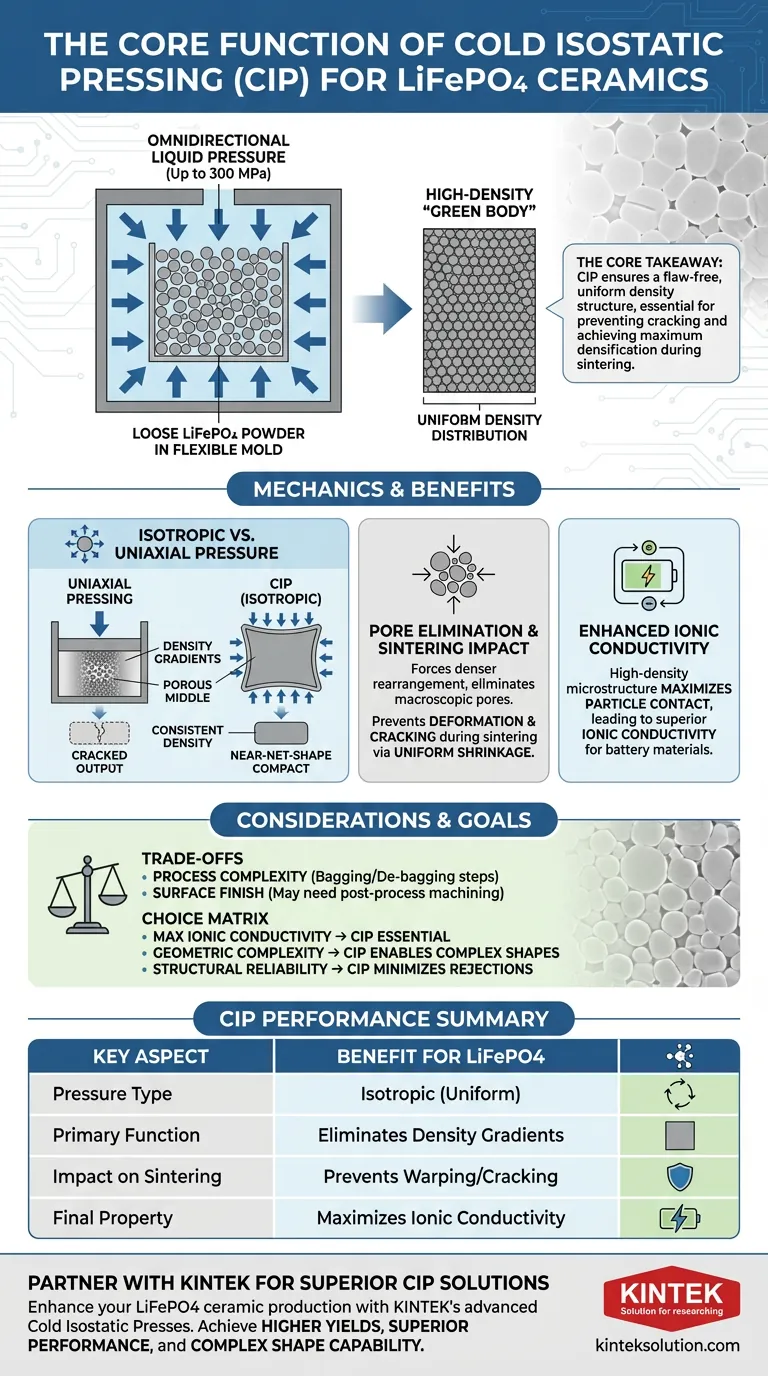
The primary function of a Cold Isostatic Press (CIP) in the fabrication of LiFePO4 ceramics is to transform loose powder into a high-density, structurally uniform "green body" through the application of omnidirectional pressure. Unlike standard uniaxial pressing, which compresses material from a single direction, CIP applies uniform liquid pressure—often up to 300 MPa—from all sides to eliminate density gradients and macroscopic pores.
The Core Takeaway Achieving high ionic conductivity in LiFePO4 ceramics requires a flaw-free internal structure before the material ever enters a kiln. CIP provides this by ensuring the "green" (unfired) material has a uniform density distribution, which is the absolute prerequisite for preventing cracking and achieving maximum densification during the sintering phase.

The Mechanics of Isostatic Densification
Isotropic vs. Uniaxial Pressure
The defining characteristic of CIP is the application of isotropic (uniform) pressure. In traditional uniaxial pressing, friction creates pressure gradients, resulting in parts that are dense on the ends but porous in the middle.
CIP uses a fluid medium to apply equal force to every surface of the flexible mold simultaneously. This results in a "near-net-shape" compact where the density is consistent throughout the entire volume of the material.
Particle Rearrangement and Pore Elimination
LiFePO4 powders require significant force to pack tightly. The high pressure utilized in CIP (up to 300 MPa) forces a denser rearrangement of particles.
This mechanical compression effectively closes the macroscopic pores between particles that gravity or lower-pressure methods leave behind. The result is a green body that exceeds 95% of its theoretical density in some cases, providing a robust starting point for thermal processing.
Impact on Sintering and Performance
Preventing Deformation and Cracking
The uniformity achieved during the pressing stage dictates how the material behaves under heat. If a green body has uneven density, it will shrink unevenly during sintering, leading to warping or cracking.
Because CIP eliminates internal stress concentrations and density gradients, the material shrinks predictably and uniformly. This significantly reduces the risk of deformation, ensuring high dimensional accuracy in the final ceramic component.
Enhancing Ionic Conductivity
For LiFePO4, the ultimate goal is electrochemical performance. The density achieved via CIP directly correlates to the final properties of the ceramic.
By maximizing the contact between particles and minimizing voids in the green body, CIP facilitates superior densification during sintering. This high-density microstructure is critical for maximizing ionic conductivity, which is the primary performance metric for ceramic electrolytes and battery materials.
Understanding the Trade-offs
While CIP offers superior material properties, it introduces specific processing considerations compared to simpler methods like die pressing.
Process Complexity and Tooling
CIP requires the material to be sealed in flexible forming molds (such as rubber bags) prior to pressing. This "bagging" and "de-bagging" process can add steps to the production line compared to the rapid cycle times of rigid die pressing.
Surface Finish Considerations
Because the pressure is applied through a flexible mold, the surface of the green body may not have the high-precision smoothness of a die-pressed part. While CIP allows for complex shapes and creates a uniform internal structure, surfaces may require post-process machining if extremely tight external tolerances are required immediately after forming.
Making the Right Choice for Your Goal
Deciding to implement CIP depends on balancing your need for material performance against production speed.
- If your primary focus is maximizing ionic conductivity: CIP is essential because it creates the high-density green body required for optimal sintering and electrical performance.
- If your primary focus is geometric complexity: CIP allows for the one-time molding of complex shapes that would be impossible or cost-prohibitive to machine from a standard billet.
- If your primary focus is structural reliability: CIP is the superior choice for minimizing the rejection rate caused by cracking or warping during the firing process.
By eliminating the internal inconsistencies inherent in other forming methods, Cold Isostatic Pressing provides the stable foundation necessary to manufacture high-performance LiFePO4 ceramics.
Summary Table:
| Key Aspect | Benefit for LiFePO4 Ceramics |
|---|---|
| Pressure Type | Isotropic (uniform from all sides) |
| Primary Function | Eliminates density gradients and macroscopic pores |
| Impact on Sintering | Prevents warping and cracking; ensures uniform shrinkage |
| Final Property Enhancement | Maximizes ionic conductivity for superior battery performance |
Ready to enhance your LiFePO4 ceramic production with uniform density and superior performance?
KINTEK specializes in high-performance lab press machines, including advanced Cold Isostatic Presses (CIP) designed for materials like LiFePO4. Our CIPs deliver the omnidirectional pressure needed to create flaw-free green bodies, ensuring maximum densification and ionic conductivity in your final sintered ceramics.
Let us help you achieve:
- Higher yields by minimizing cracking and warping during sintering.
- Superior electrochemical performance through optimal particle contact and pore elimination.
- Complex shape capability with consistent internal structure.
Contact our experts today to discuss how a KINTEK Cold Isostatic Press can be tailored to your specific laboratory needs. Get in touch now!
Visual Guide
Related Products
- Manual Cold Isostatic Pressing CIP Machine Pellet Press
- Automatic Lab Cold Isostatic Pressing CIP Machine
- Electric Split Lab Cold Isostatic Pressing CIP Machine
- Electric Lab Cold Isostatic Press CIP Machine
- Lab Isostatic Pressing Molds for Isostatic Molding
People Also Ask
- Why is Cold Isostatic Pressing (CIP) necessary for SBN ceramics? Achieve High-Density and Crack-Free Sintering
- What are the process advantages of using Cold Isostatic Pressing (CIP) for LSMO? Achieve Defect-Free Density
- Why is Cold Isostatic Pressing (CIP) applied after uniaxial pressing? Optimize Superconductor Precursor Density
- What types of equipment are available for cold isostatic pressing? Explore CIP Solutions for Labs and Production
- What are the technical advantages of cold isostatic pressing equipment compared to uniaxial compression equipment? Learn More!







