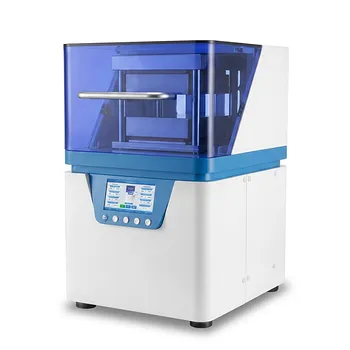
The critical function of a laboratory heated hydraulic press in LTCC lamination is to transform a stack of individual green tapes into a single, monolithic "green body" through controlled thermal and mechanical energy. By applying simultaneous heat and pressure, the press softens the organic binders within the tapes, allowing them to flow and fuse at the molecular level. This process is essential for eliminating interlaminar voids and ensuring the ceramic structure remains intact during the high-temperature sintering phase.
Core Takeaway: A heated hydraulic press enables "thermoplastic flow," where softened polymers and glass-ceramic components interpenetrate across layer boundaries to create a permanent, high-density bond. This step is the primary defense against delamination and internal structural failure in multilayer ceramics.
The Mechanics of Thermoplastic Bonding
Softening the Organic Matrix
Low Temperature Co-fired Ceramic (LTCC) green tapes contain organic binders that provide flexibility at room temperature but remain distinct layers when simply stacked. The heated platens of the laboratory press, often set to temperatures around 70°C, increase the plastic fluidity of these binders. This softening is the prerequisite for any meaningful physical connection between the layers.
Facilitating Molecular Diffusion
Once the binders are softened, the hydraulic pressure forces polymer chains to diffuse across the interfaces of adjacent layers. This is not merely a surface contact; it is a mutual penetration where the boundaries between tapes effectively disappear. This molecular-level bonding transforms the stack from a collection of sheets into a unified physical entity.
Promoting Glass-Ceramic Interpenetration
Beyond the organic binders, the pressure encourages the glass-ceramic components within the tape to interlock. This mechanical and chemical synergy ensures that the layers will not separate when the organic binders are eventually burned off during the sintering process.
Ensuring Structural Integrity and Density
Eliminating Interlaminar Voids
The application of uniform pressure, sometimes reaching significant levels like 50 MPa or several tons, serves to extrude air and excess solvents. By removing these interlaminar voids, the press prevents the formation of gas pockets that could expand and cause "blistering" or cracking during firing.
Achieving High Green Density
A primary goal of the lamination stage is to increase the overall density of the green body. A high-density green body is critical for pressureless sintering, as it ensures uniform shrinkage and prevents the warping of the final ceramic component.
Preserving Particle Orientation
In specialized applications, the hydraulic press must compact the layers without disrupting the previously established particle orientation within the tapes. The "uniaxial" nature of the press—applying force in a single direction—allows for significant densification while maintaining the internal alignment required for specific electrical or mechanical properties.
Understanding the Trade-offs
Pressure vs. Internal Geometry
While high pressure is necessary to eliminate voids, it can be destructive to internal flow channels or cavities. If the pressure exceeds the structural limits of the green tape, unsupported internal features may collapse or deform, ruining the functionality of the device.
The Risk of Delamination
If the temperature or dwell time (the duration the pressure is held) is insufficient, the interlayer bonding strength will be weak. This often results in delamination, where layers peel apart during the cooling phase or the subsequent sintering cycle due to mismatched thermal expansion or trapped gases.
Thermal Uniformity
Uneven heating across the platens can lead to localized bonding failures. If one section of the stack does not reach the required glass transition temperature of the binder, the thermoplastic flow will be incomplete, creating a weak point in the final ceramic structure.
How to Apply This to Your LTCC Project
Strategic Recommendations
- If your primary focus is maximizing mechanical strength: Prioritize higher dwell times at the target temperature to ensure complete polymer chain diffusion across all layer interfaces.
- If your primary focus is preserving complex internal channels: Utilize lower, precisely controlled pressures and consider internal sacrificial supports to prevent the collapse of weakened features.
- If your primary focus is high-volume production yield: Ensure your press platens are calibrated for extreme thermal uniformity to prevent "cold spots" that lead to localized delamination.
- If your primary focus is minimizing sintering shrinkage: Aim for the highest possible green density during lamination to reduce the volume change that occurs during the final firing.
Mastering the balance of heat and pressure during lamination is the most critical factor in ensuring the reliability and performance of multilayer ceramic electronics.
Summary Table:
| Parameter | Function in LTCC Lamination | Resulting Advantage |
|---|---|---|
| Heated Platens | Softens organic matrix polymers | Enables thermoplastic flow & bonding |
| Uniaxial Pressure | Drives molecular chain diffusion | Eliminates voids & increases density |
| Dwell Time | Allows for interpenetration | Prevents delamination during sintering |
| Uniformity | Maintains consistent thermal profile | Ensures structural & geometric integrity |
Unlock Precision in Your Material Research with KINTEK
Mastering the LTCC lamination process requires the perfect balance of heat and pressure. KINTEK specializes in comprehensive laboratory pressing solutions, offering manual, automatic, heated, multifunctional, and glovebox-compatible models, as well as cold and warm isostatic presses.
Our equipment is widely applied in advanced ceramic fabrication and battery research, ensuring high-density results and structural reliability. Whether you are preserving complex internal geometries or maximizing mechanical strength, we provide the tools necessary for excellence.
Contact a KINTEK Specialist Today to find the perfect pressing solution for your lab!
References
- Yannick Fournier. 3D Structuration Techniques of LTCC for Microsystems Applications. DOI: 10.5075/epfl-thesis-4772
This article is also based on technical information from Kintek Solution Knowledge Base .
Related Products
- 24T 30T 60T Heated Hydraulic Lab Press Machine with Hot Plates for Laboratory
- Automatic Heated Hydraulic Press Machine with Heated Plates for Laboratory
- Automatic Heated Hydraulic Press Machine with Hot Plates for Laboratory
- Automatic High Temperature Heated Hydraulic Press Machine with Heated Plates for Lab
- Automatic Heated Hydraulic Lab Press 120x120mm Plate Fully Automated Material Research Press
People Also Ask
- Function of a Laboratory Hydraulic Press with Heated Platens in SSE? Enhance Battery Density & Conductivity
- Why is a laboratory hydraulic press with heating plates required for PLA/TEC films? Achieve Precise Sample Integrity
- What role does a laboratory heated hydraulic press play in LTCC? Essential for High-Density Ceramic Lamination
- What is the primary function of a laboratory heated hydraulic press? Mastering Thermoplastic Carbon Fiber Composites
- What is the critical role of a laboratory heated hydraulic press? Mastering PVC Sample Prep for Testing