
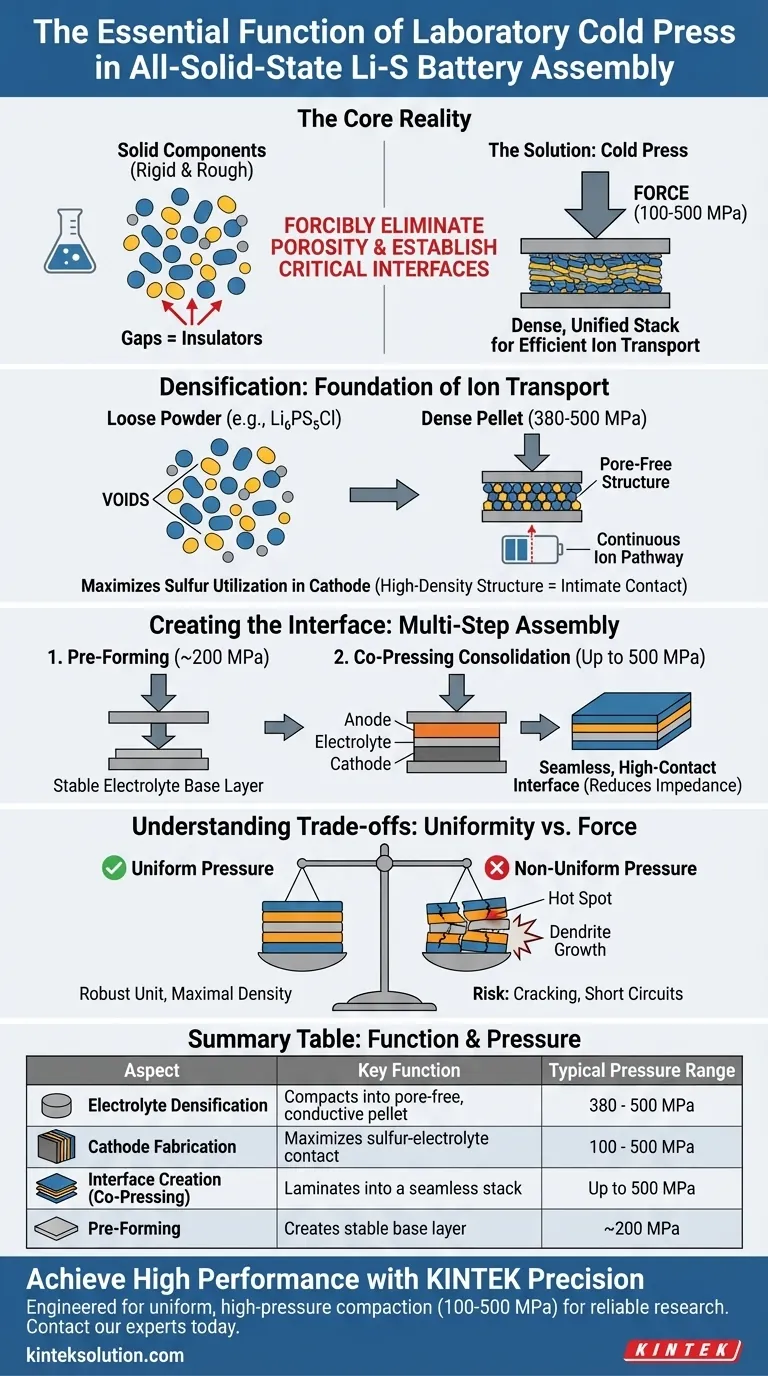
The essential function of a laboratory cold press in assembling all-solid-state lithium-sulfur batteries is to forcibly eliminate porosity and establish critical solid-solid interfaces. By applying precise pressures ranging from 100 MPa to 500 MPa, the press transforms loose electrolyte and electrode powders into a dense, unified electrochemical stack capable of efficient ion transport.
The Core Reality: Unlike liquid electrolytes that naturally "wet" surfaces to create contact, solid-state components are rigid and rough. Without the extreme densification provided by a cold press, the gaps between particles act as insulators, preventing ions from moving and rendering the battery non-functional.
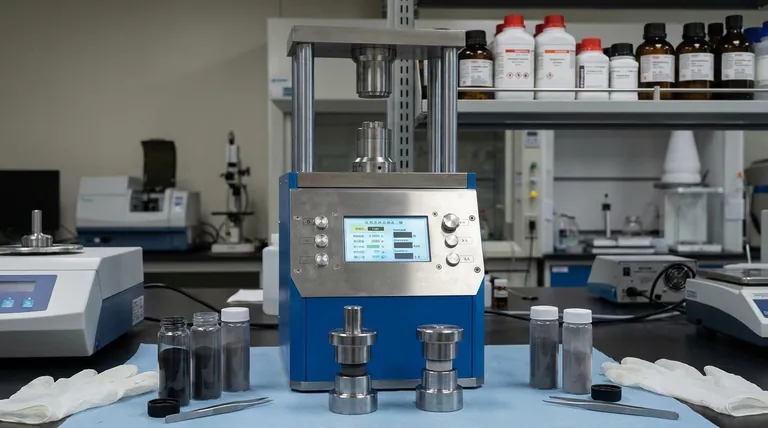
Densification: The Foundation of Ion Transport
Eliminating Voids and Porosity
The primary physical challenge in solid-state batteries is the presence of microscopic voids between powder particles. A cold press applies high pressure (often around 380 to 500 MPa) to compact solid-state electrolyte powders, such as Li6PS5Cl, into a dense pellet.
This compaction creates a pore-free structure. By minimizing voids, you ensure a continuous pathway for lithium ions to travel through the electrolyte layer.
Maximizing Sulfur Utilization in the Cathode
For lithium-sulfur batteries specifically, the cathode is typically a mixture of sulfur active material and solid electrolyte. The press is used to fabricate mechanically stable cathode pellets with minimal internal porosity.
This high-density structure ensures intimate contact between the sulfur and the electrolyte. This is fundamental for achieving high ionic conductivity and ensuring that the maximum amount of sulfur participates in the reaction.
Creating the Interface: The Multi-Step Assembly
The Pre-Forming Stage
Assembly is rarely a single-step event. A common protocol involves using the press at a lower pressure, such as 200 MPa, to pre-form the electrolyte powder into a stable separator layer.
This creates a base foundation without fully hardening the material, preparing it to bond with the electrode layers in the next step.
The Co-Pressing Consolidation
Once the cathode and anode materials are positioned, the press is used to apply significantly higher pressure (up to 500 MPa) to the entire stack. This "co-pressing" technique laminates the lithium metal anode and cathode onto the electrolyte.
This maximizes the effective contact area between layers. It overcomes surface irregularities to create a physically seamless interface, which is critical for reducing interfacial impedance.
Understanding the Trade-offs: Uniformity vs. Force
The Risk of Non-Uniform Pressure
While high pressure is necessary, the application of that pressure must be perfectly uniform. A laboratory hydraulic press is designed to deliver this force precisely across the entire surface area of the cell.
If pressure is uneven, it can lead to internal cracking or regions of poor contact. These defects create "hot spots" for resistance or pathways for lithium dendrites to grow, leading to internal short circuits.
Balancing Structural Integrity
The press does not just facilitate chemistry; it ensures structural survival. The compaction seals the anode, cathode, and separator into a robust unit.
However, excessive or uncontrolled pressure can damage fragile separator layers. The goal is to reach the threshold of maximal density without mechanically degrading the active materials.
Making the Right Choice for Your Goal
Achieving high performance in all-solid-state lithium-sulfur batteries requires tailoring your pressing strategy to your specific development phase.
- If your primary focus is Electrolyte Development: Prioritize pressures between 380 and 500 MPa to produce pellets with near-theoretical density to accurately measure ionic conductivity.
- If your primary focus is Full Cell Cycling: Use a multi-step pressing protocol (low-pressure pre-forming followed by high-pressure consolidation) to ensure seamless interfaces and stable sulfur utilization.
- If your primary focus is Interface Stability: Ensure your press delivers highly uniform pressure to maximize the contact area between the lithium metal anode and the electrolyte, minimizing interfacial impedance.
Ultimately, the laboratory cold press acts as the bridge between theoretical materials chemistry and a functioning, conductive device.
Summary Table:
| Aspect | Key Function | Typical Pressure Range |
|---|---|---|
| Electrolyte Densification | Compacts powder into a pore-free, conductive pellet | 380 - 500 MPa |
| Cathode Fabrication | Maximizes sulfur-electrolyte contact for high utilization | 100 - 500 MPa |
| Interface Creation (Co-Pressing) | Laminates anode/cathode/electrolyte into a seamless stack | Up to 500 MPa |
| Pre-Forming | Creates a stable base layer for subsequent assembly | ~200 MPa |
Ready to build high-performance solid-state batteries with precision?
KINTEK's laboratory presses are engineered to deliver the uniform, high-pressure compaction (100-500 MPa) essential for eliminating porosity and creating the critical solid-solid interfaces in your all-solid-state lithium-sulfur battery research. Our automatic lab presses and heated lab presses provide the control and reproducibility you need for reliable electrolyte densification and stable cell assembly.
Contact our experts today to discuss how our lab press solutions can help you achieve superior ionic conductivity and maximize sulfur utilization in your development cycle.
Visual Guide
Related Products
- Electric Lab Cold Isostatic Press CIP Machine
- Automatic Lab Cold Isostatic Pressing CIP Machine
- Electric Split Lab Cold Isostatic Pressing CIP Machine
- Manual Cold Isostatic Pressing CIP Machine Pellet Press
- Laboratory Hydraulic Press Lab Pellet Press Machine for Glove Box
People Also Ask
- What are the applications of electric lab cold isostatic presses in research settings? Advance Material R&D with High-Pressure CIPs
- What role do electric lab cold isostatic presses play in industrial contexts? Bridge R&D and Manufacturing with Precision
- How does electrical Cold Isostatic Pressing (CIP) contribute to cost savings? Unlock Efficiency and Reduce Expenses
- What are some research applications of electric lab CIPs? Unlock Uniform Powder Densification for Advanced Materials
- What are the characteristics of standard off-the-shelf electric lab CIP solutions? Achieve Immediate, Cost-Effective Processing



















