
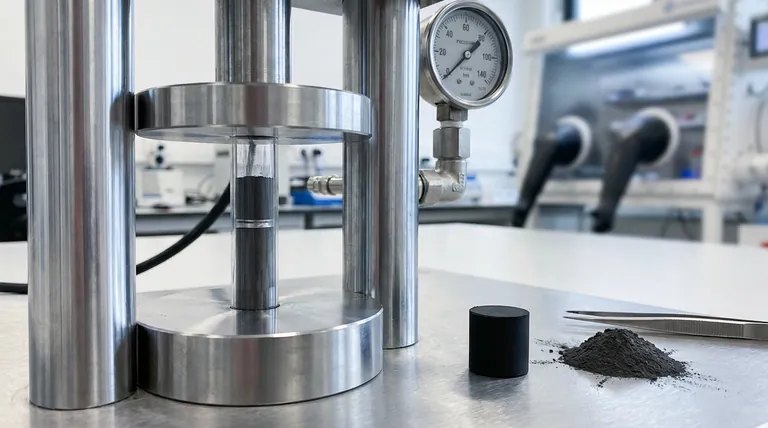
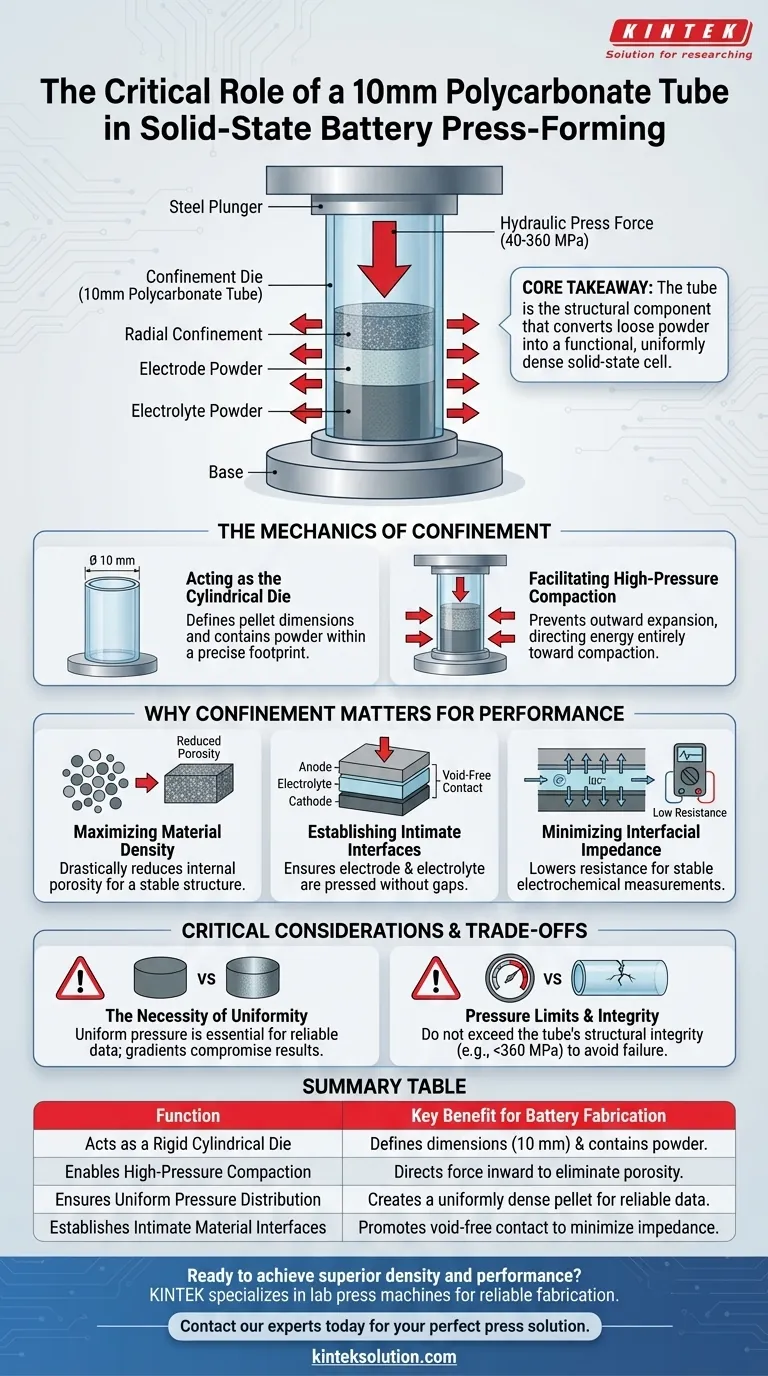
The 10 mm diameter polycarbonate tube functions as the confinement die within the press-forming assembly. It acts as the rigid mold that holds electrode and electrolyte powders in place, preventing them from scattering while a hydraulic press applies vertical force. By constraining the material within a fixed cylindrical space, the tube translates the force of the press into the formation of a uniformly dense, solid battery pellet.
Core Takeaway The tube is not merely a container; it is the structural component that enables the conversion of loose powder into a functional solid-state cell. Without the radial confinement provided by the tube, the high pressures required to eliminate internal porosity and minimize interfacial impedance could not be achieved.
The Mechanics of Confinement
Acting as the Cylindrical Die
In the fabrication context, the polycarbonate tube serves as the "female" die.
It defines the physical dimensions of the battery cell, specifically the diameter.
It provides the necessary radial resistance to keep the powder particles contained within a precise 10 mm footprint.
Facilitating High-Pressure Compaction
The pressing process involves significant forces, ranging typically from 40 to 360 MPa.
Because the tube prevents the powder from expanding outward, the energy from the hydraulic press is directed entirely toward compaction.
This allows the system to cold-press loose composite materials into a cohesive, solid shape.
Why Confinement Matters for Performance
Maximizing Material Density
The primary goal of using the tube and press setup is to increase the density of the electrolyte and electrode pellets.
By forcing particles closer together, the process drastically reduces internal porosity.
This densification is critical for creating a stable mechanical structure that can withstand handling and testing.
Establishing Intimate Interfaces
For a solid-state battery to function, the electrode and electrolyte must have "void-free physical contact."
The confinement provided by the tube ensures that the solid-state electrolyte and lithium metal electrode are pressed together without gaps.
This contact allows for the maximization of ion conduction pathways throughout the cell.
Minimizing Interfacial Impedance
High-quality physical contact directly correlates to electrochemical performance.
Proper confinement and pressing lower the resistance (impedance) at the material interfaces.
This reduction is fundamental for enabling stable electrochemical measurements and efficient energy transfer.
Critical Considerations and Trade-offs
The Necessity of Uniformity
While the tube allows for high pressure, the application of that pressure must be precise and uniform.
If the confinement is not uniform, the resulting pellet may suffer from density gradients.
Ref 1 highlights that the tube is essential for a "uniformly dense" result; failure to maintain this uniformity compromises the data reliability.
Pressure Limits and Dendrite Suppression
The setup allows for the investigation of how mechanical pressure suppresses lithium dendrite growth.
However, relying on a polycarbonate tube implies a mechanical limit compared to steel dies.
You must ensure the pressure applied (e.g., up to 360 MPa) does not exceed the structural integrity of the tube itself, or the confinement—and the experiment—will fail.
Making the Right Choice for Your Goal
To maximize the utility of your press-forming setup, align your process with your specific research objectives:
- If your primary focus is fabrication quality: Ensure the tube maintains rigid confinement to achieve maximum pellet density and reduce internal porosity.
- If your primary focus is electrochemical testing: Utilize the uniform pressure provided by the die to establish the void-free contacts necessary for minimizing impedance.
By effectively utilizing the polycarbonate tube as a high-pressure die, you transform raw powders into a high-density system capable of reliable solid-state performance.
Summary Table:
| Function | Key Benefit for Battery Fabrication |
|---|---|
| Acts as a Rigid Cylindrical Die | Defines pellet dimensions (10 mm) and contains powder during pressing. |
| Enables High-Pressure Compaction | Directs force (40-360 MPa) inward to eliminate porosity and increase density. |
| Ensures Uniform Pressure Distribution | Creates a uniformly dense pellet, critical for reliable electrochemical data. |
| Establishes Intimate Material Interfaces | Promotes void-free contact between electrode and electrolyte to minimize impedance. |
Ready to achieve superior density and performance in your solid-state battery research?
The precise confinement provided by a die is critical for transforming powders into functional pellets. KINTEK specializes in lab press machines, including automatic and heated lab presses, designed to deliver the uniform high pressure your laboratory needs for reliable fabrication and testing.
Contact our experts today to find the perfect press solution for your specific battery development goals.
Visual Guide
Related Products
People Also Ask
- What is the purpose of making KBr pellets for FTIR? Achieve Precise Molecular Analysis with Solid Samples
- What factors should be considered when choosing a lab press for XRF pellet preparation? Ensure Accurate and Consistent Results
- Why are pellets used in XRF analysis, and what is their limitation? Boost Accuracy and Speed in Your Lab
- How are pellets prepared for XRF analysis and what is a potential drawback? Master XRF Sample Prep and Accuracy
- What should be included in a checklist for making XRF pellets? Ensure Accurate and Repeatable XRF Analysis
