
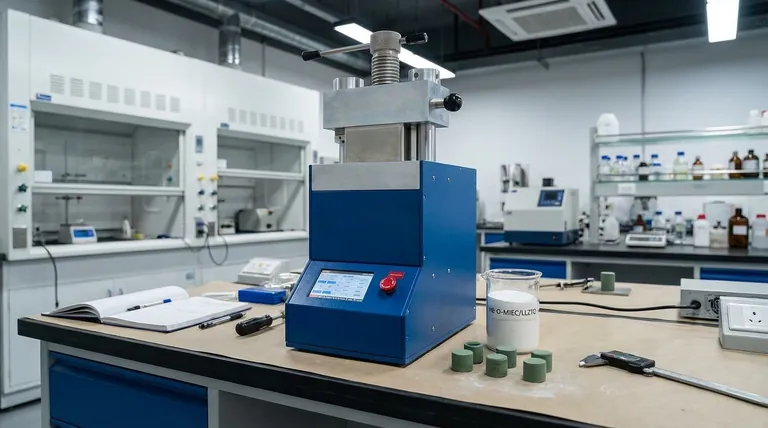
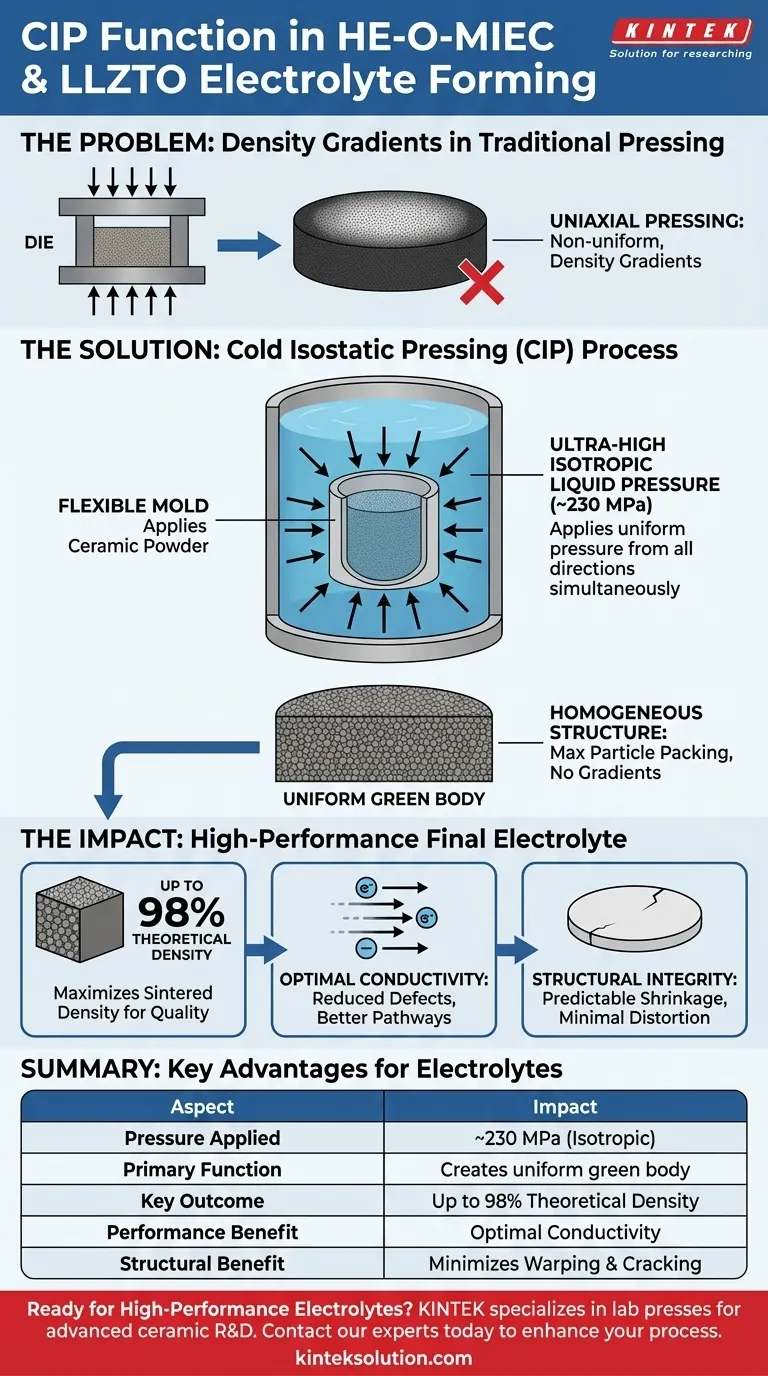
The primary function of a Cold Isostatic Press (CIP) is to apply ultra-high, isotropic liquid pressure to encapsulated ceramic powders to create a structurally uniform "green body."
In the specific context of HE-O-MIEC and LLZTO electrolytes, this process typically utilizes pressures around 230 MPa at room temperature. By compressing the powder equally from all directions, CIP maximizes particle packing density and eliminates the internal stress gradients common in other forming methods.
Core Takeaway Achieving high ionic and electronic conductivity requires a material with minimal internal defects. CIP provides the essential pre-sintering uniformity that allows these ceramics to reach 98% of their theoretical density, serving as the foundation for high-performance electrolytes.
The Mechanics of Isotropic Densification
Applying Uniform Pressure
Unlike standard uniaxial pressing, which compresses powder from only one or two axes, CIP utilizes a liquid medium to apply pressure from every direction simultaneously.
This isotropic application ensures that the force exerted on the powder is equal across the entire surface of the material.
Eliminating Density Gradients
Standard pressing methods often result in "density gradients," where the core of the material is less dense than the exterior due to friction.
CIP significantly lowers these frictional forces, resulting in a homogeneous internal structure where particle spacing is consistent throughout the entire volume.
Creating the Green Body
The immediate output of this process is a "green body"—a compacted, unfired ceramic shape.
For HE-O-MIEC and LLZTO powders, a high-quality green body is critical because it dictates how the material will behave during the final firing stage.
Impact on Final Material Performance
Maximizing Sintered Density
The uniformity achieved during the green body stage directly translates to the final density of the sintered ceramic.
By starting with a tightly packed structure, the material can achieve up to 98% of its theoretical density after sintering, which is a key metric for electrolyte quality.
Enhancing Conductivity
For electrolytes like HE-O-MIEC and LLZTO, performance is defined by ionic and electronic conductivity.
CIP reduces internal defects and porosity, establishing the continuous material pathways necessary for optimal conductivity.
Reducing Distortion
Because the green body has a uniform density, shrinkage during the high-temperature sintering phase occurs predictably and evenly.
This minimizes the risk of the final product warping, cracking, or distorting, which is vital for maintaining the structural integrity of the electrolyte.
Understanding the Advantages and Trade-offs
The Benefit of Complexity
CIP allows for the formation of complex shapes and high-integrity billets that simple die pressing cannot achieve.
It is specifically designed to produce predictable compression in materials that are sensitive to flaws, ensuring higher reliability in the final component.
Comparison to Uniaxial Pressing
While potentially more time-consuming than simple uniaxial pressing, CIP is superior for eliminating gradient properties.
If your application tolerates lower density or density variations, uniaxial pressing might suffice; however, for high-performance electrolytes, the uniformity provided by CIP is generally non-negotiable.
Making the Right Choice for Your Project
The decision to utilize CIP depends on the specific performance thresholds required for your electrolyte application.
- If your primary focus is Maximizing Conductivity: Prioritize CIP to achieve the 98% theoretical density required for efficient ionic and electronic transport.
- If your primary focus is Structural Integrity: Use CIP to ensure uniform shrinkage and eliminate the internal defects that lead to cracking during sintering.
By securing a uniform green body today, you guarantee the material performance required for tomorrow's energy solutions.
Summary Table:
| Key Aspect | Impact on HE-O-MIEC/LLZTO Electrolytes |
|---|---|
| Pressure Applied | ~230 MPa (Isotropic, from all directions) |
| Primary Function | Creates a structurally uniform green body by maximizing particle packing density |
| Key Outcome | Enables final sintered density of up to 98% of theoretical density |
| Performance Benefit | Reduces internal defects and porosity for optimal ionic/electronic conductivity |
| Structural Benefit | Ensures uniform shrinkage, minimizing warping and cracking during sintering |
Ready to build the foundation for high-performance solid-state electrolytes?
Achieving 98% theoretical density starts with a perfectly uniform green body. KINTEK specializes in high-performance lab press machines, including Isostatic Presses, designed to meet the precise demands of advanced ceramic R&D and production.
Our expertise ensures your HE-O-MIEC and LLZTO electrolytes achieve the structural integrity and conductivity required for next-generation energy solutions.
Contact our pressing experts today to discuss how our CIP technology can enhance your process.
Visual Guide
References
- Xiangkun Kong, Weiwei Ping. A high-entropy mixed ionic and electronic conductor for accelerating the cathode dynamics in all solid–state lithium metal batteries. DOI: 10.1126/sciadv.adw4710
This article is also based on technical information from Kintek Solution Knowledge Base .
Related Products
- Electric Lab Cold Isostatic Press CIP Machine
- Electric Split Lab Cold Isostatic Pressing CIP Machine
- Automatic Lab Cold Isostatic Pressing CIP Machine
- Manual Cold Isostatic Pressing CIP Machine Pellet Press
- Lab Isostatic Pressing Molds for Isostatic Molding
People Also Ask
- What are the applications of electric lab cold isostatic presses in research settings? Advance Material R&D with High-Pressure CIPs
- What role do electric lab cold isostatic presses play in industrial contexts? Bridge R&D and Manufacturing with Precision
- How does electrical Cold Isostatic Pressing (CIP) contribute to cost savings? Unlock Efficiency and Reduce Expenses
- What are some research applications of electric lab CIPs? Unlock Uniform Powder Densification for Advanced Materials
- What are the characteristics of standard off-the-shelf electric lab CIP solutions? Achieve Immediate, Cost-Effective Processing
















