
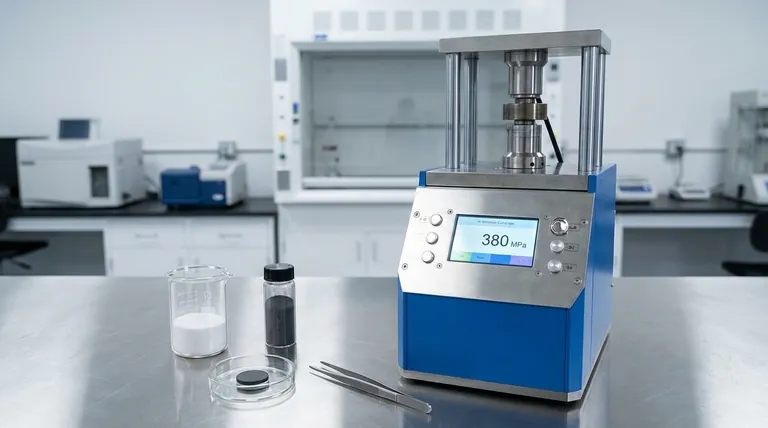
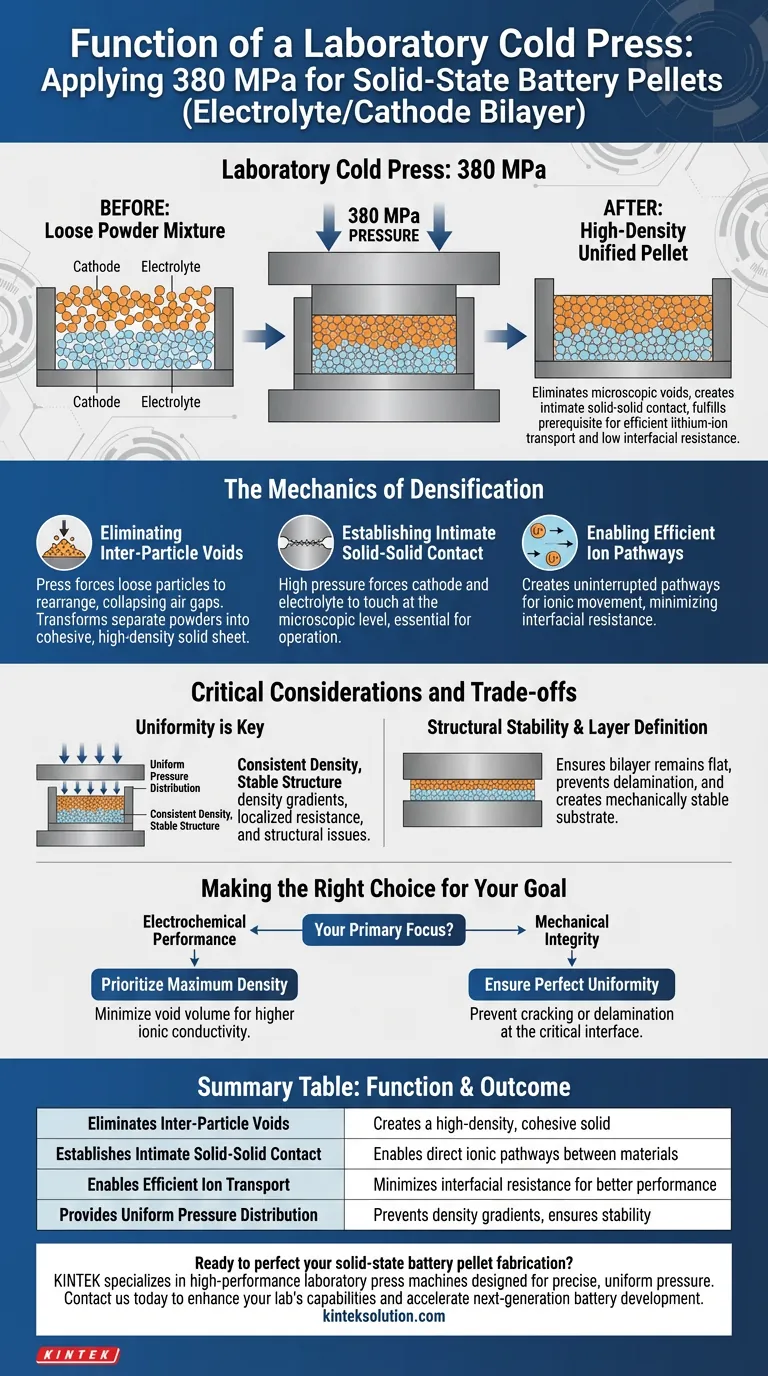
The primary function of a laboratory cold press in this context is to mechanically force the cathode mixture and electrolyte powder into a unified, high-density bilayer pellet. By applying 380 MPa of pressure, the press eliminates microscopic voids between particles to create intimate solid-solid contact. This physical densification is the prerequisite for efficient lithium-ion transport and low interfacial resistance within a solid-state battery.
In solid-state battery fabrication, applying 380 MPa is not merely about shaping materials; it is a critical densification step that replaces air voids with continuous ionic pathways. Without this high-pressure compaction, the lack of physical contact between active materials and electrolytes results in high impedance and poor electrochemical performance.
The Mechanics of Densification
Eliminating Inter-Particle Voids
The immediate effect of applying 380 MPa is the drastic reduction of porosity within the powder mixture. The press forces the loose particles to rearrange and deform, collapsing the air gaps that naturally exist in the raw powder. This transforms the separate cathode and electrolyte powders into a cohesive, high-density solid sheet.
Establishing Intimate Solid-Solid Contact
Unlike liquid electrolytes, which naturally wet surfaces, solid electrolytes rely entirely on mechanical pressure to connect with active materials. High pressure forces the cathode active material and the solid electrolyte to touch at the microscopic level. This "intimate" contact is fundamental to the device's operation.
Enabling Efficient Ion Pathways
Lithium ions cannot traverse air gaps; they require a continuous material medium to move. By compacting the bilayer into a dense composite, the press creates uninterrupted pathways for ionic movement. This connectivity is directly responsible for minimizing interfacial resistance.
Critical Considerations and Trade-offs
The Necessity of Uniformity
It is insufficient to simply apply high force; the pressure must be distributed evenly across the entire surface of the pellet. A laboratory hydraulic press is designed to deliver this uniform load to prevent density gradients. If pressure is uneven, the pellet may exhibit localized areas of high resistance or poor structural integrity.
Structural Stability and Layer Definition
Applying pressure creates a mechanically stable substrate and defines the interface between the electrolyte and cathode layers. Proper compaction ensures the bilayer remains flat and prevents the layers from separating (delaminating). This structural rigidity is essential for handling the pellet during subsequent assembly steps or testing.
Making the Right Choice for Your Goal
To maximize the effectiveness of the cold press process, align your pressure application with your specific fabrication objectives:
- If your primary focus is electrochemical performance: Prioritize achieving maximum density to minimize void volume, as this directly correlates to higher ionic conductivity.
- If your primary focus is mechanical integrity: Ensure the pressure application is perfectly uniform to prevent cracking or delamination at the critical bilayer interface.
Ultimately, the laboratory cold press acts as the bridge between raw chemical potential and functional electrochemical performance by establishing the physical connectivity solid-state systems demand.
Summary Table:
| Function of a Laboratory Cold Press (380 MPa) | Key Outcome |
|---|---|
| Eliminates Inter-Particle Voids | Creates a high-density, cohesive solid |
| Establishes Intimate Solid-Solid Contact | Enables direct ionic pathways between materials |
| Enables Efficient Ion Transport | Minimizes interfacial resistance for better battery performance |
| Provides Uniform Pressure Distribution | Prevents density gradients and ensures pellet stability |
| Defines Layer Interface & Prevents Delamination | Creates a mechanically robust bilayer structure |
Ready to perfect your solid-state battery pellet fabrication?
At KINTEK, we specialize in high-performance laboratory press machines, including automatic lab presses and isostatic presses, designed to deliver the precise, uniform pressure your research demands. Our equipment is engineered to help you achieve the high-density, void-free pellets essential for superior electrochemical performance.
Contact us today using the form below to discuss how our solutions can enhance your lab's capabilities and accelerate your development of next-generation solid-state batteries.
Visual Guide
Related Products
- Laboratory Hydraulic Press Lab Pellet Press Button Battery Press
- Lab Cylindrical Press Mold for Laboratory Use
- Manual Cold Isostatic Pressing CIP Machine Pellet Press
- Automatic Laboratory Hydraulic Press for XRF and KBR Pellet Pressing
- Laboratory Hydraulic Pellet Press for XRF KBR FTIR Lab Press
People Also Ask
- How is a laboratory hydraulic press used for HAP composite gels? Master Mineral Substrate Standardization
- What role does a laboratory hydraulic press play in reaction pellets? Optimizing Lunar Soil and Metal Fuel Density
- What role does a laboratory hydraulic press play in the preparation of piezoelectric ceramic discs for DC-PG? | KINTEK
- Why is a laboratory hydraulic press required for PBAT and PLA sample preparation? Achieve Flawless Characterization
- What role does a laboratory hydraulic press play in the assembly of all-solid-state battery test cells? Expert Guide



















