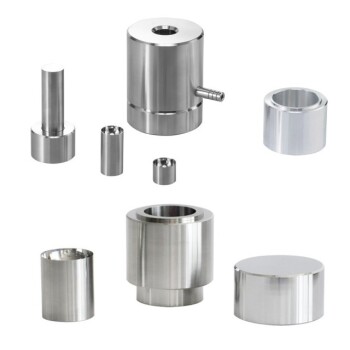
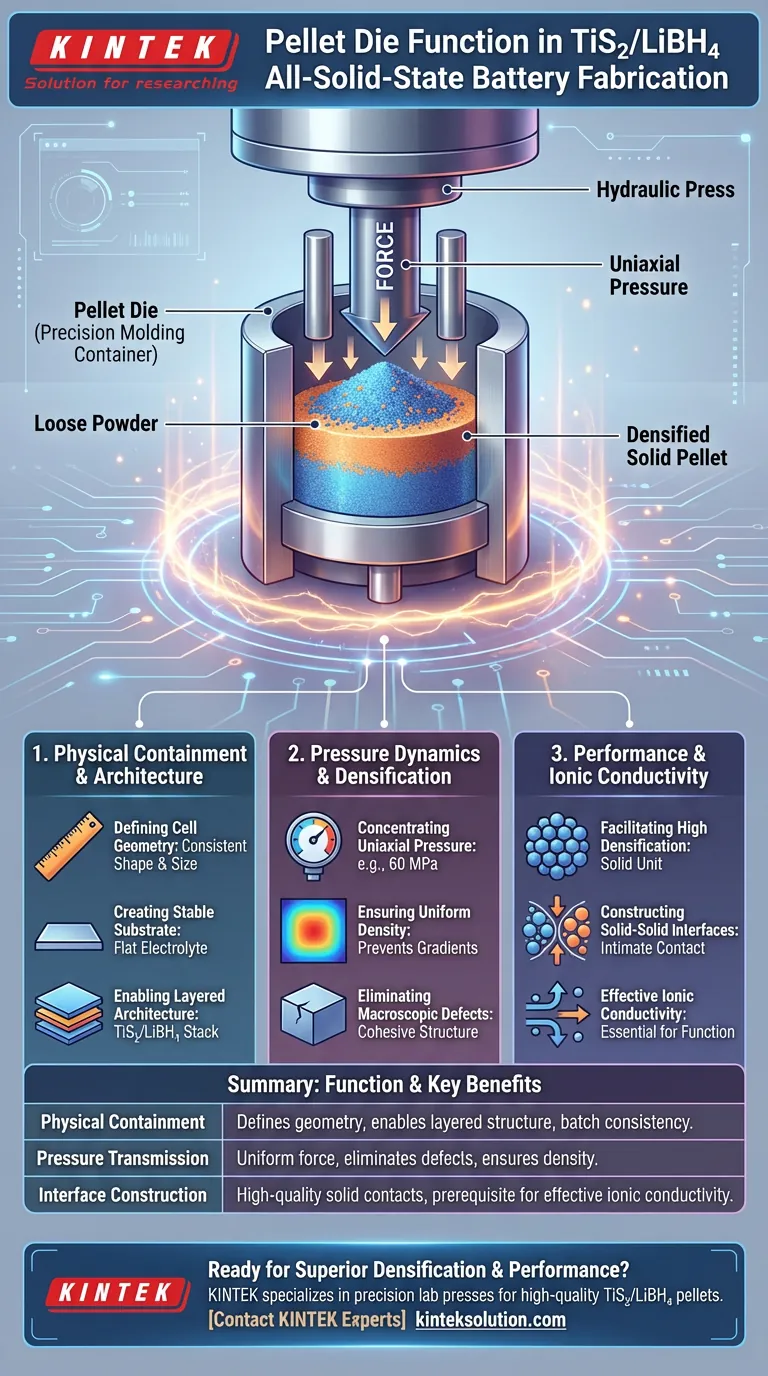
The pellet die serves as a precision molding container designed to facilitate the densification of TiS₂/LiBH₄ powder materials. While it establishes the physical geometry of the battery cell, its most critical technical function is to concentrate and uniformly transmit uniaxial pressure from a hydraulic press, converting loose powder into a dense, defect-free solid structure.
Core Takeaway The pellet die is not merely a shaping tool; it is a pressure-regulation vessel. Its primary value lies in ensuring the uniform distribution of force required to eliminate macroscopic defects and establish high-quality solid-solid interfaces, which are the prerequisites for effective ionic conductivity in solid-state batteries.
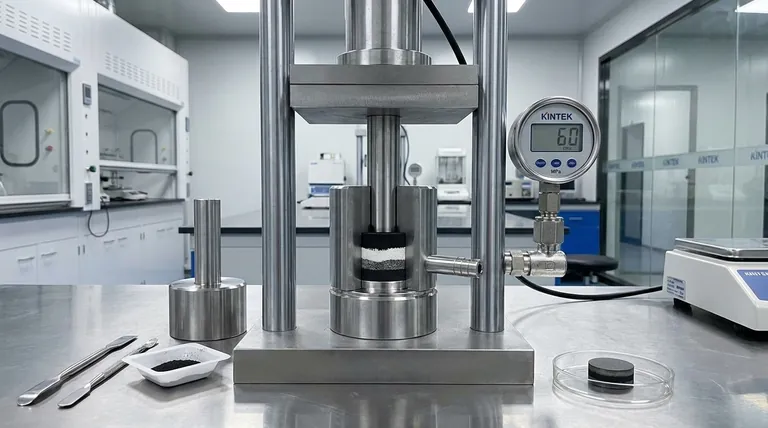
The Role of Physical Containment
Defining Cell Geometry
The die functions as a precision mold that dictates the final size and shape of the battery cell. By maintaining rigid boundaries, it ensures strict dimensional consistency across different production batches.
Creating a Stable Substrate
In the fabrication of TiS₂/LiBH₄ cells, the die allows for the creation of an independent structural foundation. For example, it enables the pre-forming of pure LiBH₄ powder into a flat, stable electrolyte separator pellet.
Enabling Layered Architecture
This pre-formed pellet acts as a substrate for subsequent fabrication steps. The die holds this base layer in place, allowing for the precise stacking of the composite cathode layer to build a clearly defined layered cell structure.
Pressure Dynamics and Densification
Concentrating Uniaxial Pressure
The die is the medium through which force from the hydraulic press is applied to the powder. It confines the material, ensuring that the applied energy—such as the 60 MPa used for LiBH₄—is concentrated entirely on compaction rather than lateral displacement.
Ensuring Uniform Density
A high-quality solid-state die plays a key role in the even distribution of pressure across the electrolyte powder. This uniformity is critical to preventing density gradients that could lead to weak points in the battery structure.
Eliminating Macroscopic Defects
By transmitting pressure evenly, the die prevents the formation of cracks or voids within the pellet. This results in a cohesive solid electrolyte layer free of macroscopic defects, which is essential for battery integrity.
Why This Matters for Performance
Facilitating High Densification
The primary goal of the compaction process is achieving high densification of the material layers. The die’s confinement capabilities allow the powder to reach the necessary density to function as a solid unit.
Constructing Solid-Solid Interfaces
Solid-state batteries rely on intimate contact between particles for ion transport. The uniform pressure provided by the die creates the high-quality solid-solid interfaces required for the battery to function effectively.
Operational Considerations
The Necessity of Precision
The die must be machined to exact tolerances to function correctly. Any irregularity in the die surface can result in uneven pressure transmission, compromising the homogeneity of the electrolyte layer.
Staged Compression Requirements
Fabricating these batteries often requires a multi-stage pressing process (e.g., pre-forming the electrolyte before adding the cathode). The die must accommodate these sequential steps without disturbing the structural integrity of the previously compacted layers.
Making the Right Choice for Your Goal
To maximize the effectiveness of your fabrication process, consider how the die impacts your specific objectives:
- If your primary focus is reproducible manufacturing: Prioritize the die's role as a precision mold to ensure strict consistency in the size and shape of every batch.
- If your primary focus is electrochemical performance: Focus on the die's ability to uniformly transmit pressure, as this directly dictates the quality of the solid-solid interfaces and ionic conductivity.
The pellet die is the foundational tool that transforms raw chemical potential into a structurally viable energy storage device.
Summary Table:
| Function | Key Benefit | Impact on Battery |
|---|---|---|
| Physical Containment | Defines precise cell geometry and structure | Enables layered architecture and batch consistency |
| Pressure Transmission | Concentrates and uniformly distributes uniaxial force | Eliminates defects, ensures uniform density |
| Interface Construction | Creates high-quality solid-solid contacts | Prerequisite for effective ionic conductivity |
Ready to achieve superior densification and performance in your solid-state battery research?
KINTEK specializes in precision lab press machines, including automatic and heated lab presses, designed to meet the exacting demands of laboratory-scale fabrication. Our equipment ensures the uniform pressure transmission and staged compression required for high-quality TiS₂/LiBH₄ pellets.
Contact our experts today to discuss how our solutions can enhance your battery development process and deliver the reliable, defect-free results you need.
Visual Guide
Related Products
- XRF KBR Steel Ring Lab Powder Pellet Pressing Mold for FTIR
- Lab Infrared Press Mold for No Demolding
- Lab Ring Press Mold for Sample Preparation
- Lab XRF Boric Acid Powder Pellet Pressing Mold for Laboratory Use
- XRF KBR Plastic Ring Lab Powder Pellet Pressing Mold for FTIR
People Also Ask
- What considerations are important regarding the die size of an XRF pellet press? Optimize for Your XRF Spectrometer and Sample
- Why are pellets used in XRF analysis, and what is their limitation? Boost Accuracy and Speed in Your Lab
- What is the general process for preparing a sample pellet for XRF? Master Consistency for Accurate Analysis
- What are the differences between manual and automatic XRF pellet presses? Choose the Right Press for Your Lab's Needs
- What are the primary factors to consider when deciding between a manual and an automatic XRF pellet press? Optimize Your Lab's Efficiency