The primary function of a polytetrafluoroethylene (PTFE) mold in the assembly of all-solid-state sodium-ion batteries is to serve as a chemically inert, non-stick shaping die. During the high-pressure compaction process, it contains the component powders—such as the solid electrolyte and cathode materials—and ensures they are pressed into a cohesive, uniform structure without adhering to the mold walls.
The PTFE mold is not merely a container; it is a critical process enabler. By preventing adhesion during high-pressure compaction, it ensures the creation of distinct, uniform solid-solid interfaces, which are strictly required for efficient ion transport in solid-state batteries.
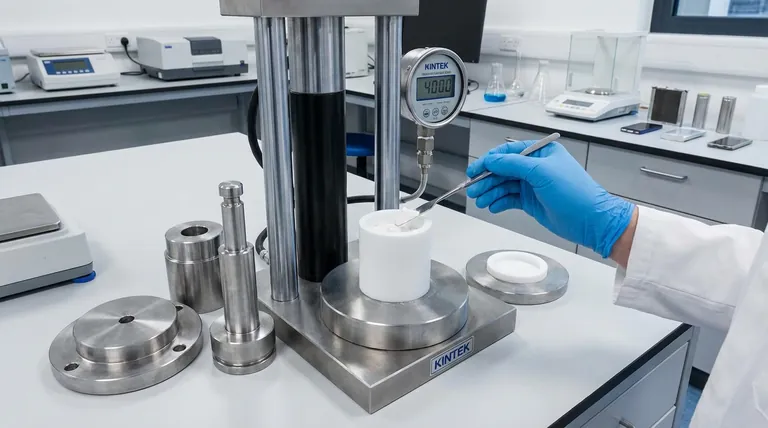
The Mechanics of Solid-State Assembly
Precision Shaping and Positioning
In all-solid-state batteries, the electrolyte and electrodes exist as solid powders rather than liquids. The PTFE mold acts as the defining boundary for these materials.
It confines the loose powders into a specific geometry, ensuring that when pressure is applied, the energy is directed entirely toward densifying the material rather than dispersing it.
Chemical Inertness and Purity
Battery chemistries, particularly sodium-ion and solid electrolytes, can be highly reactive.
PTFE is selected for its chemical inertness, ensuring that the mold does not react with the precursor powders. This guarantees that the purity of the battery components is maintained throughout the assembly process.
The Critical Role of Non-Stick Properties
Preventing Wall Adhesion
The most significant challenge during high-pressure compaction is the tendency of fine powders to stick to the container walls.
The PTFE mold utilizes its naturally low coefficient of friction to prevent the electrolyte and cathode materials from adhering to the sides of the die. This ensures that the applied pressure results in a dense vertical stack rather than material clinging to the mold periphery.
Ensuring Uniform Layer Thickness
For a solid-state battery to function correctly, the layers must have a regular shape and uniform thickness.
By eliminating friction and sticking at the walls, the PTFE mold allows the powders to settle evenly. This uniformity is vital for preventing hotspots or short circuits in the final cell assembly.
Facilitating Demolding
Once the high-pressure assembly is complete, the fragile pressed pellet must be removed without cracking.
The non-stick nature of PTFE allows for easy demolding. This minimizes mechanical stress on the newly formed cell, preserving the integrity of the solid-solid interfaces established during pressing.
Understanding the Trade-offs
High Pressure vs. Material Rigidity
While PTFE is excellent for release properties, the assembly process requires applying stable, high external pressure.
This pressure is mandatory to force cathode, anode, and electrolyte particles into continuous physical contact. This "intimate contact" is the only way to minimize interfacial resistance and allow ions to move smoothly across the solid boundaries.
However, PTFE is softer than metal dies. Consequently, while it ensures excellent surface quality and release, the assembly setup must be carefully designed to ensure the mold can withstand the high pressures required to densify the rigid solid-solid interfaces without deforming.
Making the Right Choice for Your Goal
The use of a PTFE mold is a strategic choice balanced between material handling and mechanical requirements.
- If your primary focus is fabrication consistency: Rely on PTFE molds to ensure high reproducibility in layer thickness and to minimize defects caused by powder sticking to the die.
- If your primary focus is electrochemical performance: Ensure the PTFE mold is used in conjunction with sufficient high pressure to guarantee the intimate particle contact required for low interfacial resistance.
By leveraging the non-stick and inert properties of PTFE, you transform raw chemical powders into a structured, high-performance energy storage unit.
Summary Table:
| Function | Benefit |
|---|---|
| Chemical Inertness | Prevents reaction with sensitive battery powders, ensuring material purity. |
| Non-Stick Properties | Eliminates wall adhesion for uniform layer thickness and easy demolding. |
| Precision Shaping | Confines powders to create a dense, cohesive stack under high pressure. |
| Interface Integrity | Facilitates the creation of distinct solid-solid interfaces for efficient ion transport. |
Ready to achieve consistent, high-performance solid-state battery assembly?
KINTEK specializes in precision lab press machines, including automatic and heated lab presses, designed to meet the exacting demands of laboratory research and development. Our equipment provides the stable, high pressure required to work effectively with PTFE molds and densify battery materials, ensuring the intimate particle contact critical for low interfacial resistance.
Let our expertise support your innovation in energy storage. Contact KINTEK today to discuss how our lab press solutions can enhance your battery fabrication process.
Visual Guide
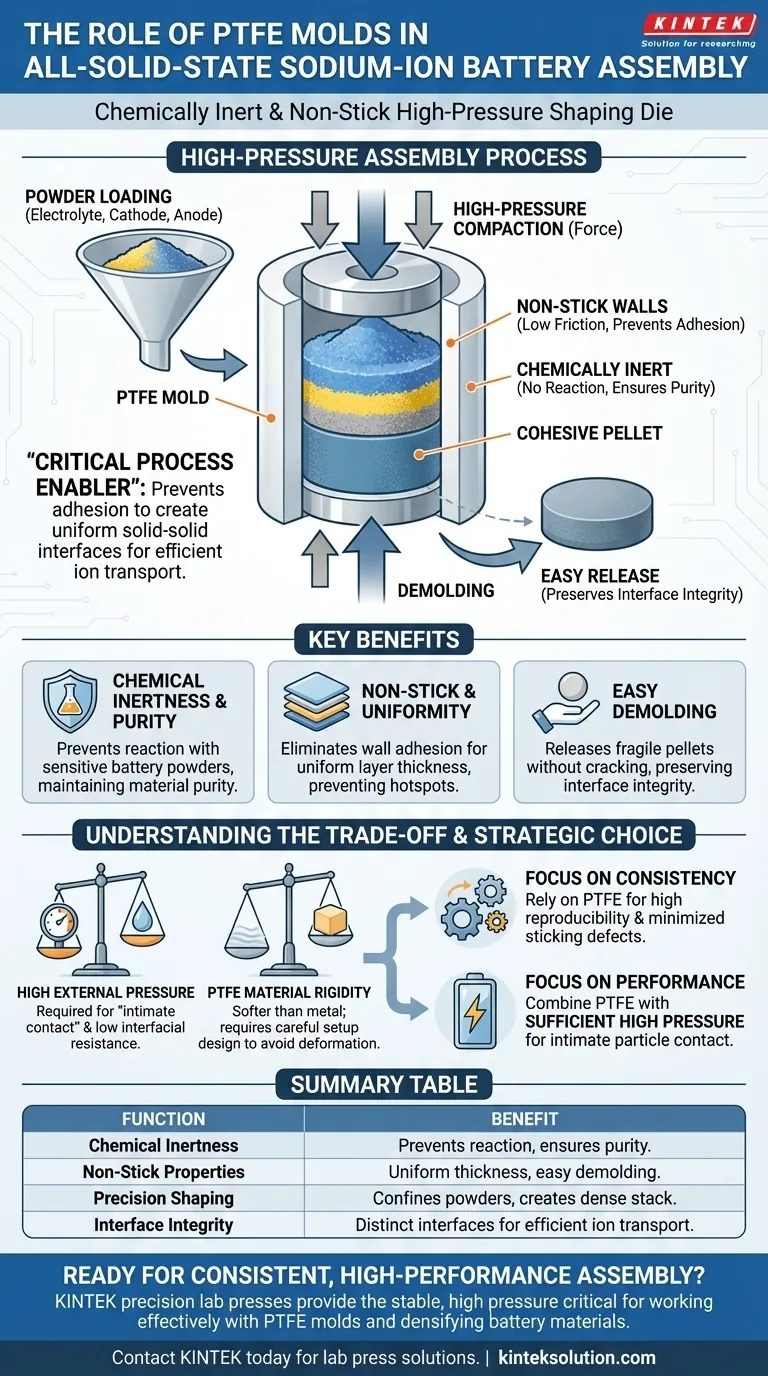
Related Products
- Lab Polygon Press Mold
- Infrared Heating Quantitative Flat Plate Mold for Precise Temperature Control
- Lab Double Plate Heating Mold for Laboratory Use
- Lab XRF Boric Acid Powder Pellet Pressing Mold for Laboratory Use
- XRF KBR Plastic Ring Lab Powder Pellet Pressing Mold for FTIR
People Also Ask
- What is the purpose of incorporating cartridge heaters into a lab press mold for MLCC block compression? Optimize Results
- How do the design and geometric precision of pressing molds and mandrels affect the quality of PTFE composite samples?
- What role do precision positioning and pressure molds play in single-lap joints? Ensure 100% Data Integrity
- What are the requirements for pressing molds when using SSCG? Key Materials for Complex Single Crystal Production
- How do industrial-grade pressure molds affect zinc metal pouch cells? Maximize Energy Density & Performance