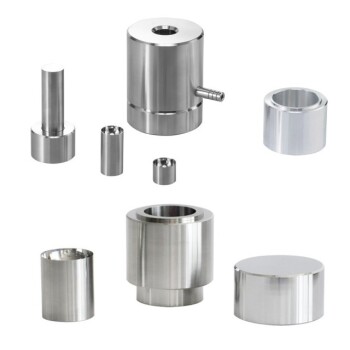
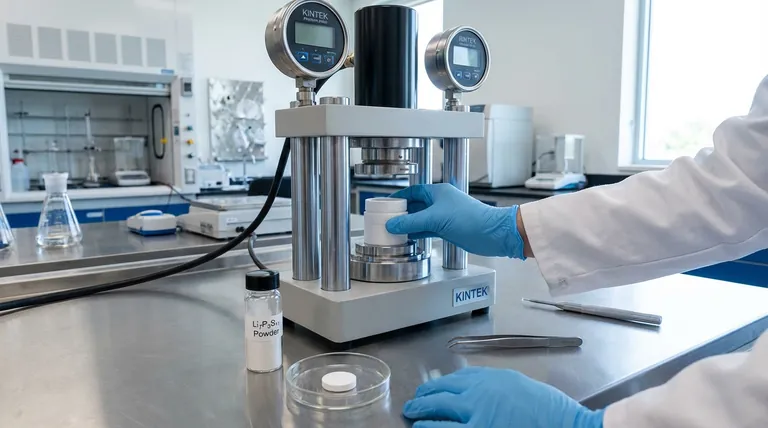
The primary function of a PTFE die is to act as a chemically inert, non-stick mold that allows for the high-pressure shaping of Li7P3S11 powder without contaminating the material or damaging the fragile pellet during removal.
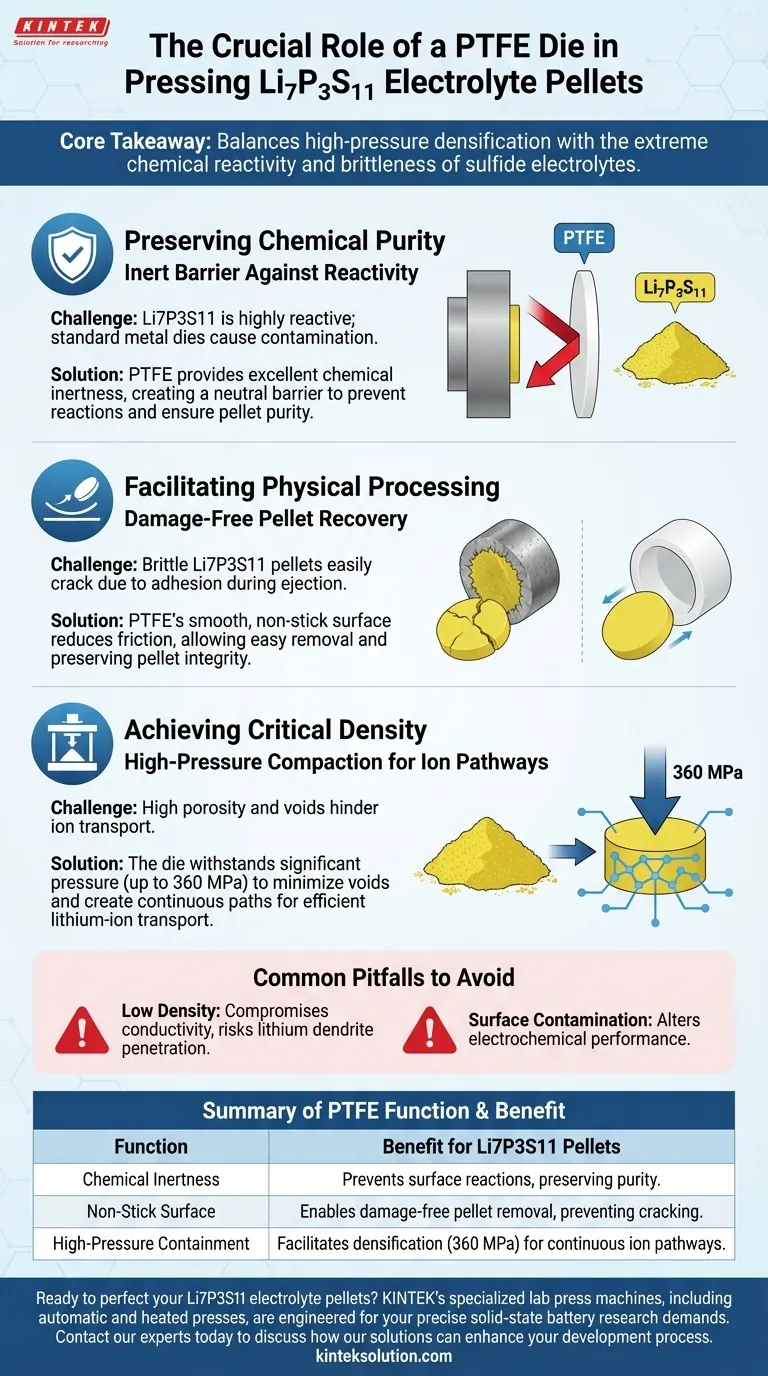
Core Takeaway The use of PTFE is dictated by the specific material challenges of sulfide electrolytes: it resolves the conflict between the need for high-pressure densification and the extreme chemical reactivity and brittleness of the compound.
Preserving Chemical Purity
The Challenge of Reactivity
Li7P3S11 is a sulfide-based electrolyte, known for being highly reactive. Standard metal dies often used in pressing can react with sulfide compounds, leading to surface degradation or chemical alteration of the sample.
The Inert Barrier
PTFE (polytetrafluoroethylene) is selected specifically for its excellent chemical inertness. By serving as the container or mold, it creates a neutral barrier that prevents the electrolyte powder from reacting with the die walls, ensuring the final pellet remains chemically pure.
Facilitating Physical Processing
Enabling Damage-Free Recovery
One of the most critical steps in pellet fabrication is removing the compacted sample from the die. Li7P3S11 pellets can be brittle; adhesion to the die walls often results in cracking or fracturing during ejection.
The Non-Stick Advantage
PTFE offers a smooth, non-stick surface that significantly reduces friction. This property facilitates the easy removal of the densified pellet, ensuring the sample remains intact and retains the geometric integrity achieved during the pressing stage.
Achieving Critical Density
Reduction of Voids
The die must withstand the application of significant force, such as 360 MPa, to cold-press the powder. This high pressure is essential to minimize interstitial voids between powder particles.
Creation of Ion Pathways
By facilitating this high-pressure compaction, the die setup helps improve physical contact among particles. This creates continuous pathways for lithium-ion transport, which is fundamental for achieving high ionic conductivity.
Common Pitfalls to Avoid
The Risk of Low Density
If the pressing process does not achieve sufficient compaction (e.g., creating a "green pellet" with only initial mechanical strength), the electrolyte layer will retain high porosity. This compromises conductivity and fails to prevent lithium dendrite penetration, a key failure mode in solid-state batteries.
Surface Contamination
Attempting to press sulfide electrolytes without a chemically compatible interface like PTFE can introduce impurities. Even minor contamination can alter the electrochemical performance of the highly reactive Li7P3S11 electrolyte.
Making the Right Choice for Your Goal
When designing your pressing protocol for Li7P3S11, consider the following distinct objectives:
- If your primary focus is Chemical Stability: Prioritize the use of PTFE components to strictly isolate the sulfide powder from any reactive metallic surfaces of the press assembly.
- If your primary focus is Electrochemical Performance: Ensure the die assembly allows for sufficient pressure (up to 360 MPa) to close voids and establish continuous ion transport pathways.
Success in fabricating sulfide electrolytes lies in balancing the massive pressure required for density with the delicate handling required for purity.
Summary Table:
| Function | Benefit for Li7P3S11 Pellets |
|---|---|
| Chemical Inertness | Prevents surface reactions, preserving electrolyte purity. |
| Non-Stick Surface | Enables damage-free pellet removal, preventing cracking. |
| High-Pressure Containment | Facilitates densification (up to 360 MPa) for continuous ion pathways. |
Ready to perfect your Li7P3S11 electrolyte pellets?
KINTEK's specialized lab press machines, including automatic and heated presses, are engineered to meet the precise demands of solid-state battery research. Our expertise ensures you can apply the necessary high pressure while maintaining the chemical purity and physical integrity of your sensitive sulfide materials.
Contact our experts today to discuss how our lab press solutions can enhance your solid-state battery development process.
Visual Guide
Related Products
- Lab Infrared Press Mold for No Demolding
- Laboratory Hydraulic Split Electric Lab Pellet Press
- Lab Ring Press Mold for Sample Preparation
- XRF KBR Plastic Ring Lab Powder Pellet Pressing Mold for FTIR
- Lab XRF Boric Acid Powder Pellet Pressing Mold for Laboratory Use
People Also Ask
- What is the purpose of incorporating cartridge heaters into a lab press mold for MLCC block compression? Optimize Results
- What is the function of a pressing tool in thermoplastic panels? Master Precision Shaping & Fusion Bonding
- Why is precise cooling management of the lab press mold necessary? Protect Core Integrity in Thermoforming
- What role do precision positioning and pressure molds play in single-lap joints? Ensure 100% Data Integrity
- Why is a lab press used for KBr pellet preparation in polyurethane FTIR? Achieve High-Resolution Spectral Data