Applying a constant mechanical pressure of approximately 5 MPa serves as a critical stabilizing force that maintains tight physical contact between the metallic lithium electrode and the solid electrolyte. This specific pressure is calibrated to suppress the "peeling" effect at the interface caused by lithium volume expansion and contraction, preventing surges in impedance and inhibiting dendrite formation to ensure stable performance over long-term cycling (up to 1000 hours).
Core Takeaway Unlike liquid electrolytes that naturally wet electrode surfaces, solid-state batteries rely entirely on external mechanical pressure to establish and maintain ionic pathways. Without this constant compression, the expansion of lithium during cycling creates physical gaps, severing ionic contact and leading to rapid battery failure.
The Challenge of the Solid-Solid Interface
Overcoming the Lack of Wetting
Liquid electrolytes flow into microscopic pores, ensuring total contact. Solid electrolytes do not. Without applied pressure, the interface between the anode and electrolyte remains distinct and rough, containing microscopic voids. These voids act as electrochemical "dead zones," preventing ion movement.
Creating Continuous Ion Channels
Applying pressure forces the materials together, minimizing interfacial gaps. This establishes continuous, tight channels for ion transport. Effective compression converts a disparate stack of materials into a unified electrochemical system.
Reducing Interfacial Impedance
High resistance (impedance) at the interface is the primary killer of solid-state battery efficiency. Pressure significantly drops this resistance by maximizing the active contact area. Supplementary data suggests that proper pressure application can reduce interfacial impedance by over 90% (e.g., dropping from >500 Ω to ~32 Ω).
Managing Lithium Dynamics During Cycling
Counteracting Volume Changes
Lithium metal is dynamic; it expands during charging and contracts during discharging. Without constant pressure (5 MPa), the contraction phase causes the electrode to pull away from the electrolyte. This separation, known as "interface peeling," breaks the circuit and causes voltage instability.
Suppressing Dendrite Formation
Lithium dendrites (needle-like growths) thrive in areas of non-uniform current distribution. Poor contact leads to local "hot spots" where current density spikes, encouraging dendrite growth. Uniform pressure ensures conformal contact, smoothing out current distribution and physically inhibiting dendrite propagation.
Leveraging Lithium Plasticity
Metallic lithium is relatively soft and exhibits plastic behavior. Under pressure, lithium effectively "creeps" (deforms) to fill microscopic pores on the harder electrolyte surface. This creates a void-free, intimate bond that maximizes the efficiency of the battery.
Common Pitfalls and Distinctions
Initial Densification vs. Operational Pressure
It is important to distinguish between pellet formation pressure and assembly/cycling pressure. Fabricating the electrolyte pellet itself often requires high pressures (e.g., 80 MPa) to densify the powder. However, the 5 MPa referenced here is the holding pressure maintained during assembly and operation to manage the interface.
The Consequence of Insufficient Pressure
If pressure drops below the optimal threshold during cycling, "breathing" issues occur. Gaps form immediately upon lithium contraction. This leads to a surge in interfacial impedance and erratic voltage profiles, rendering the battery unreliable for long-term use.
Making the Right Choice for Your Goal
- If your primary focus is Long-Term Cycling Stability: Ensure the pressure remains constant at approximately 5 MPa to counteract volume expansion and prevent interface peeling over hundreds of hours.
- If your primary focus is Lowering Initial Impedance: Recognize that pressure induces lithium creep, allowing the metal to fill surface voids and eliminate electrochemical dead zones before cycling begins.
- If your primary focus is Safety and Reliability: Use uniform pressure to ensure conformal contact, which prevents local current density spikes that lead to dendrite short-circuits.
Constant pressure is not merely a manufacturing step; it is an active component of the battery that replaces the wetting function of liquid electrolytes.
Summary Table:
| Feature | Function & Impact |
|---|---|
| Interface Contact | Replaces liquid wetting; establishes continuous ion channels |
| Impedance Reduction | Can reduce interfacial resistance by over 90% (e.g., 500 Ω to 32 Ω) |
| Volume Management | Counteracts lithium expansion/contraction to prevent 'peeling' |
| Safety & Life | Physically inhibits dendrites; ensures 1000+ hours of stable cycling |
| Lithium Plasticity | Encourages lithium 'creep' to fill microscopic voids in electrolytes |
Optimize Your Battery Research with KINTEK Precision
Achieving consistent 5 MPa pressure is critical for reliable solid-state battery data. KINTEK specializes in comprehensive laboratory pressing solutions tailored for researchers, offering manual, automatic, heated, and multifunctional presses, as well as glovebox-compatible models and isostatic presses (CIP/WIP).
Whether you are working on initial powder densification at 80 MPa or maintaining precise holding pressures during long-term cycling, our equipment ensures the accuracy and uniformity your materials demand.
Ready to eliminate interfacial impedance and stabilize your battery testing?
→ Contact KINTEK Today for a Professional Solution
References
- Victor Landgraf, Theodosios Famprikis. Disorder-Mediated Ionic Conductivity in Irreducible Solid Electrolytes. DOI: 10.1021/jacs.5c02784
This article is also based on technical information from Kintek Solution Knowledge Base .
Related Products
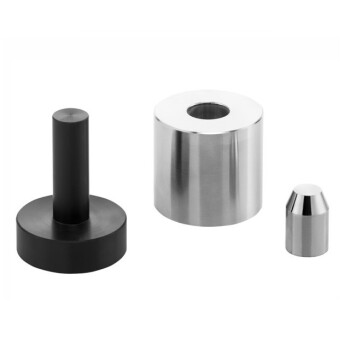
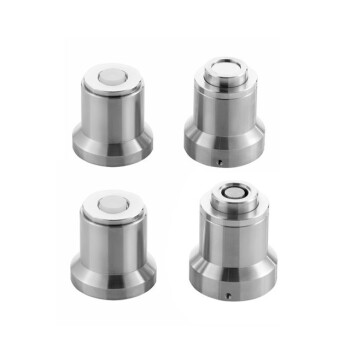
- Lab Button Battery Tablet Press Sealing Mold
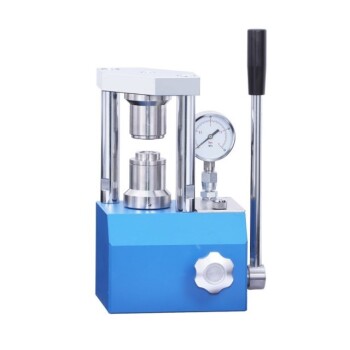
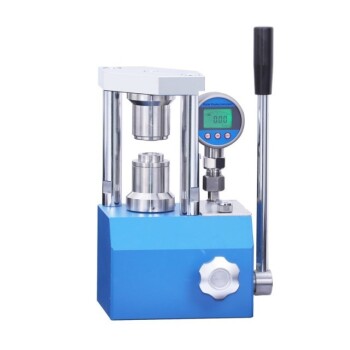
- Button Battery Sealing Press Machine for Lab
- Laboratory Hydraulic Press Lab Pellet Press Button Battery Press
- Warm Isostatic Press for Solid State Battery Research Warm Isostatic Press
- Lab Infrared Press Mold for Laboratory Applications
People Also Ask
- How does a sealed battery mold facilitate the assembly and testing of asymmetric supercapacitors using VO2?
- Why use standardized CR2032 components & high-precision presses? Ensure reliability in lithium metal battery research.
- Why is a laboratory battery sealing press essential for desolvation energy testing? Ensure Reliable Kinetic Data
- What is the function of specialized battery molds and sealing consumables? Optimize Your In-situ XRD Testing Today
- What role does a laboratory sealing press play in thermal analysis of solid dispersion films? Ensure Data Integrity